Email US
 Hours
Hours
 Visit Our Showroom


Reducing Equipment Vibration Through Advanced Wheel Materials
Mar 18th 2026
Industrial environments depend on controlled movement. When carts, racks, and mobile platforms travel across concrete floors, expansion joints, or uneven surfaces, vibration becomes part of the operating equation. In facilities using industrial casters, unmanaged vibration can affect precision equipment, shorten service intervals, and increase operator fatigue.
Equipment vibration is not limited to visible impacts. Micro-oscillation during rolling often goes unnoticed until bearing wear, fastener loosening, or structural fatigue appears. For engineers and maintenance supervisors, the root cause usually lies in wheel construction and load matching.
Caster wheel materials directly influence how vibration is transmitted from the floor to the mobile equipment frame. The wrong selection can amplify shock. The correct material can dampen it. This is particularly important for equipment casters used in assembly lines, fabrication cells, and material transport systems where reliability and repeatability matter.
This article explains how wheel material science, bearing systems, and caster load capacity interact to reduce vibration in mobile industrial systems.
Why Equipment Vibration Impacts Performance and Safety
Vibration in mobile equipment appears in two primary forms- continuous micro-vibration and discrete impact shock.
Micro-vibration occurs during rolling over textured surfaces. Impact shock happens when a wheel crosses a joint, debris, or floor transition. Both affect structural integrity over time.
Excessive vibration shortens the life of the caster bearings and reduces the adequate caster load capacity. When oscillation transfers through the fork and mounting plate, fasteners loosen and frames fatigue. This can lead to misalignment in sensitive tools or measurement systems mounted on carts.
Repeated impact loading increases bearing clearance, which increases vibration amplitude during rolling.
Noise is another consequence. Rugged wheels on sealed concrete can produce significant sound levels, especially at higher speeds. In regulated facilities, this affects compliance and employee comfort.
For equipment casters supporting precision assembly stations, vibration can influence calibration. Even small oscillations can affect the repeatability of measurement processes.
Equipment vibration in mobile systems is the mechanical oscillation transmitted from the floor through the caster assembly into the equipment structure.
The solution begins with material selection and load planning, not just heavier hardware.
How Caster Wheel Materials Influence Shock and Stability
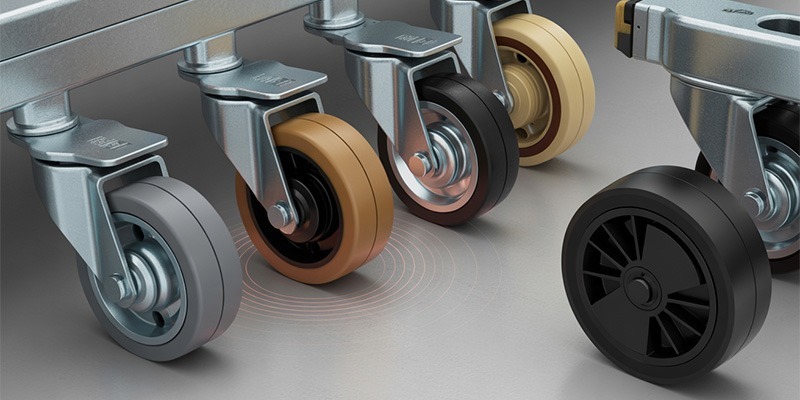
The performance of caster wheel materials depends on modulus of elasticity, tread composition, and internal structure. Different wheel materials respond differently to shock energy.
Softer wheel materials absorb shock, while harder materials maximize load capacity.
Polyurethane
Polyurethane is widely used in industrial casters because it balances resilience and strength. It offers moderate shock absorption while maintaining high load support.
Polyurethane can reduce transmitted vibration by 20–40% compared to rigid nylon wheels under similar conditions, depending on durometer rating. This makes it common in quiet casters used in assembly and medical environments.
Polyurethane caster wheels combine an elastic tread bonded to a rigid core to distribute load while dampening vibration.
Rubber
Rubber wheels provide higher vibration dampening due to their softer composition. They are effective where noise reduction is a priority.
However, rubber may deform under sustained heavy loads. In high-weight applications, it can reduce adequate caster load capacity if not correctly sized.
Increased tread deflection reduces rolling efficiency and increases push force.
Nylon / Polyolefin
Hard plastic materials, such as Nylon, offer low rolling resistance and high static strength. They are commonly selected for smooth floors and controlled environments.
Nylon wheels roll more efficiently than rubber, but transmit more vibration to the equipment frame.
Because of their minimal tread deflection, they are often used in high capacity casters where load support is prioritized over damping.
Phenolic
Phenolic wheels tolerate heat and chemicals. They are dimensionally stable under heavy static loads and are commonly used in high capacity casters for industrial ovens or manufacturing plants.
However, phenolic is rigid. It provides minimal shock absorption.
Phenolic wheels are compressed resin-based wheels designed for high-load, high-temperature applications with limited elastic deflection.
Selecting among caster wheel materials requires evaluating floor conditions, environmental exposure, and vibration tolerance thresholds.
Shock Absorbing Casters Compared to Standard Industrial Casters
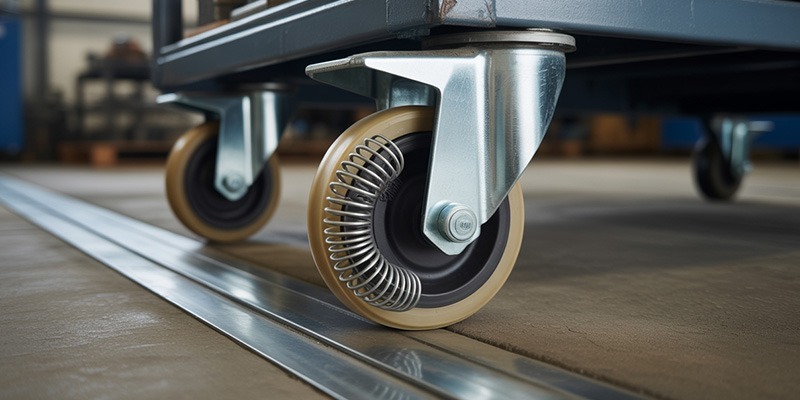
Standard industrial casters rely primarily on wheel elasticity for vibration control. In contrast, shock absorbing casters incorporate additional mechanical systems.
Shock-absorbing casters incorporate mechanical or material-damping systems to reduce transmitted vibration.
These systems may include-
- Spring-loaded suspension forks
- Elastomer inserts
- Pneumatic cores
- Articulated mounting plates
Standard casters absorb vibration at the wheel tread, while shock-absorbing casters dissipate energy through mechanical travel.
Shock absorbing casters are typically required when transporting fragile instruments, electronics, or precision assemblies. They are also used in aerospace and medical manufacturing, where vibration thresholds are tightly controlled.
Suspension travel of 0.5–1.5 inches can significantly reduce peak impact force compared to rigid-frame assemblies.
Increased suspension travel reduces impact acceleration transmitted to mounted equipment.
While commercial casters may suffice for light-duty transport, industrial environments with high shock exposure often require suspension systems to maintain equipment stability.
Engineers must evaluate return on investment by comparing reduced maintenance costs against initial hardware expense.
Why the Caster Bearing System Matters
Wheel material alone does not control vibration. The caster bearing system determines how rotational forces transfer through the assembly and into the equipment frame.
A caster bearing is the rolling element mechanism that allows the wheel or swivel section to rotate with minimal friction. In most industrial casters, bearings exist in two locations- within the wheel hub and within the swivel raceway. Both influence vibration behavior.
Ball bearings provide smooth rotation and moderate load capacity. They distribute the load across multiple contact points, helping maintain consistent rolling motion. Roller bearings support higher loads due to their larger contact surface, but they may transmit more vibration if not properly lubricated or aligned.
Precision sealed ball bearings reduce noise more effectively than plain bore designs under identical loads. Sealed units limit contamination from dust, metal shavings, and moisture. Contamination increases friction variation, and friction variation creates oscillation during rolling.
A poorly matched caster bearing can amplify vibration even when premium wheel materials are used. For example, a high-resilience polyurethane tread cannot compensate for excessive bearing clearance. If radial play exists inside the hub, the wheel will not rotate concentrically under load.
Bearing clearance increases radial play, which increases oscillation at higher rolling speeds. As rotational speed increases, even slight deviations from concentric motion result in measurable gains in vibration frequency.
Increased bearing wear leads to inconsistent rotation, thereby increasing the vibration amplitude transmitted through the fork and mounting plate.
For Caster wheels used in precision applications, sealed and lubricated bearings reduce contamination and maintain smoother operation over time. In clean manufacturing environments, this helps maintain repeatable motion across long transport paths.
Bearing wear can increase rotational resistance by measurable percentages, affecting push force and vibration frequency. Increased resistance also causes intermittent stick-slip motion, which produces additional micro-vibration.
In high-speed transport carts, selecting the correct equipment casters with appropriate bearing ratings reduces noise transmission and structural fatigue. Engineers should evaluate bearing dynamic load ratings, lubrication type, and expected travel speed when selecting industrial casters for vibration-sensitive systems.
How Caster Load Capacity Affects Vibration
Proper selection of caster load capacity is central to vibration control. Load rating influences deflection, stability, and long-term structural performance.
Caster load capacity is the maximum weight a caster can support under specified operating conditions. This rating typically assumes uniform distribution and controlled movement. Real-world environments rarely meet those ideal conditions.
Static load refers to weight at rest. Dynamic load includes movement, turning, and impact forces. Dynamic forces frequently exceed static values when carts cross expansion joints or uneven flooring.
Casters operating near maximum load exhibit greater deflection than those operating at 60–70% of rated capacity. This deflection occurs in the wheel tread, core, fork legs, and even mounting hardware.
Casters operating well below maximum rating maintain more stable wheel geometry than those near capacity limits.
Deflection changes wheel geometry. When the tread compresses excessively, oscillation increases. The wheel may temporarily flatten at the contact patch, creating cyclical vibration during rotation.
Selecting casters for carts with an insufficient load rating increases vibration and structural fatigue. Excessive flex transfers movement into the equipment frame, loosening fasteners and increasing wear at mounting interfaces.
Underrated casters flex excessively, increasing vibration amplitude and accelerating bearing wear.
High capacity casters reduce deflection and maintain stability during movement. In heavy manufacturing, overspecifying capacity can improve long-term performance by reducing mechanical stress.
Engineers often apply a 25–30% safety margin above the calculated load to account for uneven distribution and shock. In multi-caster configurations, load is rarely shared equally. When crossing uneven surfaces, one or two casters may momentarily carry a majority of the weight.
Quantifiable reference- Even a 10% overload beyond rated dynamic capacity can significantly increase tread compression and vibration transmission.
For industrial casters in dynamic environments, proper load planning directly affects vibration levels. Evaluating total system weight, travel speed, floor condition, and shock exposure ensures the selected caster load capacity supports both durability and vibration control.
Choosing the Right Caster Solutions for Your Equipment
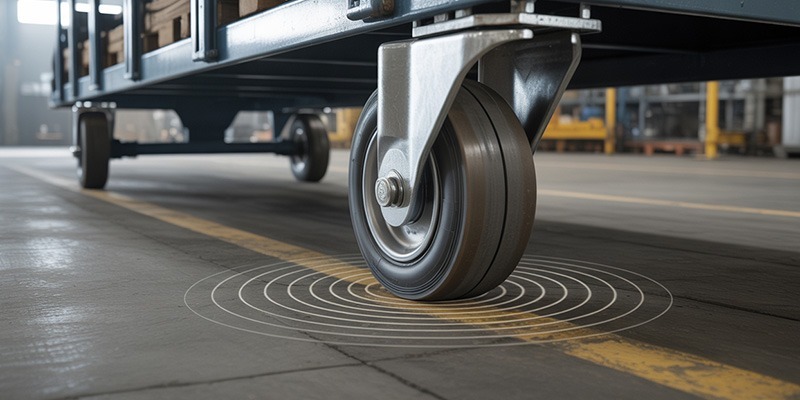
Selecting appropriate caster solutions requires matching material, bearing type, and configuration to the application.
Caster solutions refer to integrated wheel, bearing, and mounting configurations designed to meet specific equipment requirements.
Manufacturing Lines
In automated production lines, vibration can influence calibration. Equipment casters should prioritize polyurethane treads with precision bearings.
Tool Carts
For tool transport, casters for carts often combine a swivel and a rigid unit. Common types of casters include-
- Swivel
- Rigid
- Locking
- Shock-absorbing
Swivel casters allow maneuverability. Rigid casters improve tracking. Locking mechanisms stabilize equipment during use.
Medical Equipment
Hospitals require quiet casters and low vibration. Softer tread materials and sealed bearings are standard.
Warehouse Transport
Warehouse platforms may require high capacity casters with durable cores. Nylon or phenolic wheels may be appropriate on smooth floors.
Precision Assembly
Shock-sensitive environments benefit from shock absorbing casters combined with carefully planned caster load capacity.
Softer wheels prioritize dampening, while higher-capacity rigid systems prioritize structural stability.
Selecting between industrial casters and lighter commercial casters depends on duty cycle, load, and vibration sensitivity.
Quiet Casters and Workplace Environment
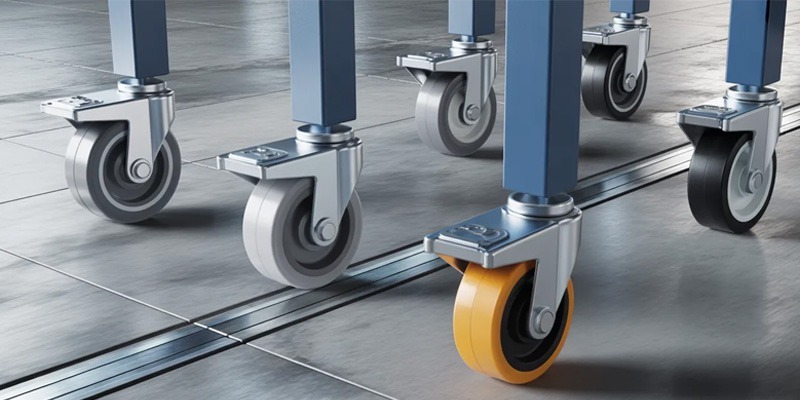
Noise often correlates with vibration. Quiet casters use resilient tread compounds and precision bearings to reduce rolling sound.
Quiet casters are wheel assemblies engineered to minimize vibration-induced noise during movement.
Hard-tread materials generate higher decibel levels on concrete. Polyurethane and rubber typically reduce noise output.
Reduced vibration transmission lowers acoustic resonance within equipment frames.
In facilities with occupational noise limits, selecting appropriate caster wheel materials supports compliance and improves operator comfort.
For industrial casters used near personnel workstations, vibration and noise control help create safer, more efficient environments.
Wrapping up
Reducing equipment vibration requires coordinated engineering decisions.
Caster wheel materials determine how shock energy is absorbed or transmitted. The caster bearing system influences rotational smoothness and noise. Proper caster load capacity planning minimizes deflection and oscillation. In high-impact environments, shock-absorbing casters provide additional protection.
Material choice controls dampening, while capacity selection controls structural stability.
When specified correctly, industrial casters improve equipment longevity, reduce maintenance intervals, and maintain operational consistency.
Engineers evaluating vibration issues should review wheel composition, bearing design, and load margins together rather than independently.
For application-specific guidance or assistance in evaluating vibration challenges, consult the engineering team at Atlanta Caster for tailored caster solutions aligned with your operating conditions.
Frequently Asked Questions
1. What are the best caster wheel materials for reducing vibration?
The most effective caster wheel materials for vibration reduction are typically polyurethane and rubber. Polyurethane balances load capacity and dampening, making it common in quiet casters used in manufacturing and medical settings. Rubber provides greater vibration absorption but may deform under high loads. Hard materials like nylon or phenolic prioritize strength rather than shock control. The correct choice depends on load, floor condition, and acceptable vibration thresholds.
2. How do shock-absorbing casters work?
Shock-absorbing casters reduce transmitted vibration by incorporating suspension systems, such as springs or elastomer inserts. These mechanisms allow controlled vertical travel when the wheel encounters impact. Instead of transferring the whole force into the equipment frame, energy is dissipated through mechanical compression. This reduces acceleration peaks and protects sensitive components. They are commonly used where fragile equipment or precision assemblies are transported.
3. Does caster load capacity affect vibration?
Yes, caster load capacity directly affects vibration levels. When a caster operates near or beyond its rated capacity, wheel deflection increases. Excessive deflection leads to oscillation and bearing stress. Maintaining a safety margin above the calculated load reduces flex and improves stability. Proper load distribution across all casters further minimizes vibration and structural fatigue.
4. What type of caster bearing reduces noise?
Precision sealed ball bearings typically reduce noise more effectively than plain bore or poorly lubricated roller designs. A properly matched caster bearing maintains consistent rotation and reduces friction-induced vibration. Sealed systems also prevent debris contamination, which can increase sound and wear. Bearing quality significantly influences long-term vibration control.
5. Are industrial casters different from commercial casters?
Yes. Industrial casters are designed for higher loads, harsher environments, and sustained duty cycles. They use reinforced forks, stronger bearings, and more durable wheel compounds. Commercial casters are generally lighter duty and intended for less demanding environments. In vibration-sensitive industrial applications, heavier duty construction improves stability and durability.
6. Which types of casters are best for carts?
The best types of casters for carts depend on movement requirements. A typical configuration includes two rigid casters for straight tracking and two swivel casters for maneuverability. Locking casters stabilize equipment during stationary use. For vibration-sensitive carts, polyurethane tread or shock-absorbing casters may be appropriate. Proper load rating and bearing selection are equally crucial for performance.