Email US
 Hours
Hours
 Visit Our Showroom


Can You Replace Just the Wheel, or Do You Need a New Caster?
Sep 15th 2026
A worn caster wheel does not always mean you need a completely new caster. Caster wheel replacement is often possible when the wheel is damaged, but the fork, axle, swivel mechanism, and mounting hardware remain in good condition. If the fork is bent, the swivel has excessive play, corrosion is widespread, or several components are worn, replacing the entire caster is usually the safer choice.
The decision comes down to two questions: Is the rest of the caster still structurally sound, and can you find a replacement wheel that matches the original specifications? Checking those points before you order can prevent repeat repairs, downtime, and incompatible parts.
What Is the Difference Between a Caster and a Wheel?
A wheel is the rolling component that touches the floor. A caster is the complete assembly that holds the wheel and attaches it to your cart, rack, machine, or other equipment.
Depending on the design, a caster can include:
- Wheel: The component that rolls across the floor.
- Axle: The pin or bolt around which the wheel rotates.
- Bearings: Minimize friction between the wheel and axle.
- Fork or yoke: Holds the wheel and axle in position.
- Swivel raceway: Allows a swivel caster to rotate and change direction.
- Mounting plate or stem: Connects the caster to the equipment.
- Brake: Locks the wheel, swivel, or both on equipped models.
Because these are separate components, damage to one part does not automatically mean the entire assembly must be discarded.
If the wheel is cracked or worn but the fork remains straight, the swivel rotates properly, and the mount is secure, wheel-only replacement may be all you need.
If you are comparing replacement materials, Atlanta Caster lets you browse replacement wheels by material.
When Does Wheel-Only Replacement Make Sense?
You can replace just the wheel when the rest of the caster is still in good working condition.
Check the following before choosing a wheel-only repair:
- The fork is straight, with no cracks, bending, or structural damage.
- The swivel mechanism turns smoothly without grinding or excessive side-to-side play.
- The axle is straight and shows no serious wear.
- The mounting plate or stem is intact and firmly attached.
- The brake, if present, operates correctly.
- A replacement wheel is available in the required diameter and width.
- The axle or bore size matches the existing caster.
- The bearing type matches the current setup.
- The replacement wheel meets or exceeds the required load capacity.
- The existing caster design allows the wheel and axle to be removed and replaced.
When these conditions are met, wheel-only replacement can restore the caster without replacing parts that still have useful service life.
This is especially practical when one wheel has worn faster than expected, but the surrounding hardware remains sound.
Once you know the wheel alone is the problem, you can compare replacement wheels by size and then confirm the remaining fitment details before ordering.
When Should You Replace the Entire Caster?
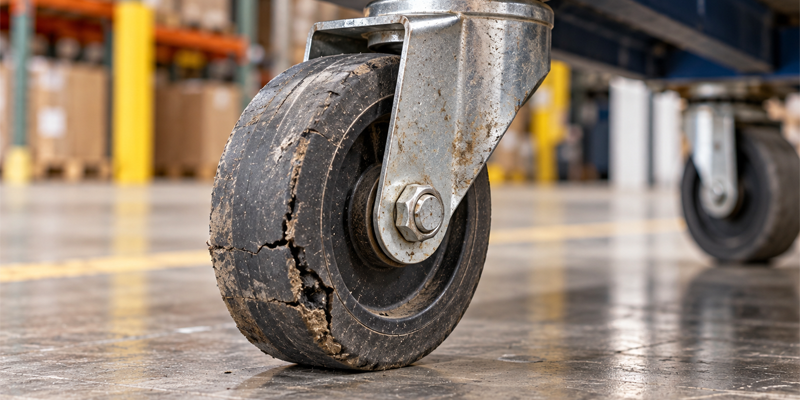
A new wheel cannot correct a damaged fork, worn swivel, or compromised mount.
Replace the complete caster when you find problems such as:
- A bent or cracked fork
- A damaged, stripped, or distorted mounting plate
- A damaged stem that no longer seats correctly
- Excessive play in the swivel section
- Grinding or binding when the caster rotates
- A worn or damaged swivel raceway
- Significant corrosion on the fork, axle, or hardware
- A brake that no longer holds reliably
- Several worn components at the same time
- Repeated caster problems even after the previous wheel replacement
- A load rating that no longer matches how the equipment is being used
- No compatible replacement wheel for the existing caster
These conditions point to a problem with the assembly rather than the wheel alone.
A damaged swivel or fork can also affect equipment stability and cause a new wheel to wear unevenly. Replacing only the wheel in that situation may save money at first, but it leaves the actual failure point unchanged.
If the existing caster is no longer suitable for the equipment's current load, use Atlanta Caster's casters by weight capacity to narrow the replacement options.
How Do You Measure a Caster Wheel for Replacement?
If a wheel-only replacement is appropriate, the next step is to confirm caster wheel compatibility.
Do not order based only on wheel diameter. Two wheels that look nearly identical may use different bearings, hub lengths, or axle sizes.
Check these measurements and specifications:
- Wheel diameter: Measure straight across the wheel through its center.
- Wheel width: Measure the tread from side to side.
- Axle or bore diameter: Confirm the diameter of the axle opening.
- Hub length: Measure the full width of the wheel hub.
- Bearing type: Identify whether the wheel uses a plain bore, ball bearing, roller bearing, or another design.
- Wheel material: Match the material to the floor, operating environment, and expected load.
- Tread profile: Check whether the tread is flat, crowned, or another shape.
- Load capacity: Verify the rating for each wheel.
- Fork clearance: Make sure the new wheel fits between the existing fork legs.
- Caster configuration: Confirm whether the caster is swivel or rigid.
- Brake clearance: Make sure the replacement wheel works with the existing brake, if equipped.
Mounting configuration matters when you are replacing the entire caster rather than only the wheel. Atlanta Caster offers rigid casters, swivel casters, top-plate options, and threaded-stem configurations.
How Do You Check the Required Load Capacity?
Load capacity should be calculated per caster, not simply by looking at the total cart weight.
Start with the fully loaded weight of the equipment, including the cart itself and everything it normally carries. Divide that number by the number of casters supporting the equipment.
For example, if a fully loaded cart weighs 1,600 lbs and uses four casters:
1,600 ÷ 4 = 400 lbs per caster
Do not select a caster rated at exactly 400 lbs and assume the calculation is finished. Uneven floors, changing loads, and movement can temporarily place more weight on one caster than another.
Build in a reasonable safety margin for the actual application.
If one wheel briefly loses contact with the floor, the remaining casters may carry more than their evenly divided share.
It is also worth inspecting the other casters while you are repairing this one. If one wheel has reached the end of its service life because of general wear, the others may be approaching the same point.
Is It Cheaper to Replace a Caster Wheel or the Whole Caster?
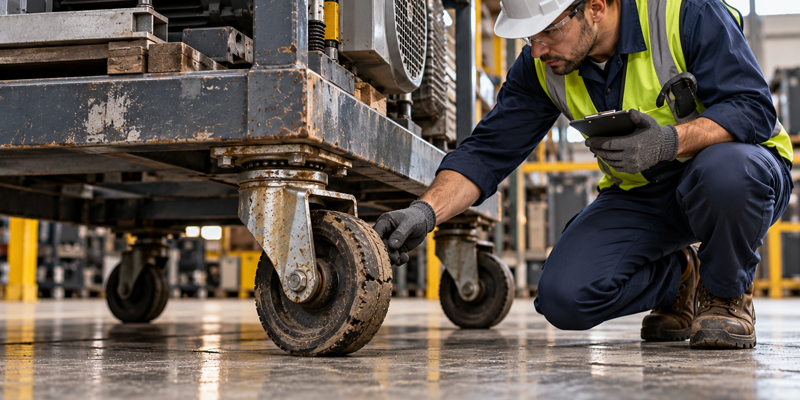
A replacement wheel usually costs less up front than buying an entire caster, and the repair may take less time when the fork and mounting components are already in good condition.
But the upfront price is not the only cost to consider.
Suppose you install a new wheel on a caster whose swivel mechanism is already loose. The cart returns to service, but the swivel continues to deteriorate. Soon, the equipment has to be removed from service again so the complete caster can be replaced.
You have now paid for:
- The first replacement wheel
- Labor for the first repair
- A complete replacement caster later
- Labor for the second repair
- Additional equipment downtime
In that situation, replacing the complete caster earlier may have cost more initially but less overall.
On the other hand, replacing a perfectly good fork and swivel simply because the tread has worn out adds unnecessary cost.
The better choice depends on the condition of the entire assembly, not a rule that one repair path is always cheaper.
Can You Change Wheel Material During Replacement?
Often, yes, provided the new wheel remains compatible with the existing caster and application.
For example, you may consider changing from rubber to polyurethane because your operating conditions have changed. But the alternative wheel still needs the correct:
- Diameter
- Width
- Bore or axle size
- Bearing arrangement
- Hub length
- Load capacity
The material must also suit the floor and operating environment.
Changing wheel material can affect rolling resistance, noise, shock absorption, floor contact, and wear behavior. For help comparing those factors, see Atlanta Caster's information on matching wheel material to your floor.
What Common Caster Wheel Replacement Mistakes Should You Avoid?
Several ordering mistakes can turn a simple repair into another round of downtime.
- Ordering by diameter alone: Width, hub length, bore, and bearing type matter too.
- Assuming similar-looking wheels are interchangeable: Internal dimensions and ratings can differ.
- Skipping the capacity check: A matching size does not guarantee a matching load rating.
- Ignoring damage to the fork or swivel: A new wheel will not correct structural wear elsewhere.
- Replacing one badly worn caster without checking the others: Uneven wear can affect cart handling.
- Guessing the bearing type: Plain bore, ball-bearing, and roller-bearing designs need to be matched correctly.
- Treating every noise problem as a wheel problem: Bearings, swivel components, mounting hardware, and wheel material can all contribute to noise.
For broader upkeep recommendations, see Atlanta Caster's general caster maintenance advice. If noise is the primary problem, use the separate resource on diagnosing a noisy cart.
What Should You Do If You're Not Sure Which Part to Replace?
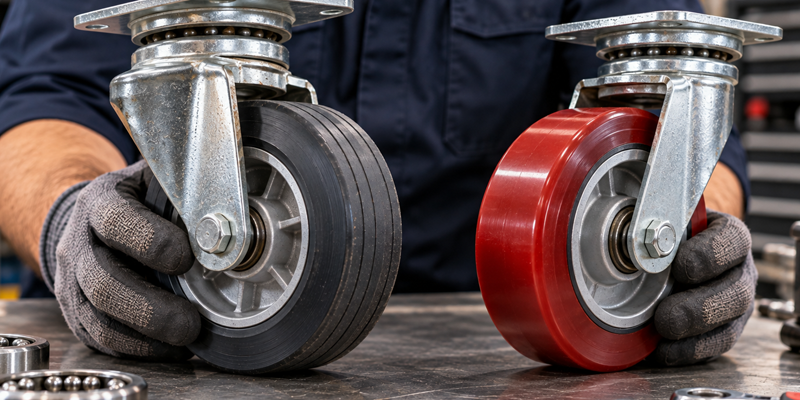
Older equipment and heavily used industrial carts do not always make the repair path obvious.
Atlanta Caster's Certified Caster Specialists can help you determine whether a replacement wheel fits the existing assembly or whether a complete caster makes more sense. Non-standard equipment may also require custom caster solutions.
If you are unsure, contact Atlanta Caster with photos of the caster and measurements for the wheel diameter, width, axle or bore, hub, and mount. Providing those details gives the team a much clearer starting point for identifying the correct replacement.
Frequently Asked Questions
1. Can caster wheels be replaced without replacing the whole caster?
Yes. If the fork, axle, swivel mechanism, and mounting hardware remain in good condition and a compatible wheel is available, you can often replace only the wheel.
2. How do I know if I need a new caster instead of just a new wheel?
Replace the full caster when the fork is bent or cracked, the swivel has excessive play or grinding, the mount is damaged, corrosion is significant, or several components are worn at the same time.
3. What parts of a caster can be replaced individually?
Depending on the design, the wheel, bearings, and sometimes the axle may be individually replaceable. Damage to the fork, swivel raceway, mounting plate, or stem more often points toward complete caster replacement.
4. How do I measure a caster wheel for replacement?
Measure the wheel diameter and width, axle or bore diameter, hub length, and bearing type. Also confirm load capacity and make sure the wheel fits inside the existing fork.
5. Can I replace a caster wheel with a different material?
Often, yes. The replacement still needs compatible dimensions, bearings, hub width, and capacity. The new material should also suit the floor and operating conditions.
6. Is it cheaper to replace a caster wheel or the whole caster?
Replacing only the wheel usually costs less initially. If other caster components are already worn, however, replacing the full assembly may reduce repeat labor and downtime.
7. How long do caster wheels typically last?
There is no single lifespan that applies to every caster wheel. Load, floor surface, operating frequency, environment, and wheel material all affect wear. Inspect for cracks, flat spots, excessive noise, uneven rolling, and bearing problems rather than relying on a fixed replacement schedule.