Email US
 Hours
Hours
 Visit Our Showroom


Caster Chemical Compatibility, Explained: Matching Wheel Material to Your Cleaning Protocol
Sep 18th 2026
Not every caster wheel material reacts to cleaning chemicals the same way, and the material name alone does not tell you whether a wheel will hold up in your facility. Caster wheel chemical compatibility depends on the specific chemical, its concentration, the solution temperature, the duration and frequency of exposure, how the chemical contacts the caster, and the wheel's formulation.
A wheel that handles an occasional detergent wipe-down may respond differently to a daily bleach washdown. The safer approach is to match the wheel and the complete caster assembly to your actual cleaning protocol, then confirm product-specific compatibility before you order.
Why Isn't Chemical Compatibility Just About the Material Name?
It is easy to see a phrase such as "chemical-resistant caster wheels" and assume that a material will work with any cleaner or disinfectant. That shortcut can lead to premature wear because chemical resistance is conditional.
Six factors matter most:
- Chemical type: Bleach, quaternary ammonium compounds, alcohol-based cleaners, degreasers, acids, and alkalis interact with materials differently.
- Concentration: A diluted maintenance cleaner is not the same exposure as a concentrated industrial chemical.
- Temperature: Heat can increase the effects of certain chemicals on plastics, elastomers, seals, and hardware.
- Exposure duration and frequency: Occasional wiping differs from daily washdown or prolonged contact.
- Exposure method: Brief surface contact differs from a wheel sitting in standing liquid.
- Exact formulation: Two products sold under the same broad material name can use different compounds and may have different resistance profiles.
The better question is not simply, "Is polyurethane chemical resistant?" It is, "Is this exact polyurethane wheel compatible with this chemical, at this concentration and temperature, for this exposure pattern?"
That distinction matters in food processing, healthcare, manufacturing, and other facilities where cleaning protocols are frequent and repeatable.
How Do Common Cleaning Protocols Affect Wheel Selection?
Different facilities use different cleaning agents, so the active chemistry matters more than the word "cleaner" or "disinfectant."
Routine detergent cleaning is often the mildest common exposure. Many wheel materials tolerate occasional contact, but frequent cleaning can still affect the tread, bearings, seals, or hardware over time.
Bleach and chlorine-based cleaners are oxidizing chemicals and should not be treated as interchangeable with milder detergents. If bleach is part of a frequent sanitation protocol, confirm compatibility for the exact wheel compound.
Quaternary ammonium disinfectants, or quats, are common in healthcare and food-service environments. Frequent quat exposure should be checked against manufacturer data rather than assumed from a general material label.
Alcohol-based cleaners are widely used for spot cleaning and high-touch surfaces. Repeated exposure can still justify a compatibility check, even if the wheel or caster assembly is cleaned frequently.
Degreasers are common in manufacturing, automotive, and maintenance settings. Their formulations vary, and some are much stronger than general-purpose cleaners.
Acidic and alkaline cleaners can also differ greatly by pH and concentration. A mild alkaline detergent and a concentrated acidic descaler are not equivalent exposures.
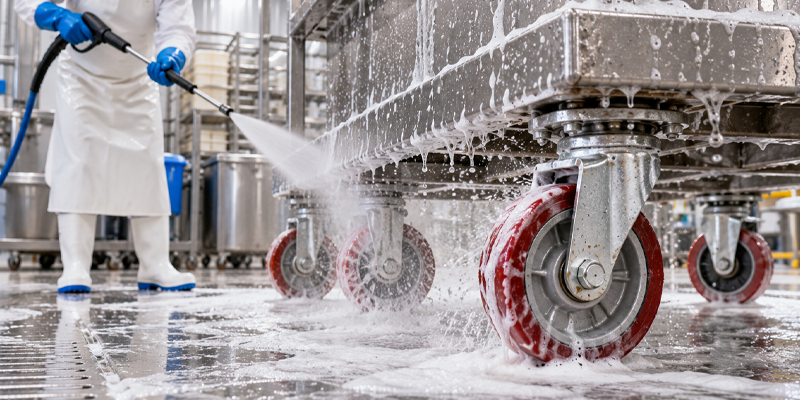
High-frequency washdown adds another factor: repeated water contact. In these environments, you need to consider the wheel, bearings, fasteners, and fork rather than evaluating the tread alone.
For sanitation-focused applications, Atlanta Caster already provides separate information on food-grade caster selection. Chemical compatibility still needs to be checked against the exact protocol in use.
How Do Common Casting Materials Compare for Chemical Exposure?
There is no universal ranking for caster wheel chemical compatibility. Each material has trade-offs, and product-specific data should take priority over broad material claims.
|
Material |
Chemical Exposure Considerations |
Water / Washdown |
What to Verify |
|
Polyurethane |
Atlanta Caster positions polyurethane as resistant to oils, greases, and moisture. |
Some formulations are marketed for washdown use. |
Confirm the exact formulation against bleach, quats, degreasers, or other named chemicals. |
|
Thermoplastic Rubber (TPR) |
Published resistance includes cleaning chemicals, acids, alcohol, and water. |
Explicitly positioned for washdown applications. |
Concentration and exposure duration are not specified; verify the demanding protocols. |
|
Nylon |
Atlanta Caster content describes resistance to water, chemicals, and corrosive substances. |
A legacy product listing notes tolerance for washdown and steam cleaning for a specific nylon wheel. |
Confirm current product data for the exact wheel. |
|
Phenolic |
Atlanta Caster describes phenolic as heat- and chemical-tolerant. |
Not specifically positioned for washdown. |
Specific chemical resistance is not quantified in the available information. |
|
Rubber |
Current Atlanta Caster content positions rubber as less suited than harder materials in chemically demanding environments. |
Not generally the first choice for heavy chemical exposure. |
Exact chemical-resistance data should be confirmed directly. |
|
Solid Elastomer |
Published descriptions focus on wheel construction and tread-to-center bonding rather than external chemical resistance. |
Not specifically promoted for washdown. |
Confirm before using in a chemical-heavy protocol. |
|
Stainless Steel fork/hardware |
Atlanta Caster content describes resistance to rust, corrosion, and cleaning chemicals. |
Frequently used for washdown, food-service, and healthcare applications. |
Stainless steel describes the fork and hardware, not the wheel tread. Verify both separately. |
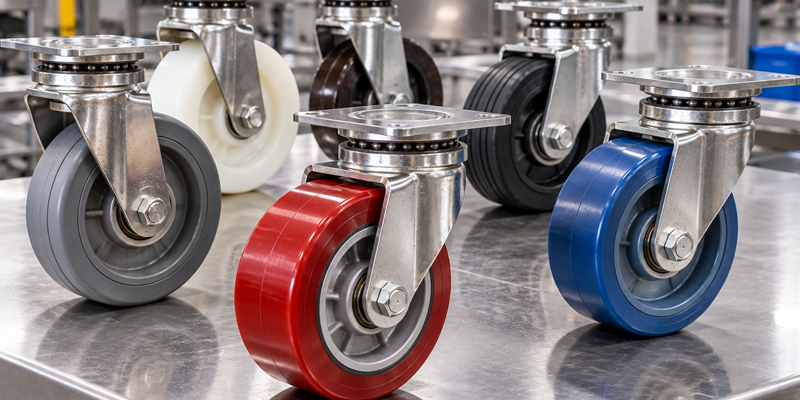
You can browse casters by material or compare specific polyurethane, nylon, thermoplastic rubber, and solid elastomer casters.
Two wheels with the same general material name may use different formulations. Category-level descriptions are useful for narrowing your options, but they do not replace data for the specific product.
How Do You Choose Casters for a Chemical-Cleaning Environment?
Use a repeatable decision-making process rather than starting with a material assumption.
- Identify the exact chemicals. Record the cleaner, disinfectant, solvent, degreaser, acid, or alkali in use, including the active ingredient where possible.
- Determine the concentration. Note whether the product is diluted per a routine cleaning protocol or used at a higher concentration.
- Determine the temperature. Include hot water and heated cleaning solutions because temperature can change material performance.
- Document exposure frequency and duration. Occasional wiping, daily washdown, and continuous contact are different conditions.
- Identify the exact wheel compound. Do not stop at a broad category such as polyurethane or nylon.
- Check manufacturer compatibility data. Compare the exact compound with the exact chemicals and conditions in your facility.
- Check the complete caster. Bearings, seals, axles, fasteners, and fork material can be affected even when the tread itself remains stable.
- Confirm mechanical requirements. Load capacity, wheel diameter, floor surface, mount type, operating speed, and noise requirements must still match the equipment.
Step 7 is especially easy to overlook. A caster is an assembly, not just a wheel. If the tread tolerates a disinfectant but the bearing seals, fasteners, or fork do not, the caster can still fail prematurely.
When Should You Consult Manufacturer Data Directly?
General material characteristics are a starting point. Manufacturer-specific data becomes more important as chemical exposure becomes stronger, hotter, more frequent, or longer.
Direct verification is especially worthwhile when:
- Bleach or chlorine cleaners are used repeatedly.
- Quaternary ammonium disinfectants are part of the routine protocol.
- Concentrated acids, alkalis, solvents, or degreasers are present.
- Wheels undergo daily or high-frequency washdown.
- A caster may sit in a standing liquid.
- Equipment failure would disrupt sanitation, production, or patient care workflows.
If a product page does not specify the exact chemical, concentration, temperature, or exposure duration you need, treat that information as unverified rather than assuming compatibility based on the base material.
What Else Matters Beyond Chemical Compatibility?
Chemical resistance is only one part of caster selection. The wheel still needs to carry the load, fit the mounting arrangement, roll properly on the floor surface, and meet your noise and mobility requirements.
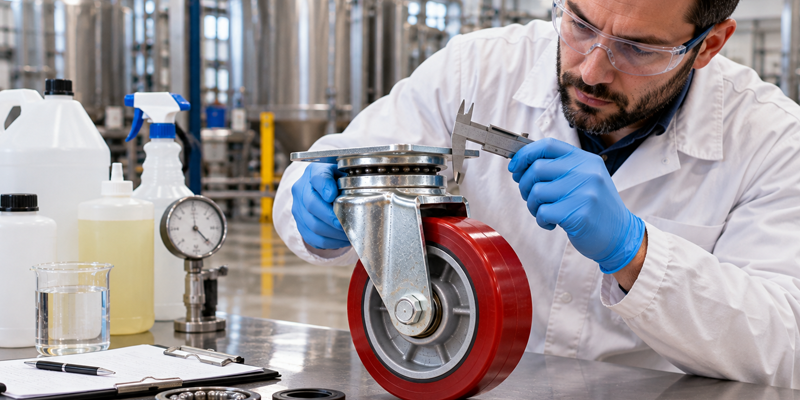
For example, a wheel may suit a washdown protocol chemically but still have the wrong capacity for a fully loaded cart. A chemically suitable tread may also be paired with hardware that does not match the cleaning environment.
Atlanta Caster's stainless steel casters can help address fork and hardware concerns in many washdown settings, but the wheel material still needs separate review.
If you are specifying equipment for food-processing environments or healthcare environments, evaluate both the cleaning protocol and the mechanical application. For an application-specific review, contact Atlanta Caster with the chemicals, cleaning frequency, cart weight, wheel size, and mounting requirements.
Frequently Asked Questions
1. What Caster Wheel Material Is Best for Chemical Exposure?
There is no single best material for every chemical. The right choice depends on the exact chemical, concentration, temperature, frequency, and duration of exposure. Polyurethane, TPR, and nylon are used in many chemically demanding environments, but the exact wheel formulation should be checked against your cleaning protocol.
2. Are Polyurethane Caster Wheels Chemical-Resistant?
Polyurethane wheels are commonly used where oils, greases, moisture, and certain cleaning chemicals are present. Some formulations are also positioned for washdown use. Resistance varies by formulation, so check the specific product rather than relying on the material name alone.
3. Are caster wheels resistant to Bleach or Disinfectants?
Some may be, but bleach and disinfectants cover different chemistries. Frequent exposure to bleach, quats, or other disinfectants should be verified against the exact wheel compound and the rest of the caster assembly.
4. What caster wheels are suitable for Washdown Environments?
Thermoplastic rubber and certain nylon and polyurethane products are used in washdown environments because published specifications may include water and chemical resistance. The right choice still depends on the cleaning agent, temperature, frequency, load, and the caster's overall construction.
5. Can Cleaning Chemicals Damage Caster Wheels?
Yes. An incompatible chemical can contribute to cracking, softening, swelling, surface deterioration, or premature wear. Risk can increase with higher concentration, higher temperature, longer contact, or more frequent exposure.
6. Does Chemical Resistance Depend on the Whole Caster, Not Just the Wheel?
Yes. Bearings, seals, axles, fasteners, and fork material are exposed alongside the wheel tread. A caster can still fail if one of those components is incompatible with the cleaning chemicals, even when the wheel material itself performs well.
7. How Do I Choose Caster Wheels for a Chemical-Cleaning Environment?
Identify the exact chemicals, concentrations, temperatures, exposure frequencies, and durations first. Then compare those conditions with manufacturer data for the specific wheel compound and complete caster. Finally, confirm load capacity, size, floor, mounting, and operating requirements before ordering.