Email US
 Hours
Hours
 Visit Our Showroom


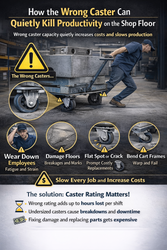
How the Wrong Caster Can Quietly Kill Productivity on the Shop Floor
Feb 25th 2026
If a cart feels “a little harder to push,” we often shrug it off. But the wrong caster load capacity can quietly drain hours from a shift, strain people’s bodies, damage equipment, and trigger avoidable manufacturing downtime. When casters are under-rated or mismatched to the floor and load, they do not fail in one dramatic moment. They fail in small ways that slow every move we make.
Weight capacity is the starting point for safety, performance, and durability. If we get it wrong, we pay for it in fatigue, floor damage, flat-spotted wheels, bent frames, and constant “why is this cart always stuck” frustration. If we get it right, carts roll smoothly, turns stay predictable, and warehouse productivity improves without changing anything else.
Key Highlights
- Weight capacity is not a guess. We must size casters for the real load, plus impact, uneven floors, and daily abuse.
- Load distribution matters. The heaviest corner often carries more than we think, especially on swivel setups and rough floors.
- Wrong caster choice shows up as downtime. Harder pushes, wobbles, vibrations, wheel failure, and damaged floors all slow factory efficiency.
- Caster type affects effort and control. Swivel, rigid, locking, and total-lock options change how equipment casters behave in real aisles.
- Maintenance keeps load capacity reliable. Debris, worn bearings, and loose fasteners reduce performance long before a wheel breaks.
Quick direct answer: We avoid productivity loss by selecting industrial casters by true working load, then matching wheel material, caster type, and floor conditions so the set rolls easily and stays stable under everyday impacts.
Where Productivity Gets Lost in Material Movement
When casters are wrong for the job, the first cost is usually time. People take shorter routes to avoid rough patches. They stop to reposition carts because swivels flutter. They team-lift a cart that should roll with one hand. They park the equipment “close enough” because the brakes do not hold. Those extra seconds add up across every move, every shift, every line.
We typically see productivity drop in five common ways:
- More force per move
- Extra push effort slows the pace and increases fatigue.
Fatigue increases mistakes and near misses.
- More micro-stoppages
- Wheels jam on debris or cracks.
- Swivels bind and require repeated repositioning.
- More damage
- Overloaded wheels deform and flat-spot.
- Frames bend when one caster is constantly overloaded.
- Floors chip when hard wheels or overloaded wheels hammer the surface.
- More noise and vibration
- Vibration loosens fasteners and wears bearings.
- Noise is a sign of rolling resistance and impact.
- More unplanned maintenance
- Replacing wheels “again” becomes normal.
- Equipment sits waiting, causing manufacturing downtime.
These are not dramatic failures. They are the daily friction that quietly kills warehouse productivity.
Why Load Capacity Matters in Caster Selection
Load capacity is the maximum weight a caster can carry while rolling and turning safely. Many teams choose based on “what looks strong enough.” That approach usually leads to under-sizing or choosing a wheel that cannot handle the floor.
What makes capacity tricky in real operations
- We rarely move loads gently. We hit thresholds, expansion joints, and dock plates.
- Loads shift. A tank cart sloshes. A pallet leans. A technician pushes from one corner.
- Floors are not perfect. Small dips shift weight to one caster, even if the cart is level when parked.
That is why capacity must include a safety buffer. It is not fear. It is reality.
Load distribution: the reason “four casters” does not mean “divide by four.”
A common mistake is calculating capacity like this: Total load ÷ number of casters = capacity per caster
In the real world, one caster often carries more than its share because floors are uneven and turning shifts weight. A practical rule we use for many shop-floor carts is:
Total load ÷ 3 = minimum capacity per caster (for a 4-caster cart)
Why divide by 3? Because at some point, a 4-caster cart can momentarily ride with only three casters taking most of the load. That is especially common when crossing a threshold or rolling over debris.
Example: 1,200 kg cart on 4 casters
- Basic math: 1,200 ÷ 4 = 300 kg per caster
- More realistic minimum: 1,200 ÷ 3 = 400 kg per caster
- Add a buffer for impact and daily abuse: often 20–40%, depending on conditions
If we ignore this, we get casters that look fine in a catalog and fail on the floor.
The early warning signs of the wrong caster
Most caster problems announce themselves long before a wheel breaks. If we spot these signs, we can prevent downtime:
- Hard pushing or sudden “dead stops.”- Usually, the rolling resistance is caused by the wrong wheel material, debris buildup, or worn bearings.
- Wobble at speed or swivel flutter - Often, a caster type mismatch, worn swivel bearings, or too small a wheel.
- Flat spots and thumping - Common when loads sit parked for long periods on wheels not designed for static load, or when wheels are overloaded.
- Cracked tread or chunking - A wheel material mismatch (for example, a tread not suited for sharp debris, oils, or heat).
- Loose caster mounts or bent frames - A sign that impact loads exceed capacity, or the mounting method is not strong enough for the application.
These are the small failures that quietly reduce factory efficiency.
Different types of casters and how they affect productivity
Choosing between different types of casters is not about preference. It changes how the load moves, how much effort it takes, and how stable the equipment feels.
1. Swivel casters
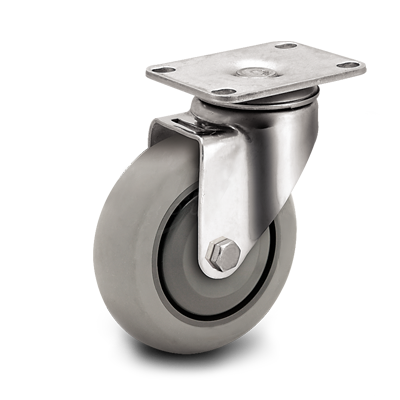
Swivel casters rotate 360 degrees. They are great for tight maneuvering but can introduce flutter if the wheel is too small, the load is high, or the floor is uneven.
Best for:
- Tight aisles and frequent direction changes
- Carts handled by one person
Watch-outs:
- More sensitive to load distribution
- Can flutter if the wrong size or worn
You can explore all options here: Swivel casters
2. Rigid (fixed) casters
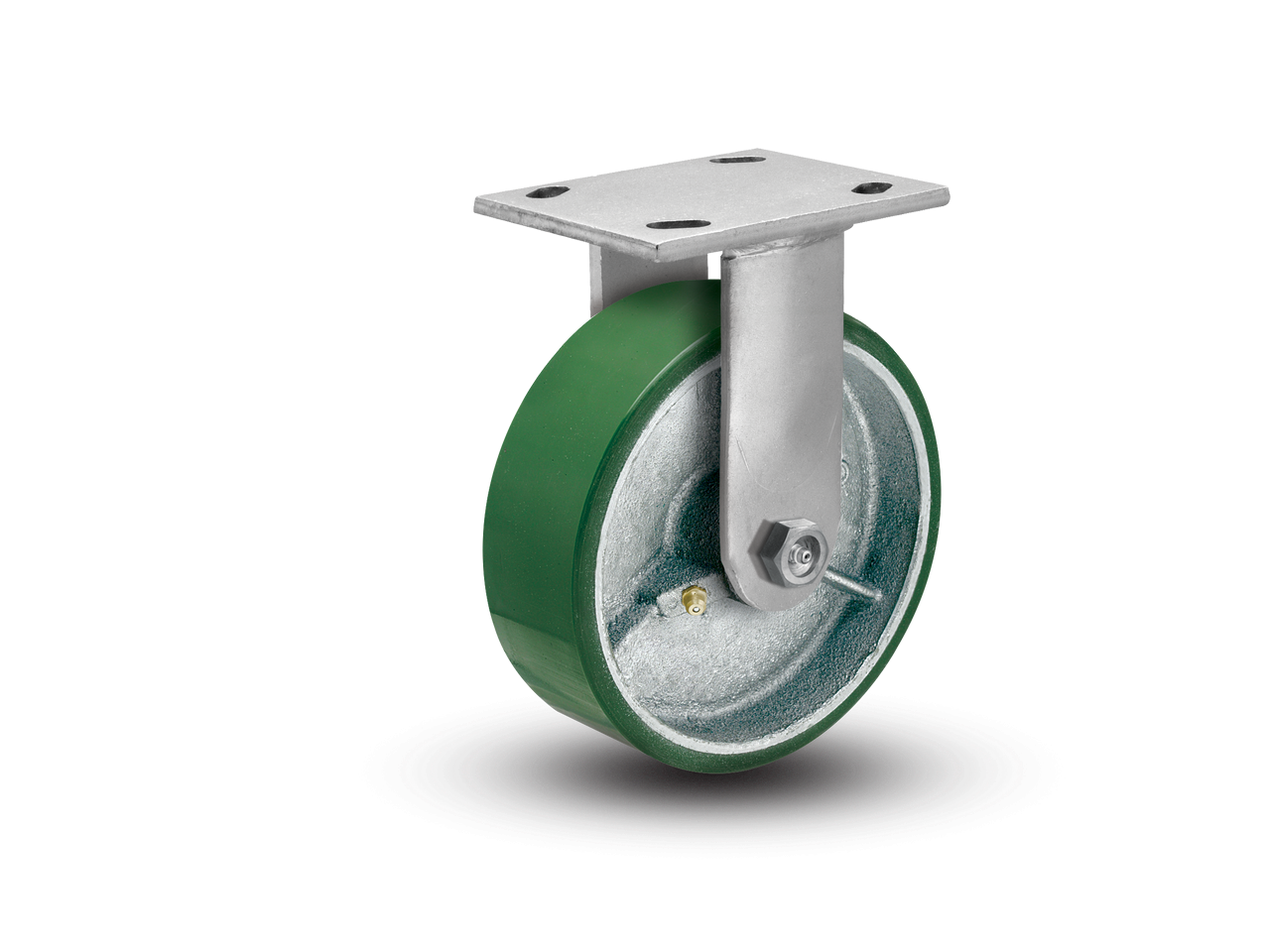
Rigid casters roll straight. They improve tracking and stability and often reduce push effort on long runs.
Best for:
- Straight-line travel
- Heavy loads that must stay stable
Watch-outs:
- Harder to turn in tight spaces
You can explore all options here: Rigid/fixed casters
3. Total-lock and directional-lock options
Locks improve control and safety. Total-lock typically locks both the wheel and swivel, reducing drift. Directional locks help keep long carts tracking straight.
Best for:
- Sloped floors
- Precision positioning at workstations
A common high-control setup is two rigid and two swivel. It balances maneuverability and tracking. For some equipment casters, a four-swivel setup works best, but only if we choose the right wheel size and quality swivels.
How Wheel Material Affects Movement and Durability
Capacity alone is not enough. Industrial casters and wheels must match the floor and environment.
1. Polyurethane tread (common for shop floors)
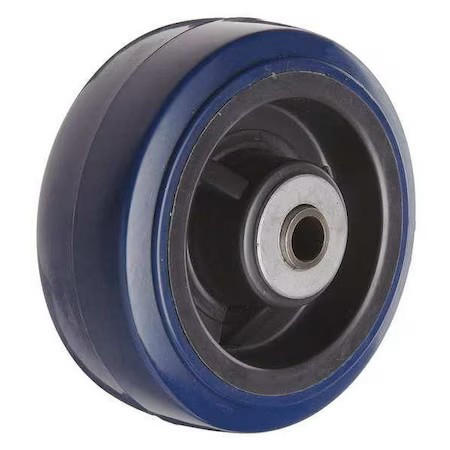
- Rolls smoothly and protects floors better than hard plastics
- Handles moderate debris better than softer rubber in many cases
- Good all-round option for many commercial casters
Best for:
- Concrete floors
- Mixed indoor environments
- Protecting coatings and finished floors
You can explore all options here: Polyurethane industrial wheels
2. Rubber tread
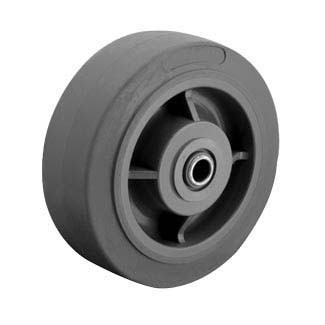
- Quieter and forgiving on uneven surfaces
- Can increase rolling resistance under heavy loads compared to polyurethane
- Some rubbers do not like oils or chemicals
Best for:
- Noise-sensitive areas
- Slightly rough floors where comfort matters
You can explore all options here: Rubber tread wheels
3. Nylon or hard poly wheels
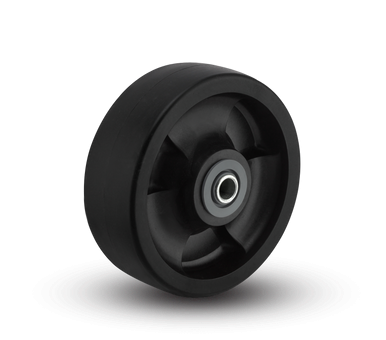
- Low rolling resistance on smooth surfaces
- Can be noisy and harsh on imperfect concrete
- Can damage floors under high load
Best for:
- Very smooth floors
- Environments where chemical resistance is important
You can explore all options here: Nylon wheels
4. Cast iron or forged steel wheels
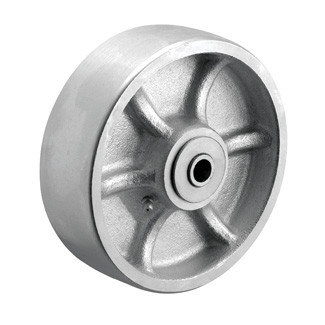
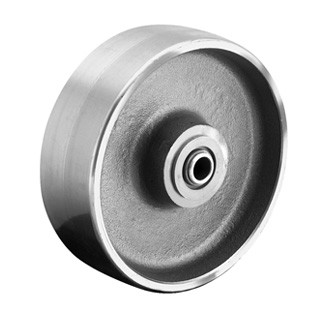
- Handles high heat and heavy loads
- Harsh, loud, and unforgiving on floors
- Best where durability is the only priority, and floors can take it
Best for:
- High-temperature zones
- Very heavy loads in harsh conditions
Wheel choice directly impacts warehouse productivity because it sets the daily push effort and the frequency of wheel replacement.
You can explore all options here: forged steel wheels and cast iron wheels
What Should We Check Before Choosing Casters?
We use this quick process when selecting mobility solutions for carts, racks, and fixtures.
1) Calculate the real working load
- Include the weight of the cart and attachments
- Include the maximum load, not the average
- Use Total load ÷ 3 for a 4-caster cart as a realistic minimum per caster
- Add a buffer for impact and rough travel
If the load is moved over dock plates, thresholds, or debris, we should treat it as higher than the scale reading.
2) Choose wheel diameter for the floor
Larger wheels roll over small obstacles more easily and reduce push effort.
- Smooth floors: medium size can work
- Cracks, debris, rough concrete: larger wheels help a lot
If carts stop at every small joint, we often see immediate gains by increasing wheel diameter.
3) Match wheel material to the environment
- Oils, chemicals, washdown, heat, chips, and scrap all change the best option
- Floor protection matters for long-term efficiency and repair costs
4) Choose the caster type for the route
- Long straight runs: add rigid casters for tracking
- Tight turns: use swivels with strong bearings and adequate wheel size
- Slopes: add reliable brakes or total-lock
5) Check mounting strength and swivel quality
Mounting plates and fasteners must match the load and impact. Swivel bearings and kingpin design affect durability. When we use dependable industrial casters built for shop conditions, we get fewer replacements and steadier performance.
You can explore all options here: Industrial casters and Heavy duty casters
Where Caster Problems Turn Into Lost Hours
1. Tooling and fixture carts
These carts often carry dense loads. If casters are under-rated, we see flat spots and seized bearings. The cart still “moves,” but slower every week until it becomes a daily problem.
What works:
- Higher capacity than the minimum calculation
- Larger diameter wheels for thresholds
- Two rigid and two swivel for tracking
2. Warehouse pick carts
Pick routes involve constant turns and stops. Low-quality swivels or the wrong wheel material cause flutter and drag, cutting speed, and increasing fatigue.
What works:
- Smooth-rolling swivels with good bearings
- Floor-friendly wheels that still roll easily
- Reliable brakes for safe stops
3. Mobile workstations
If the station drifts or the brakes slip, people waste time repositioning. That is a productivity leak we can fix quickly.
What works:
- Total-lock casters for stability
- Wheels sized for comfort and control
How Maintenance Protects Caster Load Capacity
Even the right caster selection can underperform if we ignore maintenance. Caster maintenance is not complicated. It is consistency.
What we check:
- Debris wrapped around axles and swivels (string, stretch wrap, chips)
- Loose bolts and mounting plates
- Worn treads and flat spots
- Swivel bearing play
- Brake function
A partially jammed caster forces people to push harder. That extra force increases wear everywhere. Quick inspections prevent a lot of downtime.
For more maintenance tips, please click here: Caster maintenance tips
Quick Caster Improvements That Boost Productivity
When productivity is slipping, we often assume the process is the problem. Many times, the mobility hardware is the bottleneck.
Upgrades that commonly improve factory efficiency:
- Moving from small wheels to a larger diameter
- Switching from harsh, hard wheels to floor-friendly polyurethane
- Increasing capacity to stop flat-spotting and bearing failure
- Using total-lock casters on mobile workstations
- Choosing higher-quality swivel assemblies for frequent turning routes
When we choose dependable commercial casters designed for real shop floors, we usually see fewer stops, smoother travel, and lower replacement frequency.
FAQ: Weight capacity questions we hear all the time
1) What happens if we use casters below the required load rating?
They may still roll at first, but performance drops fast. We see flat spots, cracked treads, bent brackets, and worn bearings. The cart becomes harder to move, reducing warehouse productivity and increasing injury risk.
2) Should we divide the total load by four for a cart with four casters?
Not as a final answer. In real use, uneven floors and thresholds can shift most of the load to three casters. A practical minimum is often total load ÷ 3, then add a buffer for impact and daily abuse.
3) How much safety buffer should we add for caster load capacity?
It depends on how the cart is used. Smooth indoor travel needs less buffer than crossing dock plates, cracks, or debris. If loads are moved fast, dropped onto the cart, or rolled over rough surfaces, we should choose a higher margin.
4) Does wheel size affect weight capacity?
Often, yes. Larger wheels typically handle obstacles better and can reduce stress from impacts, which helps real-world durability. But the full caster assembly rating matters, not just the wheel.
5) Why do some casters fail even when the rating looks high enough?
Common reasons are uneven load distribution, impacts, poor swivel quality, wrong wheel material for the environment, and lack of maintenance. Capacity on paper does not protect us from debris, thresholds, and side loads during turning.
6) How do we know if we need heavy-duty casters?
If we see frequent wheel replacements, hard pushing, wobble, bent frames, or carts that struggle over small floor joints, it is often time to step up to higher-capacity industrial casters and wheels built for that environment.
The practical takeaway
If productivity is slipping and carts feel harder to move, we should not treat it as normal. The wrong caster can quietly steal time, increase manufacturing downtime, and wear out equipment faster than it should. When we size caster load capacity realistically, account for load distribution, choose the right types of casters, and keep up with simple caster maintenance, shop-floor movement becomes smoother and more predictable.