Email US
 Hours
Hours
 Visit Our Showroom


How to Calculate Caster Load Capacity for Uneven Weight Distribution
Apr 15th 2026
When a cart, rack, machine base, or mobile worktable fails in the field, the problem is not always the frame or the wheel material. In many cases, the real issue starts with poor load calculation. A unit may look stable when parked, yet once it starts rolling, turning, or crossing uneven flooring, the actual weight distribution changes. That shift can overload one or two wheels long before the total rated load is reached.
This is why caster load capacity matters so much in industrial and commercial settings. If the calculation is incorrect, you may experience wheel failure, poor maneuverability, floor damage, or recurring maintenance issues. This becomes even more important when the load is not centered, the floor is uneven, or the unit experiences movement and shock during use.
In this guide, we will break down how to calculate caster load capacity, how weight distribution affects performance, and how to make better decisions during caster selection. The goal is simple- help buyers, engineers, and maintenance teams choose the right wheel setup before problems start.
What Is Caster Load Capacity?
Caster load capacity refers to the maximum weight a caster can safely support under normal operating conditions. In simple terms, it tells you how much load one caster can handle without reducing performance or increasing the risk of failure.
You will also see related terms such as caster wheel load capacity and caster weight capacity. These are often used similarly, but context matters.
Caster load capacity usually refers to the full rated support ability of the caster assembly. That includes the wheel, bearings, mounting section, and, if applicable, the swivel structure.
Caster wheel load capacity is often used when the focus is more on the wheel itself. This can be useful when comparing wheel materials, tread types, or wheel diameters.
Caster weight capacity is a broader term buyers often use to get a quick answer on how much weight a caster can hold.
No matter which phrase is used, the key point stays the same- the rating should never be treated as a simple total-load shortcut. Real performance depends on movement, floor conditions, turning force, and the distribution of weight across the equipment.
That is why load capacity should always be reviewed alongside application details rather than treated as a catalog number alone.
Why Uneven Weight Distribution Matters
A common mistake in load calculation is assuming that the total load is evenly distributed among all wheels. In real use, that rarely happens.
Uneven weight distribution happens when-
- The load is heavier on one side
- The equipment has an off-center motor or tank
- The frame flexes slightly under weight
- The floor is uneven
- One caster loses full contact during movement
For example, a four caster cart carrying 2,000 pounds may support 500 pounds per caster. But if the load sits toward one end, or if the floor lifts one wheel slightly, two or three casters may carry most of the weight. In that situation, the actual load capacity needed per caster becomes much higher than the average.
This is where failures begin. A wheel may flatten, bearings may wear quickly, swivel sections may bind, and operators may notice poor control. In harsher environments, poor weight distribution can also create safety concerns during turning, braking, or crossing thresholds.
Even if the unit does not fail immediately, repeated overload shortens service life. So when reviewing caster load capacity, always assume real-world loads are uneven unless the application clearly proves otherwise.
Step-by-Step Load Calculation for Casters

A proper load calculation should follow a repeatable method. This helps teams avoid under-specifying or overspending during caster selection.
Step 1- Determine the Total Load
Start with the unit's full working weight. This should include-
- equipment base weight
- product or material weight
- attachments or tools
- fluid contents if tanks are involved
- Any expected added load during operation
Do not use empty weight if the unit will normally operate loaded. Accurate load calculation begins with the heaviest realistic working condition.
Step 2- Divide by the Number of Load-Bearing Casters
Next, divide the total load by the number of casters expected to support it.
Formula-
Load per caster = Total load / Number of supporting casters
If a cart weighs 1,200 pounds and uses four casters-
1,200 / 4 = 300 pounds per caster
This gives a starting point, but not the final answer for caster load capacity.
Step 3- Apply a Safety Factor
Most applications need a safety factor to account for movement, shock, and minor imbalance. A common rule is to multiply by 1.25 to 1.5.
Formula-
Required load rating per caster = Average load per caster × Safety factor
If the average is 300 pounds-
- with 1.25 safety factor = 375 pounds
- with 1.5 safety factor = 450 pounds
This extra margin is important because real-world load capacity demands rise when carts stop suddenly, cross floor joints, or shift during transport.
Most heavy-duty casters include a safety factor of 25–50% above the calculated load for this reason.
Step 4- Adjust for Uneven Load Conditions
This is the step many buyers skip. When the load is uneven, one caster may end up carrying more than its share. In four-caster systems, a practical approach is to assume that only three casters fully share the weight.
Formula-
Adjusted load per caster = Total load / 3
If the same cart weighs 1,200 pounds-
1,200 / 3 = 400 pounds
Then apply the safety factor-
- 400 × 1.25 = 500 pounds
- 400 × 1.5 = 600 pounds
Now the required caster load capacity is much higher than the original 300-pound average.
This is why load calculation must consider imbalance. It provides a more realistic estimate of caster wheel load capacity and reduces the risk of early failure.
Dynamic vs Static Load Explained
Dynamic vs static load is one of the most important comparisons in caster planning.
Static load refers to the weight a caster supports when the equipment is not moving. If a machine sits parked in one location, the load remains mostly vertical and stable.
Dynamic load refers to the forces on the caster while the equipment is moving. That includes rolling resistance, turning, vibration, debris impacts, threshold crossings, and sudden changes in direction.
Dynamic load differs from static load because it accounts for movement, shock, and rolling resistance.
This difference matters because a caster that handles a parked unit without trouble may still struggle once the equipment is pushed across a rough floor. That is why dynamic vs static load should never be treated as a minor detail.
In many industrial settings, dynamic conditions are the real test. A unit may start, stop, pivot, or travel across expansion joints several times per shift. Each of those actions increases the caster's actual stress.
When comparing dynamic vs static loads, always use ratings based on the actual operating condition rather than the parked condition alone.
Types of Casters and Their Load Impact
Different types of casters are built for different duty levels, floor conditions, and movement patterns. The type you choose directly affects performance and lifespan.
Industrial casters
Industrial casters are designed for heavier loads, more frequent movement, and tougher environments. They are commonly used on carts, fabrication equipment, racks, and material handling systems. These casters often feature thicker mounting plates, stronger bearings, and improved shock resistance.
Commercial casters
Commercial casters are usually intended for lighter or medium-duty use. You may see them on store fixtures, food service equipment, office carts, and lighter transport units. Commercial casters can perform well in the right application, but they are not always suitable for repeated high-load movement.
Heavy-duty casters
Heavy duty casters are built for higher weight demands and harsher use conditions. They are a better fit when the equipment carries large loads, sees continuous movement, or rolls across rough flooring. In many cases, heavy duty casters also offer stronger frames and wheel options for load concentration and shock resistance.
High-load wheel options
For demanding applications, buyers often move toward high-capacity caster wheels that can support larger loads while maintaining rolling performance. These are useful where standard wheels are not enough, especially on equipment with concentrated or shifting loads.
Knowing the types of casters available helps improve caster selection by matching the load rating to the actual job rather than just the price point.
Choosing the Right Casters for Uneven Loads
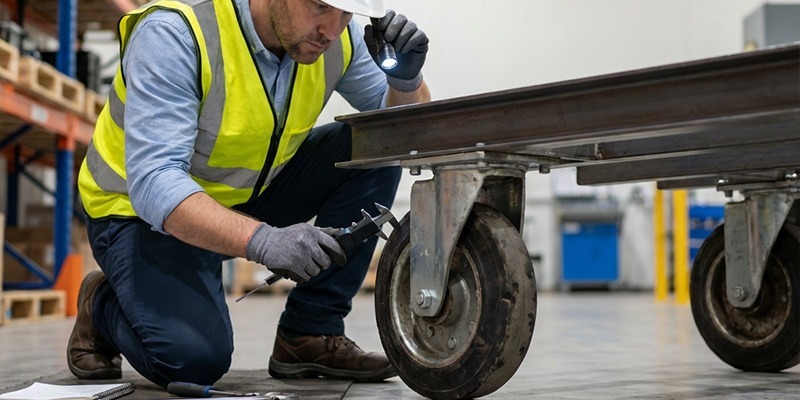
When choosing the right casters, load rating is only one factor. You also need to consider how the unit moves and where it operates.
Here are the main factors to review during caster selection-
Wheel material
Polyurethane, rubber, nylon, forged steel, and cast iron all behave differently under load. Softer materials may protect floors and roll quietly, while harder materials often handle higher loads better.
Wheel diameter
Larger wheels generally roll more easily over joints, debris, and rough flooring. A small wheel may technically meet caster weight capacity requirements but still perform poorly in motion.
Floor conditions
Smooth concrete, coated floors, expansion joints, grates, and outdoor surfaces all affect caster performance. Floor conditions can increase rolling resistance and exacerbate uneven loading.
Mounting and frame design
The best wheel in the wrong fork or mounting style will still fail. Mount type, swivel design, and bearing quality matter in high-load applications.
Real operating load
Always review how the load behaves during transport. Units with shifting contents, off-center machinery, or uneven frames need extra attention.
When choosing the right casters, the safest approach is to calculate the expected load per caster, apply a safety factor, then choose a model rated for actual movement conditions rather than ideal conditions. That leads to better caster selection and fewer surprises after installation.
Atlanta Caster provides industrial casters designed to handle uneven load conditions in demanding environments.
Common Mistakes to Avoid
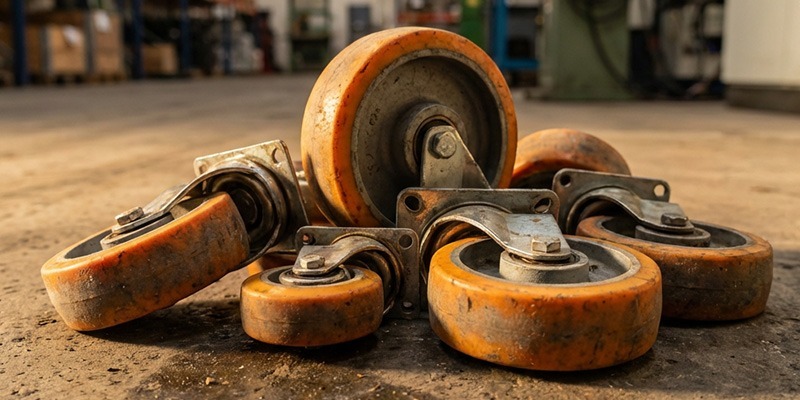
Even experienced buyers can run into trouble if they skip key checks. Here are some common issues-
- Ignoring uneven load and assuming all four casters share the load equally.
- Using only the average number from the initial load calculation without applying a safety factor.
- Focusing on static support and forgetting dynamic vs static load differences.
- Choosing commercial casters for applications that really call for heavy-duty casters.
- Selecting by wheel size or price alone without checking mounting strength and floor conditions.
- Overlooking weight distribution changes caused by turning, floor transitions, or shifting material.
- Most caster failures are not random. They usually trace back to one of these basic selection mistakes.
Practical Example Calculation
Let’s walk through a real example.
A steel cart weighs 800 pounds empty. It will carry 1,600 pounds of product, for a total working load of 2,400 pounds. It uses four casters.
Basic average load
2,400 / 4 = 600 pounds per caster
Apply the uneven load assumption
Because the product may shift slightly and the floor has minor irregularities, assume only three casters fully share the load-
2,400 / 3 = 800 pounds per caster
Apply a safety factor
For regular movement in a warehouse, use 1.25 to 1.5
- 800 × 1.25 = 1,000 pounds
- 800 × 1.5 = 1,200 pounds
The recommended caster load capacity should be at least 1,000 pounds per caster, and 1,200 pounds may be the safer choice depending on speed, floor joints, and frequency of movement.
This example shows why relying on the average alone can lead to an undersized choice. The actual caster wheel load capacity needed is far above the simple 600-pound estimate.
Wrapping Up
Getting caster load capacity right starts with good math, but it does not end there. You also need to account for uneven weight distribution, real floor conditions, movement, and safety margin. A simple average may look acceptable on paper, yet the actual load capacity required in operation can be much higher.
The safest approach is to start with a full working load, divide conservatively, apply a safety factor, and carefully consider dynamic vs. static loads. From there, compare the available casters and choose the right cones for the environment, not just the lowest-rated option that fits.
For applications involving concentrated loads, rough surfaces, or repeated movement, high-capacity caster wheels and properly specified industrial casters are often the better long-term choice.
FAQs
1. What is caster load capacity?
Caster load capacity is the maximum weight a caster can safely support under normal operating conditions. It should be evaluated based on the actual application, not just the total parked weight.
2. How do you calculate caster load capacity?
Start with the total working load, divide by the number of supporting casters, then apply a safety factor of about 1.25 to 1.5. If uneven loading is likely, use a three-caster assumption in a four-caster setup.
3. What is the difference between dynamic and static load?
Static load is the weight a caster supports while the equipment is standing still. Dynamic load includes movement, shock, turning, and rolling resistance. In most applications, dynamic conditions place more stress on the caster.
4. How does uneven weight distribution affect casters?
Uneven weight distribution can cause one or two casters to carry much more than the average share of the total load. That raises the chance of wheel damage, bearing wear, poor handling, and early failure.
5. What safety factor should be used in load calculation?
A common safety factor is 1.25 to 1.5 times the calculated load per caster. The right margin depends on speed, floor condition, and how frequently the unit moves.
6. How do I improve caster selection?
Better caster selection starts with accurate load data, then moves to floor review, wheel material choice, and application-specific movement conditions. It is also important to compare industrial, commercial, and heavy-duty casters based on actual use.
7. When are high-capacity caster wheels needed?
High-capacity caster wheels are useful when the equipment has high total weight, concentrated loads, rough floor conditions, or repeated dynamic stress that standard caster models may not handle well.
8. Why is choosing the right casters so important?
Choosing the right casters helps reduce downtime, improve operator control, protect equipment, and avoid repeated replacement costs. The wrong choice can create safety and maintenance issues even if the unit appears fine at first glance.