Email US
 Hours
Hours
 Visit Our Showroom


How to Calculate the Total Cost of Ownership for Industrial Casters
Jun 24th 2026
The initial purchase price of industrial casters represents only one part of the total cost a company will incur over the product’s service life. Installation labor, routine inspections, repairs, downtime, floor damage, replacement frequency, and worker productivity can make an inexpensive caster considerably more costly over time.
Total cost of ownership (TCO) provides operations and procurement teams with a clearer way to compare caster options. Instead of selecting products based solely on the quoted caster's price, the calculation examines every expense created from purchase through final replacement.
For manufacturers, warehouses, food-processing facilities, healthcare organizations, and distribution centers, this broader view supports more informed equipment decisions. Atlanta Caster helps companies assess loads, operating conditions, floors, speed, exposure, and maintenance demands before selecting industrial casters.
What is the Total Cost of Ownership?
Total cost of ownership is the complete expense of acquiring, installing, operating, maintaining, and replacing an asset throughout its usable life. It includes both direct expenses, such as purchasing and repair, and indirect expenses, such as downtime and reduced employee productivity.
Procurement teams use TCO because the lowest initial bid is not always the least expensive option. Two sets of caster wheels may perform the same basic function, but differences in materials, bearings, load ratings, and construction can produce very different long-term costs.
For example, inexpensive commercial casters may work well on a lightly used cart. The same products may fail quickly when installed on frequently moved material handling equipment carrying heavy loads across damaged concrete.
TCO analysis answers a more useful question than “What do these casters cost today?” It asks, “What will these casters cost the business during the entire period they remain in service?”
This distinction is important when comparing standard products with heavy duty casters, corrosion-resistant products, ergonomic designs, or application-specific mobility solutions. A higher purchase price may be justified when it results in fewer repairs, longer service life, safer movement, and less downtime.
The Five Costs Most Companies Overlook
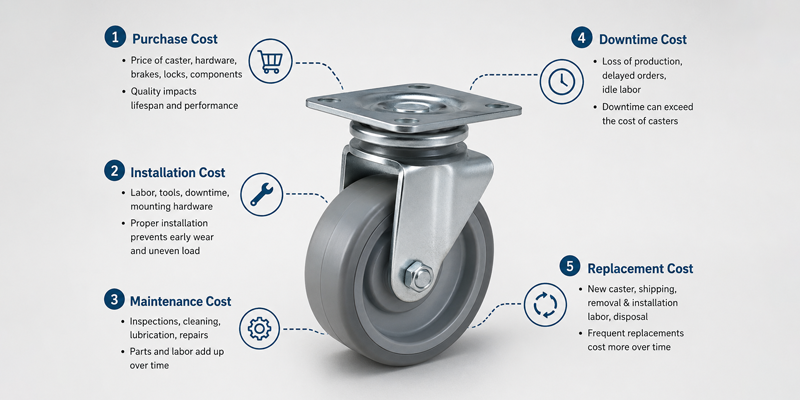
A complete TCO calculation should include expenses that occur before, during, and after caster use. The following five categories account for much of the actual cost.
1. Purchase Cost
Purchase cost is the amount paid for the original casters, mounting hardware, wheel brakes, swivel locks, and related components. This is usually the easiest expense to identify because it appears on the supplier’s invoice.
However, comparing only the purchase cost can be misleading. Differences in load rating, wheel tread, bearing design, mounting plate, and construction quality affect how long industrial caster wheels will remain usable.
2. Installation Cost
Installation expenses include employee time, equipment shutdown, tools, mounting hardware, and any frame modifications required to fit the new products.
A complicated installation may take a cart or machine out of service for several hours. Incorrect mounting can also create uneven load distribution, which may shorten wheel life and increase rolling resistance.
Installation costs should be included each time a caster is replaced, not only during the original equipment setup.
3. Maintenance Cost
Caster maintenance can include inspections, cleaning, lubrication, bearing service, fastener tightening, wheel replacement, and debris removal from axles.
Maintenance frequency often depends on the environment. Facilities with metal fragments, moisture, chemicals, extreme temperatures, or continuous operation may require more frequent servicing than clean, lightly used locations.
Maintenance costs should include replacement parts and the employee's hourly labor rate.
4. Downtime Cost
Downtime occurs when a cart, rack, workstation, or production unit cannot be used because of caster failure. The resulting expense may include interrupted production, delayed order fulfillment, idle workers, missed shipment deadlines, and emergency repair labor.
For some facilities, one hour of downtime can cost more than the original set of industrial casters. This makes downtime one of the most important elements in a TCO comparison.
5. Replacement Cost
Replacement cost includes the new product, purchasing administration, shipping, removal labor, installation labor, and disposal. Frequent caster wheel replacement can also consume maintenance capacity that could have been used for other facility needs.
Repeated replacement of low-cost casters may eventually exceed the cost of purchasing a longer-lasting system upfront.
How to Calculate the Lifecycle Cost of Industrial Casters
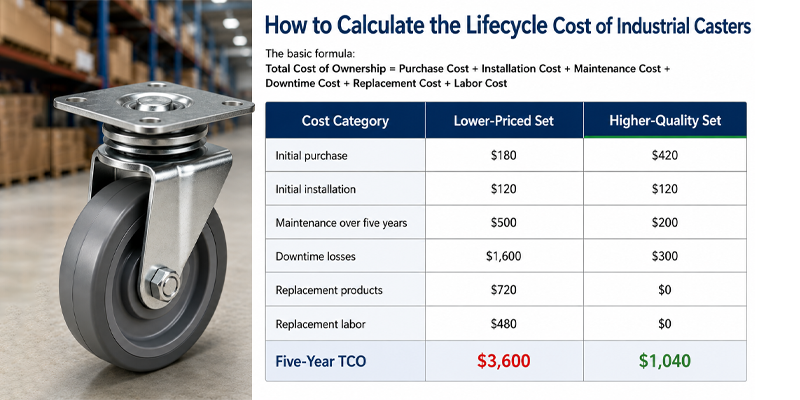
The basic formula is-
Total Cost of Ownership = Purchase Cost + Installation Cost + Maintenance Cost + Downtime Cost + Replacement Cost + Labor Cost
The calculation should cover a defined evaluation period, such as 3, 5, or 10 years. All competing products must be assessed over the same period for the comparison to be meaningful.
Consider a five-year example involving a set of four casters installed on frequently used warehouse equipment.
|
Cost Category |
Lower-Priced Set |
Higher-Quality Set |
|
Initial purchase |
$180 |
$420 |
|
Initial installation |
$120 |
$120 |
|
Maintenance over five years |
$500 |
$200 |
|
Downtime losses |
$1,600 |
$300 |
|
Replacement products |
$720 |
$0 |
|
Replacement labor |
$480 |
$0 |
|
Five-Year TCO |
$3,600 |
$1,040 |
Although the higher-quality set costs $240 more at the time of purchase, its five-year ownership cost is $2,560 lower.
To calculate downtime, multiply the number of hours the equipment is unavailable by the estimated operational cost per hour.
Downtime Cost = Downtime Hours × Cost Per Hour
If a failed caster stops a production cart for four hours and the interruption costs $350 per hour, the downtime expense is $1,400. That figure should be added to repair, replacement, and labor costs.
Companies should use their actual maintenance rates, production values, and replacement records whenever possible. Atlanta Caster can help buyers compare industrial casters based on application conditions, but each organization must apply its own operational figures to calculate a meaningful TCO.
How Caster Quality Affects Long-Term Costs
Caster quality affects service life, rolling performance, maintenance frequency, workplace safety, and the risk of unexpected failure. A durable caster is designed to withstand the actual load and environmental demands of the application rather than merely fitting the mounting pattern.
Low-priced products may use lighter mounting plates, smaller bearings, thin wheel treads, or materials that are poorly suited to the operating environment. Under frequent use, these limitations can lead to tread separation, flat spots, bearing damage, bent forks, and difficult steering.
By contrast, properly specified heavy-duty casters may feature stronger frames, better bearings, thicker wheel materials, and greater impact resistance. The higher initial expense may be recovered through longer service intervals and fewer replacements.
Suppose a $45 caster lasts 1 year, while a $110 caster lasts 4 years. Over four years, the lower-priced product requires four purchases, while the higher-priced product requires one. Before labor or downtime is considered, the products cost $180 and $110, respectively.
Quality does not mean purchasing the highest-capacity product available. An excessively hard wheel may damage floors, while an oversized caster may raise equipment to an unsuitable working height. The goal is to choose a durable caster that matches the load, floor, speed, environment, and maneuvering requirements.
The Hidden Cost of Downtime
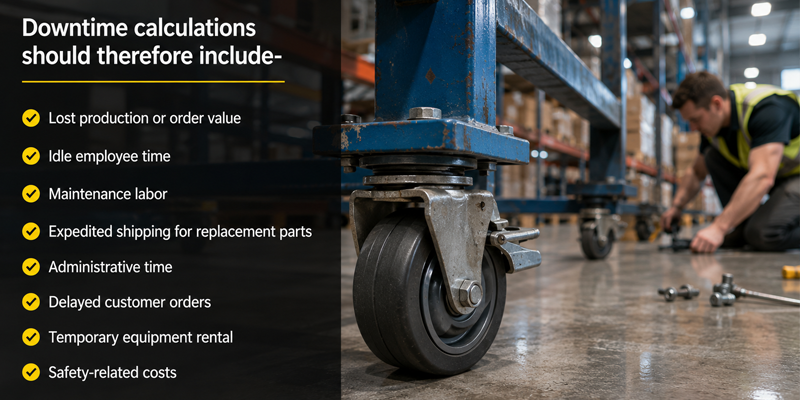
Downtime is often excluded from caster purchasing decisions because it does not appear on the product invoice. Yet it can become the largest component of ownership costs.
In manufacturing, a damaged caster may prevent components from reaching an assembly station. In a warehouse, a disabled cart may delay picking or replenishment. In distribution, equipment failure can interrupt loading schedules and cause missed carrier deadlines.
Damaged caster wheels can increase push and pull forces before complete failure occurs. Employees may move more slowly, experience greater fatigue, or struggle to control loads. This can reduce output and raise ergonomic concerns.
Downtime calculations should therefore include-
- Lost production or order value
- Idle employee time
- Maintenance labor
- Expedited shipping for replacement parts
- Administrative time
- Delayed customer orders
- Temporary equipment rental
- Safety-related costs
Atlanta Caster works with manufacturing, warehousing, healthcare, food-processing, and other operations to identify mobility solutions that suit real operating conditions. Selecting appropriate industrial casters can reduce the likelihood that a small component will interrupt a much larger process.
When Does Caster Replacement Make Financial Sense?
Replacement makes financial sense when the expected cost of continued repairs and operational disruption exceeds the cost of installing a new product.
Visible tread damage, cracks, flat spots, loose mounting hardware, excessive swivel play, bent forks, seized bearings, and persistent steering problems are common signs that replacement should be considered.
Caster wheel replacement may be sufficient when the rig, swivel section, axle, and mounting plate remain in good condition. Replacing the full caster may be more practical when structural components are damaged or when the existing product is not properly rated for the application.
Maintenance records can help establish a replacement threshold. If a caster requires repeated attention within a short period, the cost of labor and downtime may already exceed its remaining value.
Facilities should also consider replacing industrial caster wheels before complete failure when they support high-value equipment, time-sensitive processes, or safety-critical loads.
A common decision rule is to replace the product when the projected repair, downtime, and labor expenses approach 50% to 70% of the cost of a suitable new caster.
Choosing the Right Casters for Lower Ownership Costs
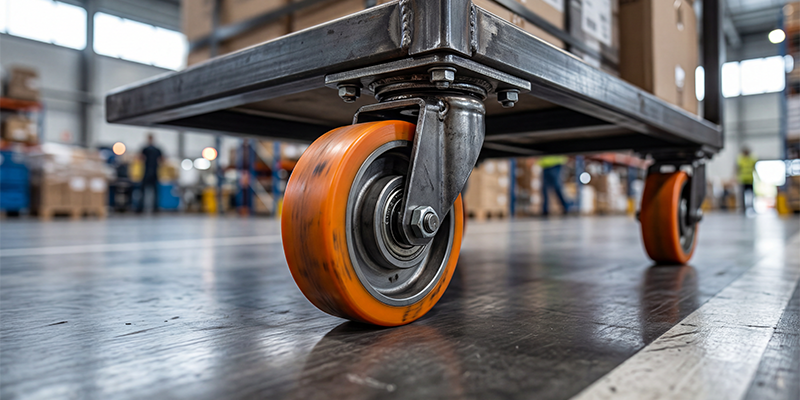
Understanding the main types of casters helps buyers select products that reduce maintenance and replacement expenses.
Swivel Casters
Swivel designs rotate around a vertical axis, allowing equipment to change direction. They are useful where carts must maneuver through tight spaces. However, poor swivel selection can cause flutter, unstable tracking, and increased push force.
Rigid Casters
Rigid casters move forward and backward but do not swivel. They support controlled tracking and are often paired with swivel units. Using the right combination can reduce steering effort and unwanted side movement.
Heavy-Duty Casters
Heavy duty casters are intended for greater loads, frequent movement, impact, or demanding industrial use. Load capacity should be calculated with a safety margin, since floors may be uneven and the weight may not remain evenly distributed.
Stainless Steel Casters
Stainless steel models are commonly considered for food processing, healthcare, washdown areas, and corrosive environments. Their corrosion resistance may reduce replacement frequency compared to ordinary steel components.
Wheel Materials
Polyurethane wheels may provide a balance of load capacity, floor protection, and quiet operation. Steel and cast-iron wheels can handle high loads but may damage floors and transmit more vibration. Phenolic wheels resist many chemicals and perform across a wide temperature range, although they may be less suitable for rough floors.
Selecting among the available types of casters requires more than checking diameter and load rating. Buyers should examine floor condition, operating temperature, moisture, chemicals, speed, noise, ergonomic demands, and exposure to debris.
Atlanta Caster helps companies compare industrial caster wheels, mounting options, materials, bearings, and accessories for various types of material-handling equipment.
Frequently Asked Questions
1. Why Is Purchase Price Only a Small Part of Industrial Caster Cost?
The purchase price excludes installation, maintenance, repairs, downtime, labor, lost productivity, and replacement frequency. Over several years, these additional expenses may far exceed the original cost of industrial casters. A TCO calculation provides a clearer picture of the cost of the casters over their usable life.
2. How Often Should Industrial Caster Wheels Be Replaced?
There is no universal replacement schedule. The service life of industrial caster wheels depends on load, travel distance, floor condition, speed, wheel material, operating environment, and maintenance. Caster wheel replacement should be considered when wheels develop cracks, flat spots, tread separation, bearing damage, or persistent rolling problems.
3. What Factors Have the Biggest Impact on Total Ownership Cost?
Downtime, replacement frequency, maintenance labor, load conditions, and product selection usually have the greatest effect. Repeated repairs or production interruptions can outweigh a low initial price for a caster. Facilities should also account for floor damage, ergonomic strain, shipping expenses, and administrative purchasing time.
4. Are Heavy-Duty Casters Worth the Higher Upfront Investment?
Heavy-duty casters can justify their higher purchase cost when equipment carries substantial loads, moves frequently, crosses rough floors, or operates in demanding conditions. A correctly specified durable caster may require fewer repairs, last longer, and reduce downtime. Overspecification, however, may add expense without improving performance.
5. How Can Caster Maintenance Reduce Operating Costs?
Regular caster maintenance can identify loose fasteners, debris, damaged treads, lubrication needs, and bearing wear before failure occurs. Routine inspections help maintain caster wheel performance, reduce push force, and allow repairs to be scheduled during planned maintenance periods rather than after an unexpected shutdown.
6. Which caster wheel materials last the Longest?
Longevity depends on the application. Polyurethane often performs well when both floor protection and load capacity are important. Steel and cast iron can withstand high loads on suitable floors. Phenolic wheels resist many chemicals and temperature conditions. The longest-lasting material is the one that is correctly matched to the load, floor, speed, and environment.
7. How Do Industrial Casters Affect Workplace Ergonomics?
The diameter, tread, bearing, swivel design, and alignment of industrial casters affect the force required to start, steer, and stop equipment. Poorly selected or damaged products can increase employee effort. Correctly specified commercial casters can support easier movement and better load control across frequently used routes.
8. What Should Buyers Evaluate Besides Casters' Price?
Besides the caster's price, buyers should compare rated capacity, expected service life, maintenance needs, wheel material, floor compatibility, bearing type, environmental resistance, replacement availability, ergonomics, and downtime risk. These factors provide a more accurate comparison than purchase cost alone.
Build Caster Decisions Around Lifecycle Value
The most economical option is not necessarily the product with the lowest invoice amount. It is the product that performs reliably at the lowest total expense during the selected evaluation period.
Companies should document purchase, installation, caster maintenance, downtime, labor, and replacement expenses for the casters already used on their equipment. These records create a practical basis for comparing future products and identifying applications where repeated failures are increasing costs.
The right selection will vary across carts, racks, workstations, dollies, and other material handling equipment. Load, floor condition, speed, environment, maneuverability, and usage frequency must all be considered.
Atlanta Caster supports buyers evaluating industrial casters, heavy-duty casters, and other industrial mobility solutions. By reviewing the complete lifecycle rather than the initial caster cost, facilities can reduce unplanned replacements, protect productivity, and make better-informed purchasing decisions.