Email US
 Hours
Hours
 Visit Our Showroom


The Role of Bearing Types in Industrial Mobility Systems
Apr 29th 2026
Industrial mobility systems are the backbone of modern manufacturing, warehousing, and logistics operations. From material handling carts to heavy equipment platforms, industrial casters enable controlled movement, reduce manual strain, and improve workflow efficiency. However, one critical component often overlooked in these systems is the role of bearing types.
Bearings are not just internal components; they directly influence how effectively a caster performs under load, how smoothly equipment moves, and how long the system lasts in demanding environments. The right caster bearings can significantly reduce rolling resistance, improve safety, and extend service life, while poor selection can lead to premature failure, downtime, and increased maintenance costs.
In high-performance mobility solutions, understanding caster bearing types, materials, and design is essential. This guide breaks down the engineering logic behind bearing selection and how it impacts real-world industrial performance.
What Are Bearings in Industrial Casters?
Bearings are mechanical components inside caster wheels that reduce friction and enable smooth rotation under load.
In industrial casters, bearings sit between the axle and the wheel, allowing movement with minimal resistance. Without proper bearings, wheels would drag rather than roll efficiently, increasing energy effort and wear.
Their importance becomes more pronounced in industrial environments where:
- Loads are heavy and dynamic
- Movement is continuous
- Conditions include dust, moisture, and impact
A well-designed caster bearing ensures consistent performance even under extreme operating conditions.
Key Caster Bearing Types Explained
Understanding different caster bearing types is essential for selecting the right system.
1. Ball Bearings
Ball bearings are the most common solution in industrial casters.
Key characteristics:
- Low friction
- Smooth and quiet operation
- Suitable for moderate to high speeds
Applications:
- Ball Bearing Casters in warehouses and carts
- Conveyor systems
- Equipment requiring frequent movement
For heavier applications, heavy duty ball bearing casters provide increased load support while maintaining smooth mobility.
2. Roller Bearings
Roller bearings are engineered for higher load capacity compared to ball bearings.
Key characteristics:
- Greater surface contact
- Better load distribution
- Ideal for handling shock impact
Applications:
- Heavy machinery
- Industrial platforms
- Rough terrain environments
They are preferred when equipment experiences sudden force changes or uneven flooring.
3. Plain Bore Bearings
Plain bore bearings are the simplest type of caster bearings.
Key characteristics:
- Low initial cost
- Minimal components
- Higher friction
Limitations:
- Require frequent maintenance
- Not ideal for continuous or high-load applications
They are typically used in light-duty types of casters where cost is prioritized over performance.
4. Precision Bearings
Precision bearings are sealed, high-performance systems designed for demanding environments.
Key characteristics:
- Sealed lubrication
- Reduced contamination
- High efficiency and durability
Applications:
- Medical equipment
- Aerospace carts
- High-precision industrial systems
These bearings are critical where reliability and consistency are non-negotiable.
Bearing Design & Engineering Factors
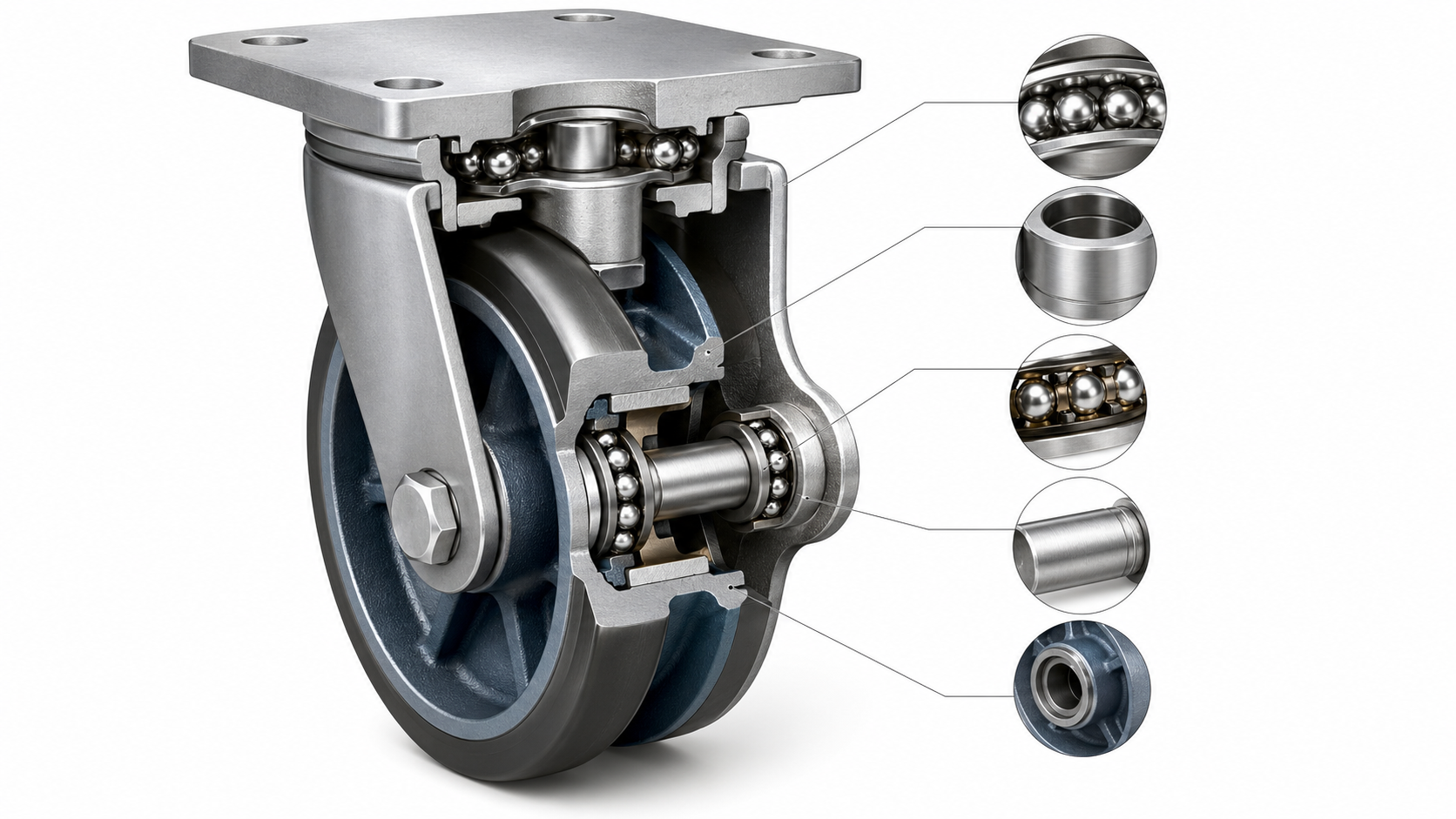
Beyond the type of bearing, the internal bearing design directly influences how a caster bearing performs under real-world conditions. Three key design elements matter most:
Raceway Geometry
The raceway is the precision-machined groove or channel in which bearing elements (balls or rollers) travel. In ball bearing casters, the depth and curvature of the raceway determine the contact angle, which affects how load is distributed between radial (side) and axial (vertical) forces. Shallow raceways favor speed; deeper raceways favor radial load capacity.
Lubrication Systems
Lubrication reduces heat generation and wear between bearing elements. Open caster bearings require periodic re-lubrication, while sealed precision bearings are factory-lubricated for their service life. In environments with extreme temperatures, water exposure, or chemical contact, the lubrication specification directly impacts bearing longevity.
Internal Clearance & Tolerance
Precision-grade caster bearing types are manufactured to tighter tolerances, meaning less play between internal components. This results in lower vibration, more consistent rolling resistance, and better performance under high-speed or high-precision requirements. For most heavy industrial applications, standard clearance is acceptable, but for sensitive equipment or automated guided vehicle (AGV) systems, a tight-tolerance bearing design is essential.
How Bearing Materials Impact Performance
The choice of bearing materials is one of the most consequential decisions in caster selection, yet it's often overlooked until a bearing fails. Different materials interact differently with load, environment, and temperature.
Steel
Chrome steel is the standard material for most industrial caster bearings. It offers an excellent balance of hardness, fatigue resistance, and cost. Standard carbon steel is used in plain bore bearing hubs for general-purpose applications.
Best for: General industrial use, dry environments, moderate to heavy loads.
Stainless Steel
Stainless steel bearing materials are required in environments with moisture, corrosive chemicals, or food-grade sanitation requirements. While slightly softer than chrome steel, stainless bearings resist oxidation and chemical degradation that would destroy standard steel bearings.
Best for: Food processing, pharmaceutical, marine, or wet floor environments.
Nylon / Composite Materials
Nylon and polymer composite bearings are non-metallic alternatives that offer corrosion immunity, electrical insulation, and ultra-quiet operation. They are commonly found in mobility solutions for healthcare, electronics manufacturing, and ESD-sensitive environments. However, load capacity and temperature tolerance are lower than those of steel alternatives.
Best for: Hospitals, cleanrooms, electronics environments, noise-sensitive applications.
Load Capacity & Shock Impact Analysis
Of all performance variables, load capacity and shock impact resistance are the two most misunderstood and misapplied factors in caster bearing selection.
Static vs. Dynamic Load
Static load refers to the weight a caster supports when stationary. Dynamic load is the weight during movement, and it is always higher than static load due to acceleration forces, floor irregularities, and inertia. Most bearing types are rated for static load at the catalog level, but real-world selection must account for dynamic load multipliers.
For example, a caster rated for 1,000 lbs static may only reliably carry 600–700 lbs in dynamic conditions, especially if the floor is uneven or the cart is frequently started and stopped. This is why heavy duty ball bearing casters are often specified with a safety factor of 1.5x to 2x the actual load.
Shock Load & Bearing Failure
Shock impact occurs when a caster encounters sudden loading events, dropping heavy items onto a cart, rolling over floor joints or ramps, or abrupt starts and stops. Roller caster bearings handle shock load better than ball bearings due to their greater contact area. However, even roller bearings can fail under repeated shock loading if not properly matched to the application.
Common failure modes from shock-related bearing damage include brinelling (surface indentation of the raceway), spalling (flaking of the raceway surface), and premature ball or roller fracture. The correct approach is to select bearing types rated for at least 150% of the expected peak shock load, not just the average operating load.
Matching Bearings with Caster Types
Different types of casters impose different mechanical demands on their bearings, and the bearing must be matched to both the caster configuration and the operational environment.
Swivel Casters
Swivel Casters rotate 360 degrees, enabling directional changes without repositioning the load. This rotation imposes lateral (thrust) forces on the bearing assembly, requiring precision bearings with adequate thrust load ratings. Choosing an undersized bearing in a swivel caster leads to premature raceway wear and loss of smooth swivel action.
Rigid Casters
Rigid casters have no swivel capability; they travel in a fixed direction. Because they don't absorb lateral forces, rigid casters typically use simpler bearing systems (including plain bore) while still requiring appropriate radial load capacity for the application.
Plate Casters
Plate Casters mount to equipment via a flat top plate, distributing load across a wider attachment area. They are commonly used in heavy-load applications and typically specify heavy duty ball bearing casters or roller bearings to handle both the vertical weight and the dynamic forces during movement.
Stem Casters
Stem Casters use a threaded or grip-ring stem for mounting, commonly seen on lighter equipment, chairs, medical carts, and retail fixtures. The bearing demands are lower than plate configurations, but precision bearings are still recommended in stem casters used in high-frequency movement environments.
Real Industrial Use Cases
Selecting the right bearing types for industrial casters isn't just a theoretical exercise; the right selection directly reduces downtime, improves worker ergonomics, and extends equipment service life.
Warehousing & Distribution
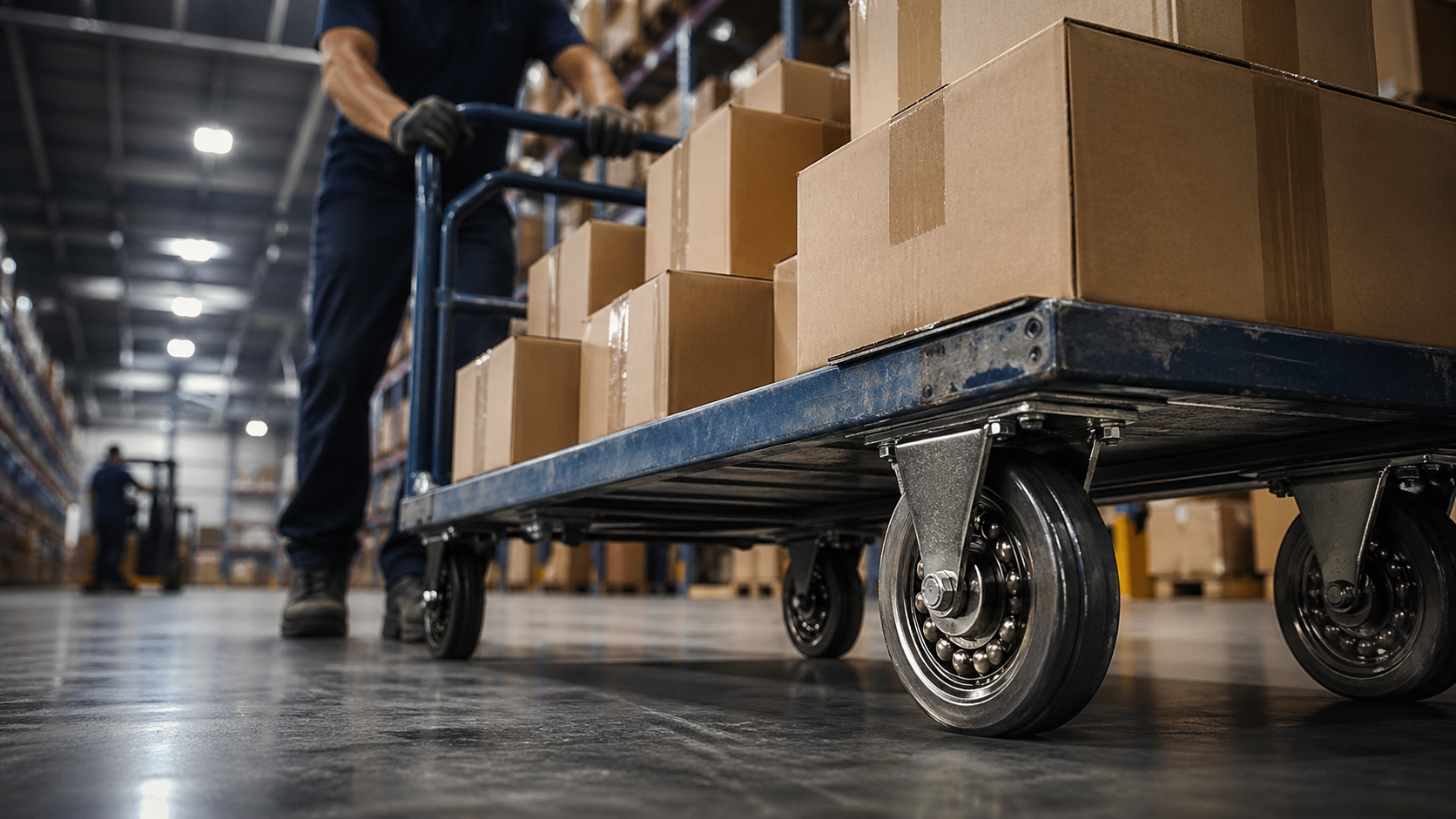
In warehouse environments, carts and shelving units are constantly in motion, often loaded near capacity. Heavy duty ball bearing casters are the standard specification due to their low rolling resistance and consistent performance under heavy dynamic loads. Improper bearing selection in this setting is one of the leading causes of caster failure and worker strain.
Manufacturing
Manufacturing floors demand caster bearings that can handle combination loads: heavy static weight during production, and repeated shock loading during repositioning. Roller bearings and sealed precision bearings are frequently specified to ensure sustained performance without maintenance interruptions during production cycles.
Healthcare
Hospital and medical facility mobility solutions prioritize quiet, effortless movement over raw load capacity. Nylon and stainless steel precision caster bearings meet the hygiene requirements and near-silent operation demands of clinical environments, while still providing reliable mobility for beds, carts, and equipment.
How to Choose the Right Caster Bearing for Your Application
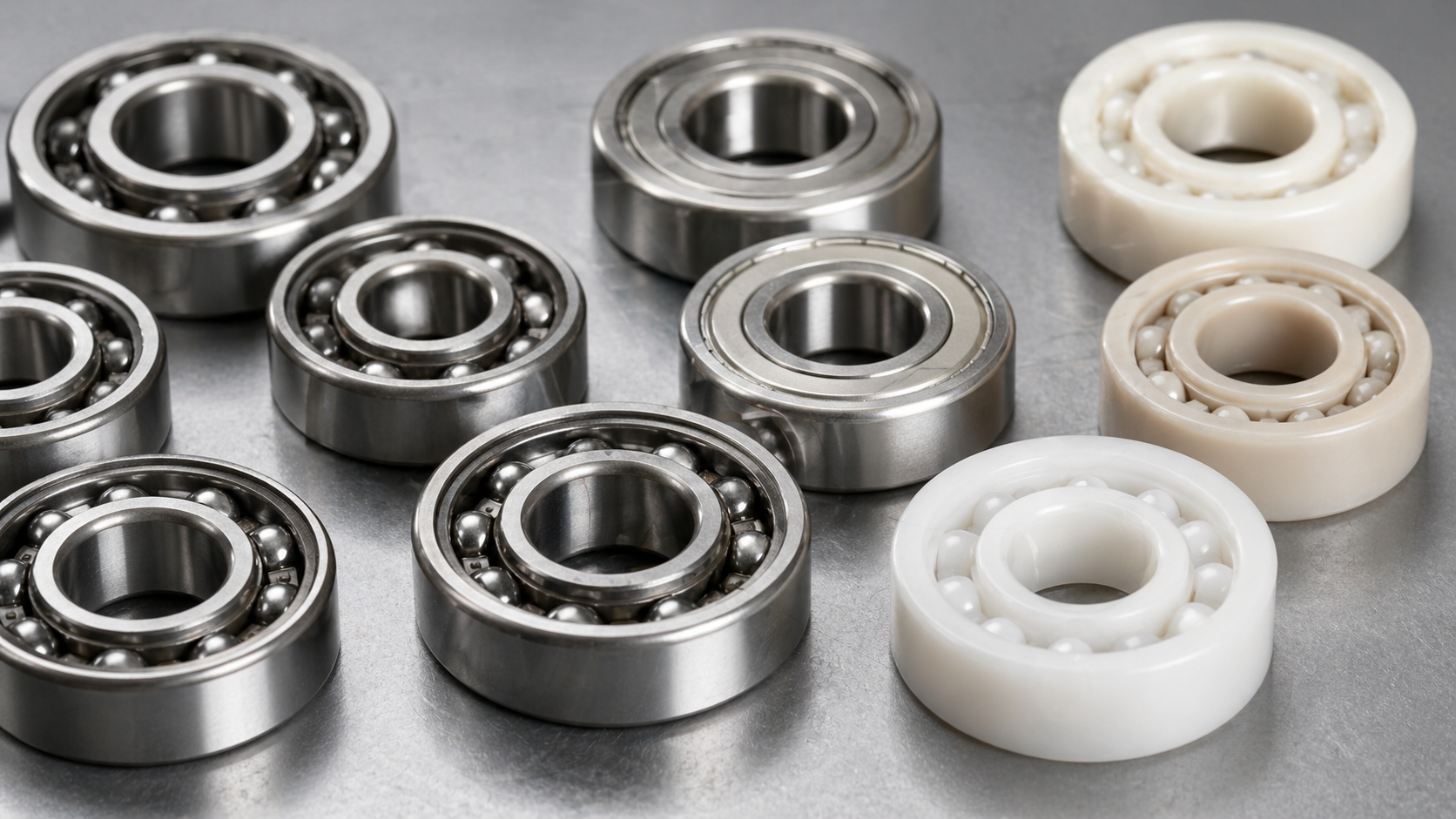
Selecting the appropriate caster bearing types requires a structured evaluation of your operating conditions. Use this decision framework:
Step 1: Define Your Load Requirements
- Calculate total load per caster (total equipment + cargo weight ÷ number of casters)
- Apply a dynamic load multiplier of 1.5x–2x for moving applications
- Account for shock impact potential (ramps, thresholds, drops)
Step 2: Evaluate the Environment
- Is there moisture, chemicals, or washdown exposure? → Stainless or sealed bearings
- Is contamination (dust, debris) a concern? → Sealed precision bearings
- Are electrical insulation or noise levels a factor? → Nylon/composite bearings
Step 3: Assess Movement Frequency & Type
- Constant movement under load → ball bearing casters for low resistance
- Heavy loads with shock events → Roller bearings for resilience
- Infrequent light-duty use → Plain bore for cost efficiency
Step 4: Match to Caster Configuration
- Swivel Casters → Precision bearings with thrust capacity
- Rigid casters → Standard or plain bore, matched to load
- Plate Casters → Heavy-duty ball or roller bearings
- Stem Casters → Precision or ball bearings for smooth rotation
Common Mistakes in Bearing Selection
Despite being a core component of industrial casters, bearings are frequently selected incorrectly, often because the selection process defaults to price rather than performance. Here are the most common errors engineers and procurement teams make:
1. Rating for Static Load Only
Using the static load rating as the only selection criterion ignores dynamic forces, shock events, and acceleration loads that can exceed static ratings by 50–100% in active operations.
2. Ignoring Dynamic Load Conditions
A bearing specified for a cart sitting still will not perform the same way in a facility where carts are pushed at a pace over floor joints and dock plates. Dynamic load capacity must be the primary specification, not a secondary consideration.
3. Wrong Bearing Material for the Environment
Using standard steel bearing materials in wet or chemically exposed environments causes accelerated corrosion and early failure. Conversely, over-specifying stainless steel in dry general-use applications adds unnecessary cost without a performance benefit.
4. Treating Bearings as an Afterthought
In many facilities, bearings are only considered after failure occurs. A proactive approach, matching bearing types to actual operating conditions before deployment, dramatically reduces unplanned maintenance, replacement costs, and operational downtime.
FAQs
1. What are the main bearing types in industrial casters?
The main bearing types include ball bearings, roller bearings, plain bore bearings, and precision bearings, each suited for different load and performance requirements.
2. Which bearing is best for heavy loads?
Roller bearings and heavy duty ball bearing casters are best for high load capacity applications.
3. How do bearings affect load capacity?
Bearings distribute weight and reduce friction, directly influencing how much load a caster can handle efficiently.
4. What is the difference between ball and roller bearings?
Ball bearings provide smoother motion with lower friction, while roller bearings offer higher load capacity and better shock resistance.
5. Are sealed bearings better?
Yes, sealed bearings protect against contamination and reduce maintenance requirements.
6. How do bearing materials impact performance?
Different bearing materials affect corrosion resistance, durability, and load tolerance.
7. What bearing is best for shock impact?
Roller bearings are typically better suited for high-impact shock environments.
8. How do I choose the right caster bearing?
Evaluate load capacity, environment, movement frequency, and maintenance needs to select the appropriate caster bearing types.
Choosing the Right Bearings for Maximum Performance
Bearings are the core of industrial mobility systems, directly impacting performance, safety, and long-term operational efficiency. The right caster bearing types determine how well your equipment handles load, movement, and daily wear in demanding environments.
The right selection directly improves:
- Load handling capability
- Movement smoothness
- Equipment lifespan
- Maintenance efficiency
In modern industrial settings, choosing the correct bearing types is not just a technical detail; it is a strategic decision that affects uptime, labor efficiency, and total cost of ownership.
If your current caster systems are experiencing resistance, premature wear, or performance issues, it may be time to reassess your bearing configuration.
Atlanta Caster offers engineered mobility solutions with a comprehensive range of caster bearing types to meet every industrial application. Whether you need heavy duty ball bearing casters for demanding warehouse environments or precision sealed bearings for sensitive facilities, the Atlanta Caster team can help you specify the right solution for your exact requirements.