Email US
 Hours
Hours
 Visit Our Showroom


Tow Line and Cart Train Configuration: Swivel, Rigid, and Tracking
Oct 6th 2026
A cart train can move perfectly on a straight path and still fail when it reaches a corner. The first cart follows the tugger, but each trailing cart follows a slightly different path. When caster configuration is not designed correctly, the last cart may cut corners, drift, or create clearance issues.
The tugger is rarely the only factor behind these problems. Cart train performance depends on the relationship between tow geometry, caster placement, steering style, and route design.
For automated material handling, the right tow line cart caster configuration helps determine whether a train tracks predictably or creates operational challenges.
How a Cart Train Actually Tracks
A cart train tracks by following the path created by the tugger, but every additional cart introduces another change in direction.
The farther a cart sits behind the tugger, the more its path differs from the vehicle ahead of it. Caster placement, tow points, cart length, and steering design control this effect.
A single cart may appear stable, while a longer train reveals tracking problems during turns. This is why cart trains must be evaluated as a complete system rather than as individual carts.
The goal is not simply to make every cart turn. The goal is to ensure the entire train follows the intended route with predictable motion.
Off-Tracking: The Number That Decides Your Aisle Width
Off-tracking is the difference between the path followed by the tugger and the path followed by each trailing cart.
During a turn, the rear carts naturally move inside the path of the cart or vehicle ahead. As more carts are added, this effect can increase. Tight corners, longer draw bars, and longer trains can create greater path variation.
For plant layouts, off-tracking determines the real space required for safe operation. Measuring aisle width based only on the tugger or first cart can create problems when the final cart approaches racks, equipment, or workstations.
Cart train design should account for:
|
Factor |
Effect on Tracking |
|---|---|
|
Train length |
More carts can increase path variation |
|
Turning radius |
Tighter turns increase cut-in |
|
Two-point location |
Changes how carts follow the lead unit |
|
Caster configuration |
Determines steering and stability behavior |
Designing around the last cart in the train and the tightest corner on the route helps prevent clearance issues.
The Four Caster Configurations for Cart Trains
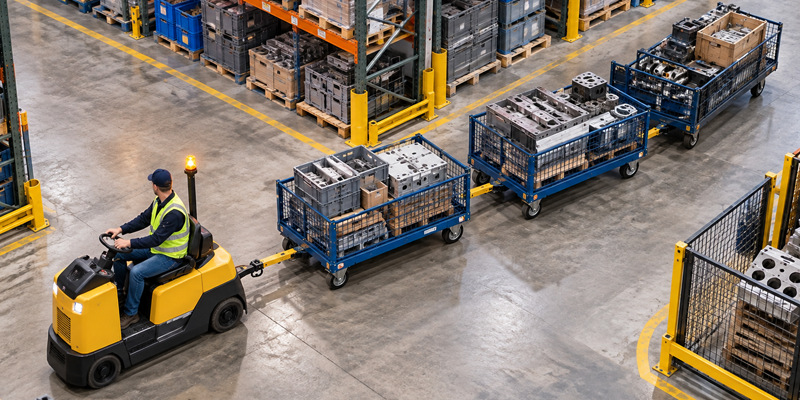
Different cart applications require different caster layouts. The correct choice depends on tracking needs, maneuverability, and operating conditions.
Two Swivel and Two Rigid Casters
This configuration is widely used because it balances cost, availability, and tracking performance.
Typically, swivel casters are placed at one end while rigid casters guide the opposite end. This arrangement helps carts maintain a straighter path while allowing controlled movement.
The trade-off is that the cart will experience more corner cut-ins than advanced steering systems.
This configuration works well for many general-purpose tugger applications where route demands are predictable.
All Swivel Casters
All-swivel configurations provide high maneuverability because every wheel can rotate freely.
However, behind a tugger, this flexibility can create tracking challenges. The cart may wander, react more quickly to changes in direction, and become harder to control during longer pulls.
All-swivel carts may work when they are frequently manually positioned and moved only short distances by a tugger.
For parked carts, locking systems can help prevent unwanted movement.
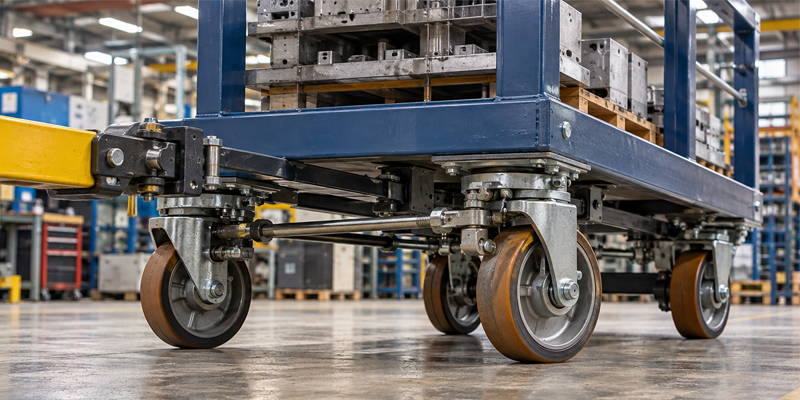
Quad Steer or Four-Wheel Steer
Quad steer systems connect the steering movement of all four corners so the cart follows the tow path more closely.
This design can reduce off-tracking and provide better control in applications requiring tight turns or narrow aisles.
The trade-off is increased mechanical complexity. More moving parts mean more components requiring inspection and maintenance.
Quad steer systems are often considered when tracking accuracy is more important than simplicity.
Fifth Wheel Steer
Fifth-wheel steer uses a steering arrangement similar to a trailer system, with a guided steering point that controls movement.
This design provides predictable handling and is commonly used for heavier cart trains.
Compared with quad steer, it generally has fewer moving parts but may allow more off-tracking during tight turns.
The right choice depends on the application, route requirements, and maintenance expectations.
What Each Steering Style Demands of the Casters
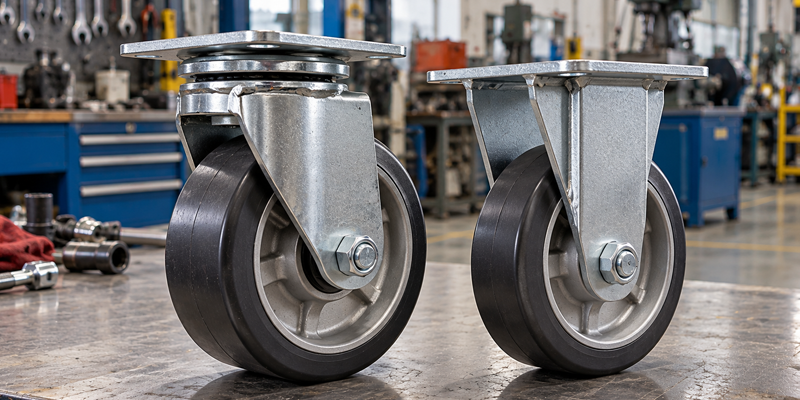
Cart builders often describe systems using terms such as quad steer, fifth wheel steer, and tracking. The caster selection must support the steering approach being used.
Each configuration creates different demands:
|
Steering Style |
Caster Considerations |
|---|---|
|
Two swivel and two rigid |
Correct alignment between rigid casters and consistent swivel behavior |
|
All swivel |
Stable swivel performance and suitable braking |
|
Quad steer |
Proper alignment, linkage maintenance, and consistent movement |
|
Fifth wheel steer |
Reliable steering components and controlled tracking |
Caster alignment is especially important in systems using rigid wheels. Misalignment can create unnecessary resistance and uneven wear.
For swivel systems, swivel lead, bearing condition, and construction quality influence how smoothly the caster follows the intended direction.
The caster does not replace a proper cart design. It works together with the steering system to create predictable movement.
Swivel Lead, Flutter, and Speed
Swivel lead is the offset between the swivel axis and the wheel contact point. This offset allows the caster to trail behind the direction of travel and naturally self-center.
At higher tugger speeds, caster behavior becomes more important. If the caster cannot maintain stable alignment, it may begin to flutter or shimmy.
Flutter is more than a noise issue. It can contribute to uneven wear, reduced tracking consistency, and instability across the cart train.
Factors that influence flutter include:
- Swivel lead design
- Wheel condition
- Bearing performance
- Operating speed
- Load distribution
Extended-lead swivel designs are used in certain towline applications that require additional stability.
Train Length, Turning Radius, and Aisle Width
Adding more carts changes how a train behaves.
Each additional cart follows a slightly different path, so route planning must account for the full train length.
Important layout considerations include:
- Longest expected train configuration
- Tightest corner on the route
- Available aisle clearance
- Location of loading and unloading points
A route that works for one cart may not work for five connected carts.
Longer draw bars can improve spacing between carts, but may also change how quickly the rear carts respond during turns.
Route design should be reviewed whenever cart numbers, layouts, or operating paths change.
When Track Guidance Beats Casters Alone
Some applications require maximum repeatability along fixed routes.
In these situations, V-groove wheels and track systems can provide controlled movement along a dedicated path. Unlike free-moving caster systems, tracked solutions reduce variation caused by steering and route conditions.
Track guidance can be useful for:
- Fixed production lines
- Heavy cart trains
- Repetitive transfer routes
- Applications requiring consistent positioning
The trade-off is reduced flexibility, as the route becomes dependent on the installed track.
Common Mistakes With Cart Train Configurations
Avoid these common design problems:
- Using all-swivel carts behind a tugger without considering tracking
- Installing swivel and rigid casters in the wrong locations
- Designing aisle space around only the first cart
- Ignoring swivel lead differences across a train
- Parking carts without proper braking systems
- Adding carts without reviewing route requirements
Small configuration decisions can create major operational differences when the train is in continuous motion.
Frequently Asked Questions
1. Should tugger cart casters be all swivel, or swivel and rigid?
Many tugger applications use a combination of swivel and rigid casters because it balances maneuverability with tracking control.
2. Why do the carts at the back of a train cut corners?
Trailing carts follow a tighter inside path during turns, creating off-tracking that increases with train length.
3. What is off-tracking, and how do I design aisle width around it?
Off-tracking is the path difference between the lead unit and trailing carts. The aisle width should accommodate the final cart.
4. What causes a cart train to jackknife?
Jackknifing can occur when cart movement becomes unstable due to poor configuration, excessive flexibility, or route conditions.
5. What is swivel lead, and why does it matter at tugger speeds?
The swivel lead allows casters to self-center. A proper lead helps maintain stable movement during towing.
6. Why do my casters flutter when the tugger speeds up?
Flutter can occur when swivel behavior becomes unstable due to design, wear, speed, or operating conditions.
7. How many carts can safely be pulled in one train?
The number depends on cart design, load, route conditions, and the tugger system requirements.
8. When should I use V-groove track wheels instead of standard casters?
V-groove systems are useful when a fixed route requires consistent tracking and repeatable movement.
Wrapping Up
Cart train performance depends on getting the geometry right before selecting components. Swivel and rigid placement, steering style, and route design all influence whether a train tracks properly.
Atlanta Caster & Equipment, Inc., based in Tucker, GA, has helped businesses solve mobility challenges since 1982. Certified Caster Specialists provide application reviews, custom configurations, and support for OEMs and industrial operations.
Share your train length, route details, and load requirements with ACE to review the right caster configuration for your application.