Email US
 Hours
Hours
 Visit Our Showroom


What Makes Casters Suitable for Oil & Gas Industry Applications?
May 13th 2026
Industrial casters play a critical role in moving heavy equipment through demanding work environments. In oil and gas facilities, the wrong caster choice can lead to equipment damage, floor wear, downtime, and safety concerns. That is why caster selection must be based on load, temperature, chemical exposure, corrosion risk, and movement requirements.
Oil and gas operations are not standard warehouse settings. Offshore rigs, refineries, chemical plants, and pipeline facilities expose industrial casters to heavy loads, vibration, impact, moisture, saltwater, heat, grease, and chemicals. Standard caster wheels may work for light-duty carts, but oil and gas applications require parts built for harsh industrial use.
Why Oil and Gas Environments Demand Specialized Casters
Oil and gas facilities place unusual stress on mobile equipment. A caster used in a clean indoor facility may fail quickly when exposed to saltwater, petroleum products, chemicals, metal debris, uneven flooring, or outdoor terrain.
In offshore environments, corrosion is a major concern. Saltwater and humidity can attack metal parts, especially when the caster frame, bearings, or fasteners are not designed for exposure. In refineries and chemical plants, the challenges may include heat, chemical spills, oils, solvents, and constant washdowns.
Heavyweight is another major factor. Pumps, tanks, valves, tool carts, skids, pipe-handling systems, and maintenance equipment can exert thousands of pounds of pressure on caster assemblies. Industrial casters must support that load without bending, cracking, locking up, or creating movement hazards.
Floor conditions also matter. Some facilities have smooth concrete. Others have grating, rough pavement, outdoor surfaces, ramps, or transition points between areas. The right caster wheels must match the terrain and the equipment's weight.
In short, oil and gas operations require equipment casters that are selected for the environment, not just the size of the cart.
Essential Features of Industrial Casters for Oil and Gas
The best industrial casters for oil and gas applications usually share several important traits. They must carry heavy loads, resist corrosion, tolerate heat, absorb shock, and continue rolling under repeated use.
High Load Capacity
Load capacity is one of the first specifications to review. Heavy duty casters are designed to support far more weight than standard models. In oil and gas facilities, this matters because equipment is often large, dense, and costly to move.
High load capacity casters can support thousands of pounds, depending on material, wheel size, mounting style, bearing type, and caster design. However, dividing the total equipment weight by 4 and assuming each caster carries an equal share is insufficient. Floors are rarely perfect, and load shifts during movement.
For safer selection, teams should account for-
- Total equipment weight
- Maximum loaded weight
- Shock loads during movement
- Uneven surfaces
- Number of casters carrying the load
- Direction of movement
- Frequency of use
Unlike standard casters, heavy duty casters are engineered for extreme loads and harsh environments. They often use thicker mounting plates, reinforced forks, stronger bearings, and larger wheels to distribute weight more safely.
When the load calculation is wrong, the result can be wheel failure, frame damage, bearing seizure, or tipping risk. That is why high load capacity casters are often required for oilfield carts, maintenance platforms, material-handling units, and heavy industrial fixtures.
Corrosion Resistance
Corrosion resistant casters are commonly used on offshore rigs, refineries, chemical processing areas, washdown zones, and outdoor pipeline facilities. These casters are built to reduce the risk of rust, surface breakdown, and part failure.
Stainless steel casters are often chosen where moisture, chemical exposure, or sanitation-style cleaning is a concern. Stainless steel resists rust better than many standard steel options, making it useful in environments where caster hardware may repeatedly be exposed to liquids.
Heat Resistance
Refineries, chemical plants, and processing areas may expose casters to elevated temperatures. In these cases, high temperature casters are necessary because ordinary wheels may soften, crack, deform, or lose strength.
A heat resistant caster is designed with materials that can tolerate higher operating temperatures. The best option depends on the temperature range, exposure time, floor condition, load, and whether chemicals are also present.
For this reason, high temperature casters should be selected using actual site conditions rather than a general product description.
Durability and Shock Resistance
Oil and gas facilities often involve vibration, impact, and repeated movement over rough surfaces. Durable casters help reduce downtime by being built to withstand frequent use in demanding conditions.
For rougher environments, teams may consider larger wheel diameters, softer wheel materials, stronger bearings, or Pneumatic Casters, depending on the use case. The goal is to protect both the equipment and the people moving it.
Best Types of Casters for Industrial Applications
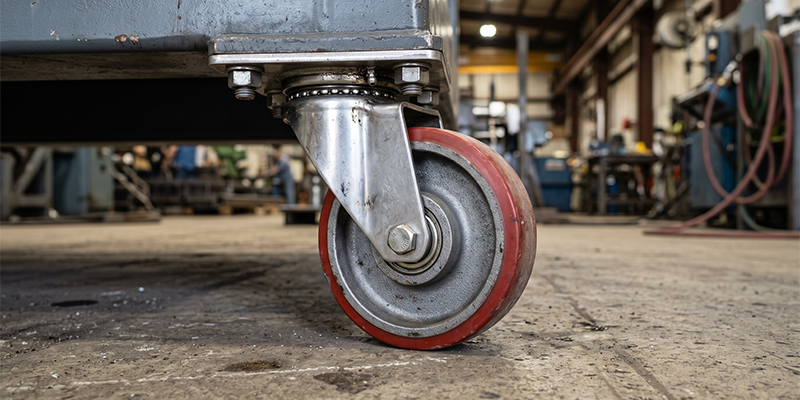
Oil and gas operations use different caster types depending on the movement pattern, surface, and load. No single caster type is best for every situation. The right choice depends on how the equipment moves and where it is used.
Swivel Casters
Swivel Casters rotate 360 degrees, allowing equipment to move in multiple directions. This makes them useful in tight spaces, maintenance areas, tool rooms, and facilities where carts need to turn frequently.
Swivel casters are commonly used when maneuverability matters. The trade-off is that too many swivel casters can reduce straight-line control. If a cart is heavy and all casters swivel, it may be harder to keep the unit tracking in one direction.
Rigid Casters
Rigid Casters move in a fixed direction. They do not rotate like swivel models. This makes them useful for straight-line movement and better directional stability.
Rigid casters are often used on equipment that moves along defined paths, long aisles, or controlled routes. They can help reduce wandering and make heavy loads easier to guide.
In many industrial setups, the best configuration uses both Swivel Casters and Rigid Casters. Swivel units provide turning ability, while rigid units help maintain direction. This combination is common for heavy carts, industrial platforms, and large mobile equipment.
Heavy Duty Casters
Heavy duty casters are built for large loads and harsh working conditions. They may include reinforced forks, thick mounting plates, precision bearings, forged steel parts, or specialized wheel materials.
In oil and gas applications, heavy duty casters are often used for-
- Pipe handling carts
- Maintenance platforms
- Tank support carts
- Valve transport
- Tooling carts
- Fabrication fixtures
- Industrial storage racks
- Skids and mobile frames
Because these applications often involve heavy loads and rough handling, durable casters are usually more cost-effective over time than light-duty parts that require frequent replacement.
Pneumatic Casters
Pneumatic Casters use air-filled wheels or cushioned wheel designs to absorb shock. They are helpful on rough terrain, outdoor surfaces, gravel, uneven floors, and areas where vibration control matters.
In oil and gas settings, Pneumatic Casters may be used for outdoor maintenance carts, pipeline facility equipment, or mobile units that travel across rough ground. They can help protect sensitive loads and reduce the force needed to move equipment across uneven surfaces.
Best Materials for Oil and Gas Casters
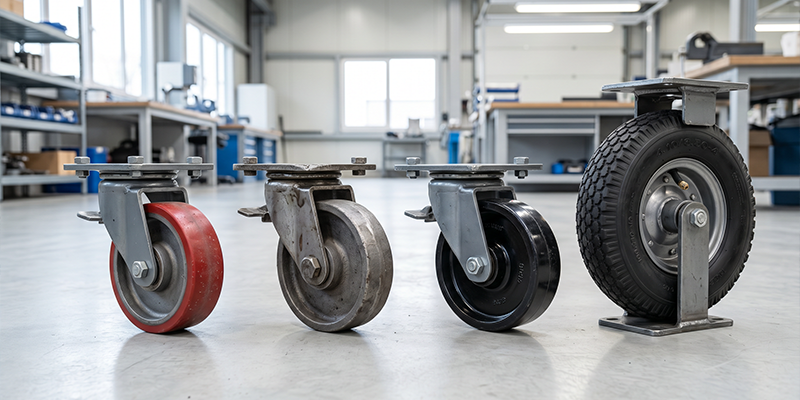
Material choice has a major effect on caster performance. The right wheel material can improve load support, floor protection, chemical resistance, heat tolerance, and rolling behavior.
Cast Iron Casters
Cast Iron Casters are known for strength, wear resistance, and high load handling. They are often used where heavy equipment must move across tough industrial floors.
For oil and gas use, Cast Iron Casters can be a strong fit when heat, heavy loads, and rough conditions are major concerns. They are less likely to flatten under load compared with some softer wheel materials.
Polyurethane Casters
Polyurethane Casters offer a useful balance between load support and floor protection. They can reduce noise compared with metal wheels and are often easier on concrete floors.
In many facilities, Polyurethane Casters are selected for their resistance to wear and smoother rolling. They may also offer resistance to certain oils, chemicals, and solvents, depending on the formulation.
For oil and gas teams, polyurethane can be a good choice when equipment must move indoors across concrete and when protecting the floor is important. However, chemical exposure and temperature range should always be checked before selection.
Phenolic Casters
Phenolic Casters are often used in industrial environments because they can handle heavy loads while resisting many chemicals, oils, and greases. They may also perform better than some softer wheels at higher temperatures.
The limitation is shock absorption. Phenolic Casters are harder than pneumatic or polyurethane options, so they may not be the best choice for rough terrain or highly uneven floors.
Pneumatic Casters
As a material and design choice, Pneumatic Casters are most valuable where cushioning is needed. They reduce shock, help with rough terrain, and make it easier to move loads over outdoor surfaces.
For oil and gas applications, they may be used where the work surface is unpredictable. However, teams should consider puncture resistance, load rating, and maintenance before using them in areas with metal fragments, sharp debris, or chemical exposure.
How to Choose the Right Equipment Casters
Choosing the right equipment casters starts with the working conditions. The caster must match the job, not just the equipment footprint.
Before buying, review these factors-
Load- Calculate the total loaded weight, not just the empty equipment weight. Add a safety margin for shock loads and uneven surfaces.
Environment- Consider saltwater, chemicals, oil, grease, heat, moisture, dust, and outdoor exposure. This will help determine whether you need corrosion resistant, stainless steel, or high temperature casters.
Floor type- Smooth concrete, grating, asphalt, gravel, and uneven flooring all require different wheel choices.
Movement pattern: If the equipment requires tight turns, consider Swivel Casters. If it moves in a straight path, Rigid Casters may offer better control.
Frequency of use- A cart moved once a month has different needs than equipment moved every shift.
Maintenance access- Bearings, axles, and swivel sections should be suitable for the facility’s maintenance schedule.
Wrong caster selection can lead to poor movement, damaged floors, worker strain, and early replacement. The right industrial casters help improve safety and reduce downtime by allowing equipment to move as it should.
Real-World Oil and Gas Use Cases
Oil and gas facilities use industrial casters across many mobile systems. On offshore rigs, corrosion resistance and load capacity are often the top concerns because equipment may be exposed to saltwater and subjected to constant movement.
In refineries, high temperature casters and chemical-resistant wheel materials may be needed near processing areas, maintenance zones, and equipment staging areas. Heat, oil, and chemical exposure can quickly shorten the life of the wrong caster.
Pipeline facilities may require heavy duty casters for outdoor carts, pipe handling systems, or mobile maintenance equipment. Where surfaces are uneven, Pneumatic Casters may help reduce shock and make movement easier.
Chemical plants often need corrosion resistant casters, stainless steel casters, or specialized wheel materials, as exposure to liquids, solvents, and cleaning agents can shorten caster life.
Atlanta Caster can support these types of industrial applications by helping buyers evaluate load, material, movement, and environmental requirements before selecting casters for equipment.
Wrapping Up
Oil and gas applications require casters that can handle more than basic movement. The best industrial casters for this field are selected for heavy loads, corrosion resistance, heat resistance, chemical contact, terrain, and movement control.
Heavy duty casters, high-load-capacity casters, corrosion-resistant casters, stainless steel casters, high-temperature casters, and specialized material options all serve different purposes. The right choice depends on the facility, the equipment, and the risks involved.
FAQs
1. What type of casters are best for oil and gas environments?
The best casters for oil and gas environments are usually heavy duty models with high load ratings, corrosion resistance, and materials suited to heat, chemicals, or rough terrain. The right choice depends on the equipment weight, work surface, exposure level, and movement pattern.
2. Why are stainless steel casters used in oil and gas facilities?
Stainless steel casters are used because they resist rust better than many standard steel options. This makes them useful on offshore rigs, in washdown areas, in chemical plants, and in other settings where moisture, saltwater, or corrosive substances may be present.
3. Are polyurethane casters suitable for chemical exposure?
Polyurethane Casters may be suitable for some chemical exposure, depending on the specific formulation and chemical type. They are often used for floor protection, quieter rolling, and wear resistance, but the exact chemical compatibility should be checked before use.
4. What is the difference between phenolic and cast-iron casters?
Phenolic Casters are often chosen for chemical resistance, load support, and resistance to oils and greases. Cast Iron Casters are usually selected for high load capacity, wear resistance, and heat tolerance.
5. How do high temperature casters perform in refineries?
High temperature casters are designed to perform in areas where ordinary wheels may soften, crack, or lose strength. In refineries, they may be used near heated equipment, processing areas, or hot floors. The correct heat-resistant caster should be selected based on the actual temperature range and exposure time.
6. When should pneumatic casters be used in industrial environments?
Pneumatic Casters should be considered when equipment moves across rough, uneven, or outdoor surfaces. They help absorb shock and reduce vibration. They are useful for pipeline facilities, outdoor maintenance carts, and areas where cushioning matters.
7. What load capacity is required for oil and gas equipment casters?
The required load capacity depends on the equipment's total loaded weight, the number of casters, the floor condition, the movement frequency, and the safety margin. High load capacity casters should be selected based on the maximum expected load, not just the empty equipment weight.
8. How do swivel and rigid casters work together in industrial setups?
Swivel Casters rotate 360 degrees, improving maneuverability. Rigid Casters stay fixed and help maintain straight-line control. Many heavy industrial carts use both types together so the equipment can turn when needed while still tracking safely during movement.