Email US
 Hours
Hours
 Visit Our Showroom


Which Handles Industrial Heat Better: Phenolic or Cast Iron Casters?
Jun 10th 2026
Industrial heat can quickly expose the wrong caster choice, especially when equipment moves through ovens, foundries, production lines, or hot storage zones. Cast iron casters and phenolic casters are both common choices for heat-resistant casters, but they behave very differently under load, temperature, impact, and floor contact. Heat resistant casters don’t all perform the same under continuous industrial heat, shock loading, and floor conditions.
Atlanta Caster supplies industrial caster wheels for manufacturing, warehousing, food processing, and heavy-duty industrial environments. This comparison will help buyers understand how each material performs across heat resistance, noise, floor impact, load capacity, and shock resistance before choosing the right casters for heat-heavy applications.
What Are Casters and Why Does Heat Matter?
A caster is a wheel-and-mount assembly designed to improve the mobility of industrial equipment, carts, racks, and machinery. When buyers ask what casters are, the simple answer is that they help equipment roll, turn, and carry loads safely across a work area. In industrial settings, the wheel material is often just as important as the bracket, bearing, or mounting plate.
|
Area |
What Buyers Should Know |
|
Basic Function |
Casters help carts, racks, machines, and equipment move safely across industrial floors. |
|
Common Types of Casters |
Rigid casters, swivel casters, locking casters, and shock-absorbing casters are widely used in industrial settings. |
|
Specialty Caster Uses |
Some caster wheels are built for heat, chemicals, washdown areas, rough floors, or heavy loads. |
|
Common Industrial Uses |
Industrial caster wheels are often used on bakery racks, drying carts, production dollies, material handling carts, oven racks, and fabrication equipment. |
|
Why Wheel Material Matters |
Caster wheel materials affect heat resistance, load handling, rolling noise, floor protection, and long-term wear. |
Heat matters because it changes how caster wheel materials respond under pressure. A wheel that works well at room temperature may soften, crack, expand, lose shape, or create more rolling resistance in hot areas. High-temperature casters are built to handle thermal exposure, but the right choice depends on the work environment. Wheel material selection should account for both operating temperature and floor conditions.
Phenolic Casters vs Cast Iron Casters
Phenolic casters and cast iron casters are both used in industrial heat applications, but they solve different problems. Cast iron casters transfer heat away from the wheel more effectively, while phenolic casters resist flat spotting and chemical exposure in many industrial environments.
Heat Resistance
Cast iron handles extreme heat better than most synthetic caster wheel materials because metal keeps its structure under severe thermal exposure. Cast iron dissipates heat rapidly because of its high thermal conductivity. This makes cast iron a strong choice where equipment rolls near ovens, furnaces, steel processing areas, and other hot production zones.
The heat capacity of cast iron is useful when the wheel must stay stable under repeated or continuous exposure. The cast iron heat capacity also helps explain why metal wheels are often used in high-temperature casters for industrial processing. Heat transfer is faster through cast iron than through phenolic material, which can be good for wheel stability but may also transfer more heat into bearings and nearby components if the caster is not specified correctly.
Phenolic casters handle moderate heat well, especially in dry heat settings. Phenolic caster wheels are often used in bakeries, food processing, and institutional applications where heat is present but not as severe as metalworking or furnace environments.
Load Capacity
For heavy loads, cast iron casters usually have the advantage. They are often used as heavy duty casters because the material resists deformation under high static and rolling loads. Load-bearing wheels made from cast iron are a strong fit for carts, fixtures, and production equipment that carry dense materials.
Phenolic casters also offer a strong caster load capacity for their weight. They are often lighter than cast iron and easier to move in many dry industrial settings. That makes them useful when a facility needs durable casters without the added weight and floor wear of metal wheels.
Shock Resistance
Shock resistance is where buyers need to be careful. Phenolic wheels can be hard and long-lasting, but they may become brittle under severe impact. Sudden drops, rough floor joints, debris, or repeated shock loads can lead to cracking or chipping.
Cast iron is rigid and strong, but that rigidity can work against it in rough environments. Cast iron casters can transmit impact rather than absorb it. In high-impact settings, shock-absorbing casters or other wheel materials may be better suited.
Noise and Floor Protection
Noise and floor wear often separate these two materials. Phenolic casters are usually quieter than cast iron and often provide better floor protection on smooth concrete. They can be a practical choice when a buyer wants noise-reducing casters for carts moving through production, food service, or institutional spaces.
Cast iron casters are louder, harder on floors, and more likely to transfer vibration through the cart. Cast iron casters handle extreme temperatures better than phenolic wheels, but create more noise and floor wear. In areas with finished concrete, tile, epoxy-coated floors, or noise-sensitive teams, that tradeoff matters.
When Phenolic Casters Perform Best
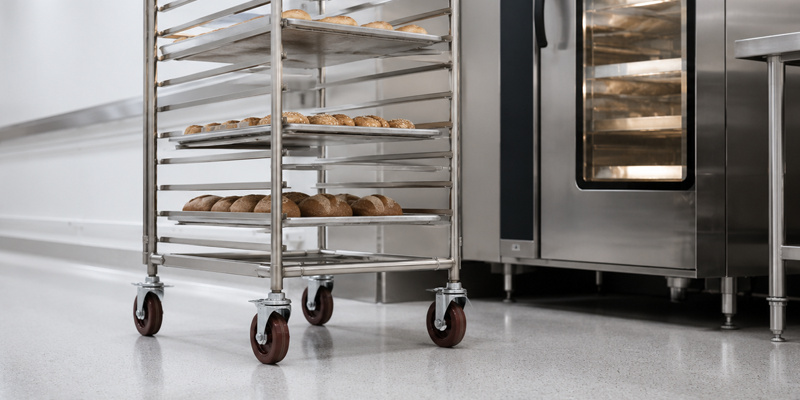
Phenolic caster wheels are made from compressed phenolic resin designed for heat and chemical resistance. The material is hard, dense, and built for industrial mobility, where moderate heat, chemical exposure, and floor protection need to be balanced.
These wheels excel in environments with operating temperatures up to 475°F. Because the composite resin does not soften under moderate heat, phenolic wheels resist flat-spotting when left stationary inside curing ovens or drying rooms. This makes them a standard selection for bakery racks, powder coating lines, and food processing operations.
In addition to heat tolerance, phenolic wheels provide excellent chemical resistance. They withstand exposure to oils, greases, fatty acids, and many industrial cleaning solvents. Unlike metal wheels, they will not rust or corrode during frequent washdown cycles. Their non-marking properties protect costly epoxy, tile, and treated concrete floors from scuffs and tracks.
Phenolic casters have clear limits. They should not be used in applications that involve frequent exposure to pooling water or high humidity, as moisture can cause some composite resins to swell and degrade over time. Their structural brittleness also makes them a poor choice for rough outdoor pavement, floor debris, or high-speed towing.
When Cast Iron Casters Are the Better Choice
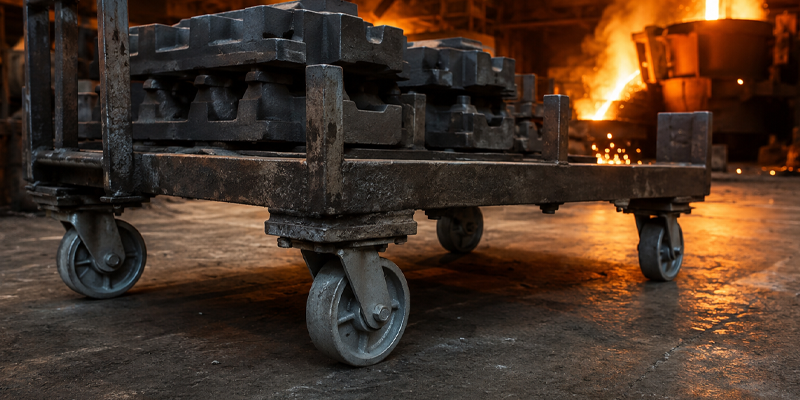
Cast iron casters are built for extreme industrial environments where temperatures exceed the limits of synthetic materials. Standard cast iron wheels can operate reliably in environments reaching 600°F and higher, making them indispensable for foundries, steel mills, forging operations, and heavy industrial baking installations.
The primary advantage of cast iron is its absolute structural integrity under extreme stress. These wheels function as high-capacity, load-bearing wheels that do not deflect, warp, or compress under multi-ton loads. If your production carts carry heavy machinery parts or raw steel through a high-heat zone, cast iron ensures the cart remains mobile.
The tradeoffs of using cast iron involve the plant floor and the acoustic environment:
- Floor Wear: Unprotected cast iron wheels concentrate immense pressure onto small contact points, which can chip concrete, destroy epoxy coatings, and create ruts over time.
- Noise Levels: Metal-on-concrete movement creates high decibel levels. In facilities focused on operator ergonomics, this noise can be an issue.
- Vibration: Solid iron provides zero shock absorption, transferring every bump and floor vibration directly to the cart frame and its payload.
Quick Comparison
The table below breaks down how these two wheel materials compare across key operational metrics.
|
Performance Metric |
Phenolic Casters |
Cast Iron Casters |
|
Maximum Temperature |
Up to 475°F |
600°F and higher |
|
Load Capacity |
High (Up to 3,000 lbs per wheel) |
Extremely High (Up to 10,000+ lbs) |
|
Floor Protection |
Excellent (Non-marking) |
Poor (Can gouge concrete) |
|
Noise Level |
Quiet to Moderate |
Loud |
|
Impact Resistance |
Moderate (Can crack under sharp shock) |
High (Resists breaking, transmits shock) |
|
Washdown/Moisture |
Fair (Avoid prolonged submersion) |
Good (Prone to surface rust if unsealed) |
Choosing the Right Casters for Industrial Heat Applications
Choosing the right casters starts with the actual work environment, not just the load rating on a spec sheet. A wheel may have enough caster load capacity on paper, but still fail early if the temperature, floor condition, or impact pattern is wrong.
Start with the operating temperature. If carts move through moderate dry heat, phenolic casters may be enough. If equipment operates near furnaces, metal processing, or extreme thermal exposure, cast iron casters are often safer.
Next, check floor conditions. Smooth concrete supports harder wheels better than cracked, uneven, or debris-filled floors. If floor protection matters, phenolic is usually easier on the surface. If the floor is already rough industrial concrete and the main concern is load under heat, cast iron may be a better match.
Impact exposure is another important factor. Neither material is ideal for severe shock. If carts drop from dock plates, hit floor joints, or carry fragile loads, shock-absorbing casters may need to be considered.
The best caster solution depends on balancing heat resistance, load capacity, floor conditions, and operational impact requirements. Industrial casters should be selected around the complete work setting, including chemicals, washdown needs, noise expectations, travel distance, and maintenance access.
Frequently Asked Questions
1. Are phenolic casters heat-resistant?
Yes, phenolic casters are highly heat-resistant and can operate reliably in continuous temperatures up to 475 degrees Fahrenheit. They are manufactured from compressed phenolic resin mixed with macerated fabric fillers, which creates a structurally stable wheel that resists melting or softening. These heat-resistant casters are ideal for medium heat industrial applications like commercial baking ovens, powder coating lines, and steam autoclaves, where floor protection is also a priority.
2. Are cast iron casters better for high temperatures?
Yes, cast iron casters are better for extreme high temperatures that exceed 500 degrees Fahrenheit. Because iron possesses exceptional thermal conductivity, it dissipates heat quickly across the entire assembly and prevents heat localization. These high-temperature casters maintain their full structural integrity at temperatures where synthetic wheels would decompose, making them the standard choice for metal foundries and steel manufacturing plants.
3. What industries use phenolic caster wheels?
Phenolic caster wheels are widely used in food processing plants, commercial bakeries, pharmaceutical labs, and institutional operations. These industries favor them because they withstand high heat and chemical washdowns without damaging floors. Their smooth rolling characteristics also help maintain clean, quiet, and efficient material handling lines while protecting expensive floor coatings from severe gouging.
4. Do cast iron casters damage floors?
Yes, cast iron casters can cause significant damage to unprotected factory floors. Due to cast iron rigidity and the heavy loads they carry, these metal wheels concentrate immense pressure on small contact areas, leading to concrete spalling, scratching, and chipping. Operating these units requires hardened industrial concrete floors or specialized protective coatings to avoid severe floor wear over time.
5. Which caster wheel material is best for industrial heat?
The best selection among caster wheel materials depends on the exact temperature profile and floor conditions of the workplace. For temperatures under 475 degrees Fahrenheit, where noise control and floor preservation matter, phenolic resin is the optimal choice. For extreme thermal loads above 500 degrees Fahrenheit combined with maximum weight demands, a cast iron or steel wheel is superior.
6. Are phenolic casters quieter than cast iron casters?
Yes, phenolic casters are quieter than cast iron wheels and function as excellent noise-reducing casters when compared directly to metal options. The composite phenolic material absorbs floor vibration and dampens sound as transport carts travel across concrete floors. Cast iron wheels generate a loud metal-on-concrete ringing sound that can increase factory noise levels beyond comfortable limits for workers.
7. What affects caster load capacity?
Several factors dictate caster load capacity, including wheel diameter, web thickness, bearing configuration, and rig construction. Heavy-duty casters use dense materials like cast iron or forged steel to maximize their load-bearing wheel capability. Operating temperatures also affect capacity, as continuous high heat can weaken composite materials and lower their safe load rating.
8. How do I choose between phenolic and cast iron casters?
When choosing the right casters, you must test your peak operating temperature, floor durability, noise tolerances, and exposure to impact. When choosing between phenolic casters and cast iron variants, select phenolic models if your facility requires floor protection and chemical resistance at moderate temperatures. Choose cast iron wheels if your industrial application involves extreme heat, high weight capacities, and automated towlines where floor wear is acceptable.