Email US
 Hours
Hours
 Visit Our Showroom



How Many Casters Do I Need for My Equipment?
Sep 28th 2026
Choosing caster count by habit can create expensive problems before the equipment reaches the floor. Too few casters can overload wheels, bearings, and mounting points; too many can raise cost, rolling resistance, and maintenance requirements. For most industrial carts, dollies, racks, machine bases, and mobile equipment, the right caster count depends on total load, frame length, center of gravity, floor conditions, and movement pattern. A sound specification starts with the application, not with whatever configuration was used last time. The goal is a stable, maneuverable platform that keeps every working caster within its rated capacity throughout normal service and expected impacts.
How Many Casters Does Equipment Need?
Most carts and equipment need four casters. Use three for light, low, centered loads; six for long or heavily loaded frames; and eight for long trailers, tow-line platforms, or very heavy equipment. That answer is only a starting point. The correct number of casters for equipment must also satisfy per-caster load requirements after derating for uneven floor contact.
- Three: stable floor contact, but a smaller tipping footprint.
- Four: the standard choice for most carts.
- Six: useful when frame length, mid-span loading, or required capacity make four impractical.
- Eight: suited to long platforms and severe-duty applications.
Always verify each caster’s rating with the expected load, safety margin, and operating conditions.
Caster Count Is Really Three Questions
A reliable caster configuration answers three separate questions. First, geometry: how many contact points does the frame need to sit securely without excessive deflection? Second, load sharing: how many of those casters can you reasonably expect to carry weight at the same time? Third, rating: what minimum capacity must each load-bearing caster provide? These questions are related but not interchangeable. A cart can have six casters and still overload three of them if the frame or floor prevents the others from making proper contact. Treat weight distribution, frame rigidity, floor variation, and caster rating as one system. That approach prevents a simple capacity calculation from hiding a layout problem.
Why Four Casters Is the Default - and When Three Works
The Four-Caster Standard
Four casters suit most industrial carts because the layout is simple, predictable, and easy to service. It supports a rectangular frame, allows for practical brake placement, and works with widely available casters within its weight capacity. The important limitation is floor contact. On a rigid frame moving across a real industrial floor, all four wheels rarely share the load equally. One corner may carry less, while the other three carry more. That uneven contact is why caster count alone never proves that a cart is correctly rated.
When Three Casters Are Legitimate
Three casters define a stable plane, so all three contact the floor, eliminating rocking. The trade-off is a smaller stability triangle. A high, offset, or shifting load can tip more easily than the same load on a four-caster footprint. Brake placement is also less convenient. Three casters fit light, low, centered industrial loads.
The Rule That Changes the Math: Assume One Caster Isn’t Working
On a rigid frame over an uneven floor, one caster may carry little or no load at a given moment. Dividing the total weight by every caster can therefore understate the demand on the casters still carrying the equipment. A common planning rule is N-1: divide the total load by one fewer than the installed caster count. For longer frames or layouts with many casters, floor variation and frame deflection can leave two casters lightly loaded or clear of the floor, so that an N-2 basis may be appropriate. After that calculation, apply the safety factor approved for the application, especially where motion, impacts, thresholds, or towing create dynamic loads.
|
Method |
Calculation |
Result |
Meaning |
|
Naive divide-by-N |
1,200 lb ÷ 4 |
300 lb |
Assumes all four share evenly |
|
N-1 basis |
1,200 lb ÷ 3 |
400 lb |
Plans for one reduced contact point |
|
Illustrative 1.25× margin |
400 lb × 1.25 |
500 lb |
Shows required per-caster rating before final selection |
The example is illustrative, not a universal design factor. For uneven loads, dynamic conditions, and application-specific safety margins, use Atlanta Caster’s full caster load capacity calculation before selecting hardware or mounts.
When to Move to Six or Eight Casters
Six Casters: Long Frames and Heavy Loads
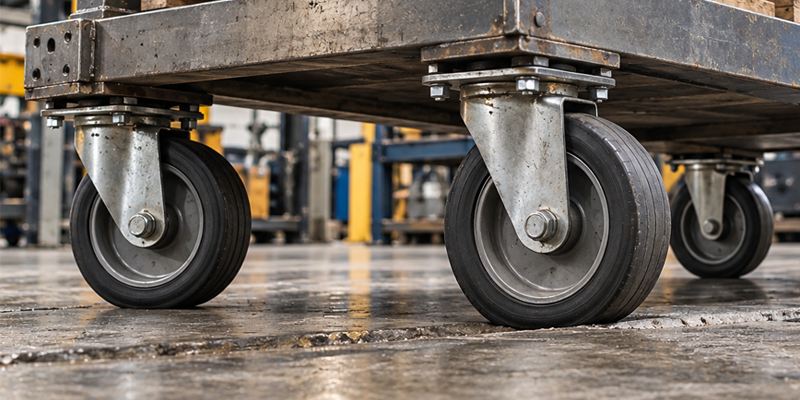
Six casters make sense when a frame is long enough to deflect between its ends, when the load is concentrated near the middle, or when four casters would require impractical individual ratings. They can also add redundancy for critical loads. However, six casters help only when the center pair actually carries weight. A center-drop layout sets the middle casters slightly lower or uses larger-diameter casters so they engage the floor. A rocker or equalizing frame can also share the load. Six casters of the same height on a very rigid frame may leave the center pair floating and ineffective.
Eight Casters and Beyond
Use eight casters for long platform trailers, tow-line equipment, and very heavy mobile bases where frame length and service conditions justify more contact points. Plan conservatively for a possible two-caster lift-off on long frames. More wheels also mean more rolling resistance, maintenance points, and alignment sensitivity. In some cases, a larger wheel diameter is a better answer than simply adding more casters.
|
Layout |
Best fit |
Benefit |
Trade-off |
|
Three |
Light low loads |
Constant contact |
Smaller footprint |
|
Four |
Most carts |
Simple layout |
Uneven sharing |
|
Six-diamond |
Long frames |
Mid-span support |
Needs equalization |
|
Eight |
Heavy tow-line trailers |
Redundancy and support |
More resistance and maintenance |
Does Adding More Casters Increase Capacity Proportionally?
No. Adding more casters does not increase usable capacity in direct proportion on a rigid frame. Moving from four to six does not automatically provide 50% more working capacity because the extra pair can carry only the load that frame geometry and floor contact allow. What additional casters reliably provide is redundancy, reduced frame deflection, and a larger support pattern. Capacity scales more predictably when the layout actively equalizes load through center-drop, rocker, sprung, or similar arrangements. A sufficiently stiff frame on a controlled flat surface can also improve contact, but industrial floors rarely remain perfect. That is why the question "Does adding casters increase capacity?" has a qualified answer: more casters create potential capacity, not guaranteed equal sharing. Keep the planning basis conservative with N-1 or, on appropriate long frames, N-2.
Where the Swivel and Rigid Casters Go
Caster count solves only half the mobility problem. The placement of swivels and rigid casters determines whether equipment turns cleanly, tracks straight, or wanders in an aisle. For most manually pushed carts, use two swivel casters at the push end and two rigid casters at the far end. This arrangement gives steering at the operator end and directional tracking ahead. An all-swivel layout provides excellent maneuverability in tight spaces, but uses total-lock brakes that lock both wheel rotation and swivel action when the cart must stay put. In a 6-caster diamond configuration, place swivel casters at the corners and rigid casters at the center. For an eight-caster layout, place swivel casters at the ends and rigid casters through the middle. For towed equipment, the specified pattern should keep the swivel end leading and the rigid end trailing to reduce the risk of jackknifing. On four-caster carts, diagonal brake placement can help secure opposite corners. See swivel vs. rigid.
Stability: Center of Gravity, Track Width, and Tipping
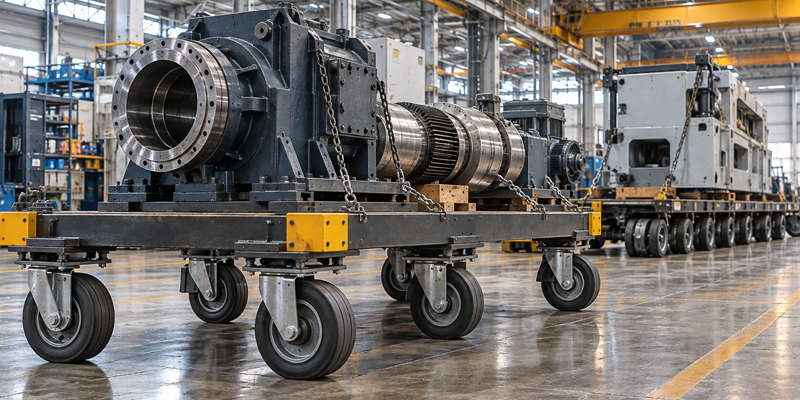
Caster capacity cannot correct a tipping problem. The center of gravity and track width determine whether the load stays within the support footprint as the cart turns, stops, or crosses an irregular floor. A tall or top-heavy load usually needs wider caster-to-caster spacing, not simply a higher wheel rating. Adding casters along the length of a cart may support the frame, but it does little to prevent side-to-side tipping if the track width remains unchanged. Offset loads and concentrated point loads can also shrink the effective stability margin by moving the combined load center toward an edge. When load height cannot be reduced, a wider frame or a properly designed outrigger position helps.
Common Mistakes in Caster Count and Layout
The most common caster mistakes come from treating count as a substitute for layout engineering:
- Dividing the total weight by every installed caster instead of using a conservative contact assumption.
- Assuming six casters provide 50% more usable capacity than four.
- Mounting center casters at equal height on a rigid frame, where they may float.
- Choosing all-swivel layouts without reliable total-lock brakes.
- Reversing the intended swivel-and-rigid pattern on towed equipment increases the risk of jackknifing.
- Adding casters to solve tipping when a wider track is the real fix.
These errors cause wear, poor handling, or instability.
What Caster Count Means for Maintenance
Every caster is also an inspection point, bearing set, wheel tread, and mounting location. An eight-caster platform can therefore carry roughly twice as many routine service points as a comparable four-caster platform. Uneven wear is useful field evidence: if one caster wears much faster than the rest, the frame or layout may be loading it disproportionately. Replace worn components in matched groups as needed so that wheel diameter differences do not cause the frame to become out of level. Count changes suggest respecification.
Choose the Right Caster Count for the Application
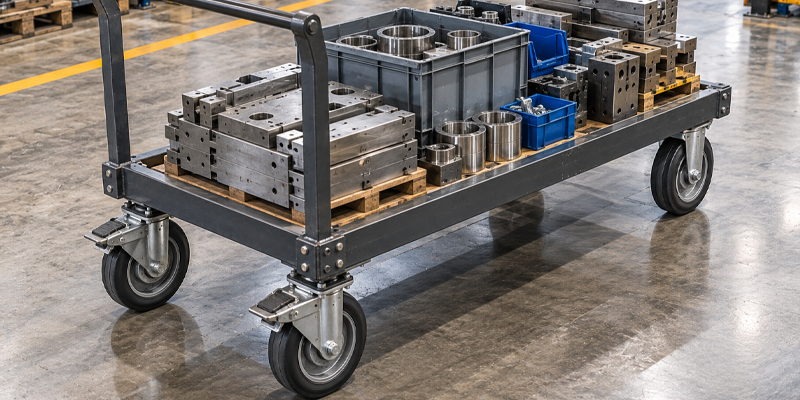
Start with total load, frame geometry, floor conditions, and movement pattern, not the count used on the last cart. Size each working caster conservatively with N-1 or, where appropriate, N-2, then apply the approved safety factor and choose the correct swivel-and-rigid layout. Since 1982, Atlanta Caster has supported OEMs and plants with Certified Caster Specialists, onsite analysis, and custom configurations. Send your application details today.
Frequently Asked Questions
1. How many casters does a cart need?
Most equipment uses four casters, with six or eight reserved for longer or heavier applications.
2. Is caster weight capacity rated per caster or for the whole set?
Capacity is normally stated per caster; calculate the required per-caster rating from the total applied load.
3. Why do most carts use four casters instead of three?
Four provides a wider rectangular footprint, while three creates a smaller triangle around the load.
4. When should I use six or eight casters instead of four?
Use six for long frames or heavy loads; use eight for severe-duty platforms and trailers.
5. Does adding more casters increase total capacity proportionally?
No. Extra casters can provide additional support, but capacity depends on actual contact and load sharing.
6. Should all casters be swivel, or a mix of swivel and rigid?
Use two swivels and two rigid for many carts; all-swivel layouts need dependable locking control.
7. What happens if I use too few casters for the load?
Too few casters can overload the wheels, shorten service life, damage the mounts, and increase the risk of failure.
8. How much safety margin should I add above my equipment’s actual weight?
Apply the safety factor approved for your application after first using the correct load-sharing basis.