Email US
 Hours
Hours
 Visit Our Showroom


How to Reduce Operator Push Force in Manufacturing Facilities
Sep 30th 2026
Manufacturing teams often notice the problem before they measure it: operators ask for help moving carts, production slows at aisle transitions, or workers report shoulder and back strain. Push force is not just an operator complaint. It is a measurable factor that can affect productivity, safety, and daily material handling performance.
However, plants can reduce operator effort through targeted improvements. Measuring the problem first, selecting the right equipment changes, and maintaining carts over time can create lasting improvements without replacing an entire fleet.
What Push Force Actually Is (and Why There Are Two Numbers)
Push force is the horizontal force an operator applies to move a loaded cart. It is usually measured in pounds of force and indicates how much effort is required to move the material.
There are two important measurements: initial force and sustained force. Initial force, also called breakaway force, is the effort required to start a stationary cart moving. Sustained force is the effort required to keep the cart rolling once motion begins.
Initial force is usually higher because the operator must overcome static resistance. Sustained force is affected by factors such as rolling resistance, wheel material, bearing condition, floor surfaces, and load distribution.
A cart that is difficult to start moving may need a different solution than a cart that requires constant effort while traveling through a facility.
What Force Threshold Should You Be Under?
OSHA does not publish a specific numeric limit for cart push or pull force. Instead, OSHA addresses ergonomic hazards through the General Duty Clause and recognizes established ergonomic guidance from organizations such as NIOSH and Liberty Mutual’s Snook tables.
The acceptable force level depends on several conditions, including the percentage of workers being protected, push distance, frequency, handle height, and the direction of movement. A force level acceptable for one workforce may not be suitable for another.
Manufacturing facilities should use recognized ergonomic assessment methods and measure actual cart conditions rather than relying on a single universal number. The goal is to identify excessive effort, reduce risk factors, and create a safer material handling process.
Measure Before You Change Anything
Before replacing casters or redesigning carts, establish a baseline measurement. A force gauge or push-pull dynamometer provides a repeatable method for measuring the effort required to move equipment.
Follow these steps:
- Test the cart at its normal operating load, not empty.
- Measure at the actual operator handle height.
- Test on the real production route, including rough areas, transitions, and dock plates.
- Record both breakaway and sustained force.
- Repeat several times and document the results.
The testing location matters. A cart that performs well on smooth epoxy flooring may require significantly more effort when crossing expansion joints, worn concrete, or uneven surfaces.
Record the cart type, load, floor conditions, wheel condition, and test date. This information allows teams to verify whether a change actually improved performance.
The Levers, Ranked by How Much They Move the Number
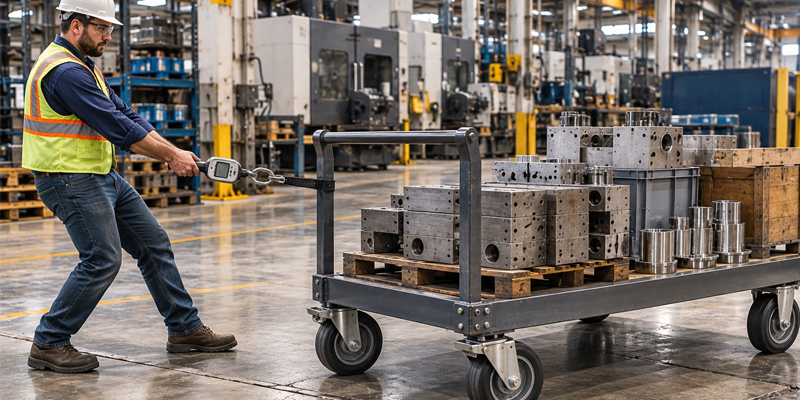
Reducing operator push force usually isn't about a single upgrade. Several factors influence performance, but some changes provide greater improvement than others.
1. Wheel Diameter
Increasing caster wheel diameter is often one of the most effective ways to reduce resistance. Larger wheels roll over floor imperfections more easily and require less effort when crossing joints or uneven surfaces.
A larger wheel can reduce the effort required to start and maintain movement, but available mounting height and equipment design may limit the increase in size.
2. Bearing Type
Bearing selection has a major effect on rolling performance. Plain bore designs typically create more resistance than ball-bearing or precision-bearing options.
A precision-sealed bearing can reduce rolling resistance and maintain smoother operation over time. Bearing selection should also consider the environment because contamination from dust, coolant, or debris can affect performance.
3. Wheel Material and Durometer
Wheel material influences the balance between rolling ease, floor protection, noise, and durability.
Harder materials generally deform less under load and can roll more easily. Softer materials protect floors and reduce noise but may require more effort because of greater tread deflection.
Common choices include polyurethane casters, thermoplastic rubber, nylon, phenolic, and other industrial wheel materials. The correct choice depends on the floor surface and operating conditions.
4. Swivel Design
Swivel resistance can significantly affect the force required to move and turn a cart. A swivel caster must rotate smoothly before the cart can change direction.
Kingpinless casters provide a durable swivel design with reduced maintenance requirements compared with some traditional designs. They can be valuable in applications where carts experience frequent turning, heavy loads, or continuous use.
5. Floor Condition
Floor conditions often receive less attention than caster selection, but they can have a major impact on performance.
Expansion joints, damaged concrete, debris, and worn surfaces increase resistance. A facility may spend money upgrading casters while leaving the actual route conditions unchanged.
Improving floor transitions, removing debris, and maintaining travel paths can reduce effort without changing the cart.
6. Cart Design and Load Distribution
The cart itself also affects movement. Excessive loads, poor handle height, uneven weight distribution, and incorrect caster placement can increase required force.
A caster upgrade cannot fully correct a cart that is overloaded or poorly designed.
What to Change First: Sequencing the Fix
The most effective push-force reduction strategy begins with the measurement results. Not every cart requires the same solution, and replacing every caster in a facility is rarely the most practical first step.
If the initial force is high but the sustained force is acceptable, focus on factors that affect the start of movement. These include swivel resistance, wheel diameter, and the surface where the cart begins moving.
If sustained force remains high after the cart starts rolling, inspect bearing condition, wheel material, tread wear, and floor conditions.
If both initial and sustained force are high, review the entire cart application. The equipment may be using the wrong caster rating, wheel type, or configuration for the load.
If force changes significantly between areas of the facility, the floor may be the primary issue. A caster upgrade cannot fully correct damaged joints, uneven surfaces, or poor travel paths.
A practical improvement process follows four steps:
- Measure the current push force.
- Identify the highest-impact correction.
- Test the change on a representative cart.
- Measure again before applying the solution across the fleet.
A pilot program allows manufacturing teams to confirm results before investing in large-scale changes. It also creates documented evidence for safety teams and management.
Why Push Force Creeps Back Up Over Time
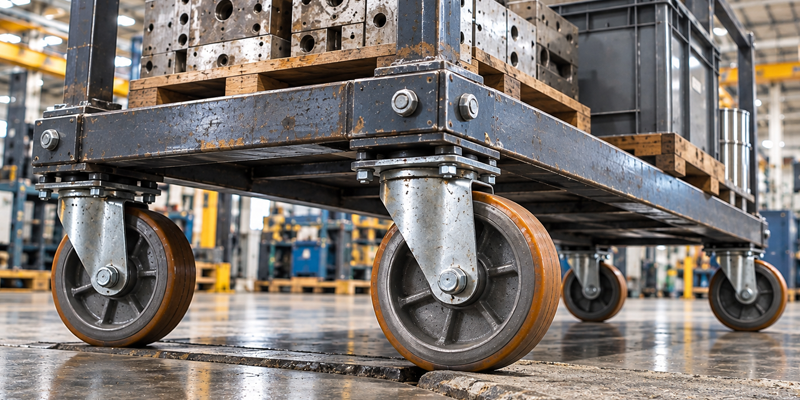
A cart that performs well when new may require significantly more effort after months or years of service. Rolling resistance changes as components wear and operating conditions change.
Several factors contribute to increasing push force over time:
- Flat spotting: Carts parked under heavy loads for long time can develop flat spots on the wheels, increasing resistance when movement begins.
- Wheel wear: As tread surfaces change, the contact area between the wheel and floor can increase, requiring more effort.
- Bearing contamination: Manufacturing environments often expose casters to swarf, coolant, dust, and debris that can affect bearing performance.
- Swivel raceway buildup: Dirt and contaminants can restrict swivel movement and increase turning resistance.
- Floor degradation: Worn coatings, damaged concrete, and developing floor gaps can create additional obstacles.
The result is often gradual. Operators may adapt by pushing harder, asking for assistance, or changing how they move carts without reporting the underlying problem.
One important warning sign is when a cart that previously moved easily becomes a two-person push. This indicates that the equipment should be inspected and measured again.
Regular inspections aid in detecting problems before they affect productivity or create ergonomic concerns. A maintenance program should include wheel condition, bearing movement, swivel operation, mounting hardware, and route conditions.
Which Carts to Fix First
Many manufacturing facilities operate hundreds of carts across multiple departments. Correcting every cart at once may not be realistic, so a prioritization process is important.
Start by identifying carts with the greatest impact:
- Carts are used frequently throughout each shift
- Equipment moved over long distances
- Carts carrying heavy or valuable materials
- Areas where operators report discomfort or difficulty
- Carts that already require two people to move
A fleet review should consider both frequency and severity. A lightweight cart used dozens of times each day may create more ergonomic exposure than a heavier cart used occasionally.
Measure a representative sample of carts rather than selecting a single example. Similar carts often share the same design, caster type, and operating conditions.
Once a successful improvement is identified, standardizing the solution across a cart family can reduce maintenance complexity and simplify future purchasing decisions.
Common Mistakes When Reducing Push Force
Facilities often spend money on improvements that do not address the actual cause. Common mistakes include:
- Replace casters before measuring the current push force.
- Testing empty carts instead of normal operating loads.
- Measuring only on smooth floors instead of actual travel routes.
- Changing wheel material without considering floor conditions.
- Upgrading wheel bearings while ignoring swivel resistance.
- Treating push force as a one-time specification instead of an ongoing maintenance factor.
A successful program combines measurement, proper caster selection, and continued inspection.
Choose a Long-Term Approach to Cart Mobility
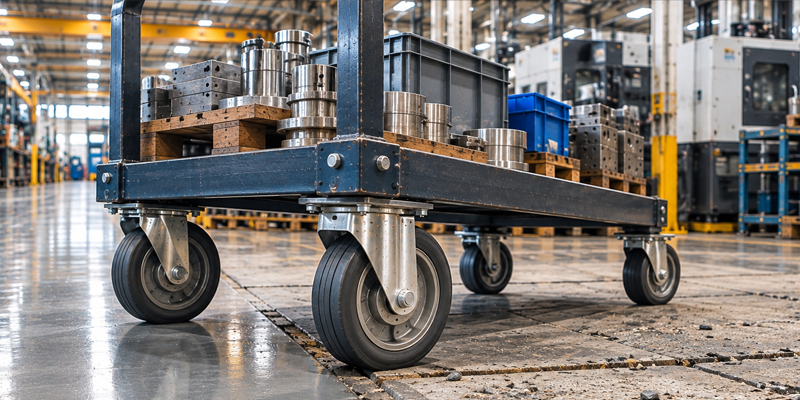
Reducing operator effort requires more than selecting a new wheel or caster. The most effective approach combines measurement, targeted improvements, and ongoing maintenance.
Start by identifying current push force levels. Determine whether the primary issue involves starting movement, maintaining movement, floor conditions, or equipment design. Then test improvements before applying them across the entire fleet.
Atlanta Caster supports manufacturing facilities with application guidance, ergonomic casters, custom solutions, and onsite analysis from Certified Caster Specialists. Since 1982, Atlanta Caster has helped companies improve equipment mobility with solutions designed around their operating conditions.
Contact Atlanta Caster to review your cart application, operating environment, and mobility challenges.
Frequently Asked Questions
1. What is push force, and how is it different from pull force?
Push force is the effort required to move a cart by pushing, while pull force is the effort required to move the same cart by pulling.
2. What is the difference between initial and sustained push force?
Initial force measures the effort needed to start movement, while sustained force measures the effort needed to keep a cart moving.
3. Does OSHA set a maximum push force for carts?
OSHA does not set one universal numeric push force limit. Facilities use recognized ergonomic guidance to evaluate acceptable operating conditions.
4. How do I measure the push force of a cart in my facility?
Use a calibrated force gauge on a normally loaded cart and test it on the actual route operators use to move the equipment.
5. Do larger caster wheels reduce push force?
Yes, larger wheels often reduce effort because they roll over surface irregularities more easily and reduce resistance from floor transitions.
6. Which bearing type gives the lowest rolling resistance?
Precision-sealed bearings generally provide smoother movement than plain-bore designs when properly selected for the application.
7. Which wheel material has the lowest rolling resistance?
The best material depends on the floor, load, and operating environment. Harder materials often roll easily, while softer materials provide floor protection.
8. Can kingpinless casters reduce the force needed to start a cart moving?
Yes, kingpinless casters can reduce swivel resistance and provide reliable performance in demanding manufacturing environments.
9. How much does floor condition affect push force?
Floor condition can significantly affect effort, as joints, debris, and uneven surfaces increase resistance to movement.
10. Why has my cart become harder to push over time?
Wear, contamination, flat spotting, damaged floors, and changes in caster condition can gradually increase the required push force.