Email US
 Hours
 Visit Our Showroom


Sliding Gate Wheels: How to Choose V-Groove Wheels for Rolling Gates
Oct 16th 2026
Sliding gate wheels are grooved metal wheels that support a gate and help it move along a fixed track. They sit beneath the gate frame, allowing heavy gates to roll open and closed while maintaining a straight path.
For warehouses, manufacturing facilities, and commercial properties, choosing the right rolling gate wheels helps prevent premature wear, uneven movement, and costly repairs.
In this guide, we'll explain how gate rollers work, what affects their weight capacity, and how to select V-groove gate wheels for your application.
This guide covers track-guided sliding and rolling gates, not swing gates.
What Are Sliding Gate Wheels Used For?
Sliding gate wheels support gates that move horizontally along a ground-mounted track. They carry the gate's weight and help maintain alignment during opening and closing.
Common applications include:
- Industrial facilities: Rolling security gates that control vehicle and personnel access.
- Warehouses: Heavy sliding gates at entrances, loading areas, and storage yards.
- Manufacturing plants: Track-guided gates separating production and restricted areas.
- Commercial properties: Perimeter gates protecting parking lots, equipment, and outdoor storage.
- Interior facilities: Heavy rolling gates and doors operating along floor-mounted tracks.
Facilities that operate gates several times daily need wheels capable of handling repeated movement and changing loads.
At Atlanta Caster & Equipment, we supply industrial wheels for demanding material-handling applications. Our warehouse and distribution casters, as well as manufacturing casters, support related facility needs.
For track-guided gates, proper wheel selection begins with matching the wheel to the gate's weight, track, and operating conditions.
How Sliding Gate Wheels Work on a V-Track
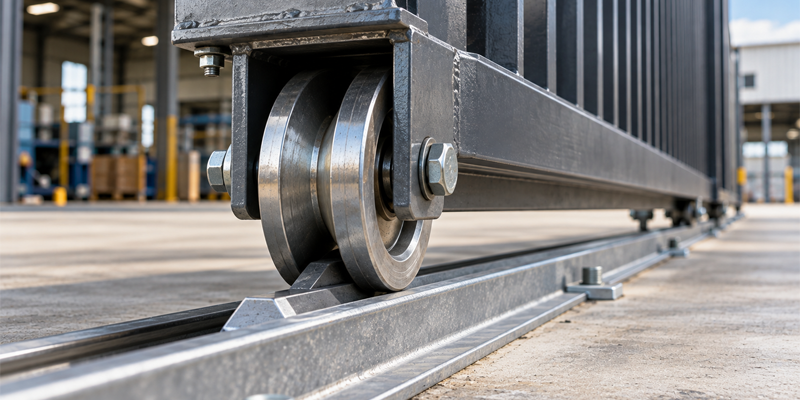
V-groove sliding gate wheels feature an angled groove around their rolling surface. This groove sits over a raised V-shaped track, helping guide the gate in a straight line.
As someone opens or closes the gate, the wheels rotate along the track while supporting the gate frame.
Most track-guided gate systems use two or more load-bearing wheels, depending on the gate's design and weight distribution.
A typical system includes three main components:
- V-groove wheels: Support the gate's vertical load while following the track.
- V-shaped track: Provides a defined rolling path and helps prevent sideways movement.
- Wheel mounting hardware: Secures the wheels to the gate frame using a suitable bracket, housing, or mounting arrangement.
The track may be surface-mounted or recessed into concrete, depending on the installation.
Proper alignment matters. A misaligned track can cause the wheels to bind, wear unevenly, or place additional stress on their bearings.
For more background, see our planned guide explaining how V-groove wheels work.
Product verification required: Confirm which mounting arrangements and gate-related hardware Atlanta Caster offers.
Sliding Gate Wheels vs. Regular Wheels
Regular flat-tread wheels and V-groove wheels serve different purposes.
A flat wheel rolls across a relatively smooth surface without needing a dedicated track. However, it does not provide the same directional guidance as a wheel seated on a V-shaped rail.
V-groove wheels offer several benefits for track-guided gates:
- Follow a fixed path during gate movement.
- Help maintain alignment with the track.
- Support heavy loads when properly rated.
- Provide predictable movement across the gate's travel distance.
These features make V-groove wheels suitable for many industrial rolling gate applications.
However, they are not appropriate for every gate design.
Swing gates, for example, rotate around hinges and may require entirely different support hardware.
Always identify the gate's movement system before selecting replacement wheels.
How Much Weight Can Sliding Gate Wheels Support?
The weight capacity of sliding gate wheels depends on the wheel's material, diameter, bearing design, and the manufacturer's rated load capacity.
There is no single weight rating that applies to every V-groove gate wheel.
To begin selecting a wheel, determine the gate's total weight and the number of wheels supporting it.
Basic load calculation:
Load per wheel = Total gate weight ÷ Number of load-bearing wheels
This calculation provides an initial estimate, assuming the load is evenly distributed.
However, real installations may experience uneven loading. Track irregularities, gate-frame deflection, and mounting differences can place more weight on one wheel than another.
Heavy-duty sliding gate wheels must also accommodate operating forces.
Important considerations include:
- Gate stops: Sudden contact with a stop can create impact loads.
- Powered operation: Motor-driven starts and stops may introduce additional forces.
- Wind exposure: Solid-panel gates can experience substantial wind-related forces.
- Uneven track: Misalignment can concentrate loads on individual wheels.
Choose wheels with suitable rated capacity and additional allowance for these conditions.
For exceptionally heavy gates, a larger wheel or a different material may be necessary.
Always compare the manufacturer's published per-wheel rating with the loads expected in your installation.
Important: Don't select heavy-duty sliding gate rollers based on gate weight alone. Track condition, mounting design, and operating forces also influence the selection.
Choosing Wheel Material for an Outdoor Gate
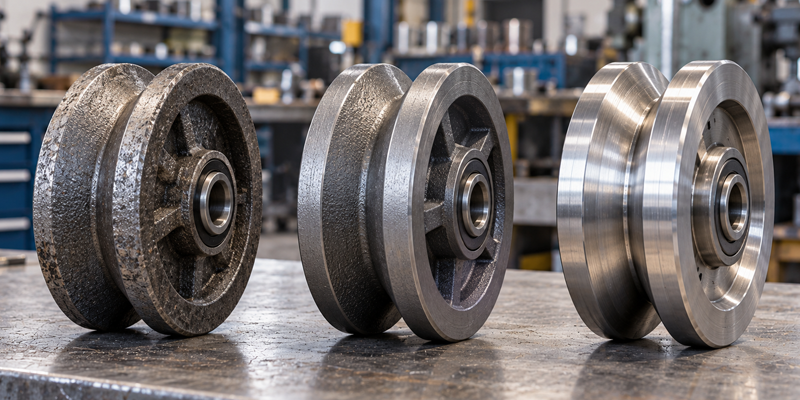
Material selection affects how well metal sliding gate wheels handle loading, repeated movement, impact, and outdoor exposure.
Three common materials for industrial V-groove wheels are cast iron, ductile iron, and forged steel.
Cast Iron V-Groove Wheels
Cast iron wheels are generally used in applications involving substantial, relatively steady loads.
Their rigid construction makes them suitable for certain industrial track systems where loading conditions are predictable.
However, cast iron is generally less resistant to sudden shock than ductile iron.
Ductile Iron V-Groove Wheels
Ductile iron provides greater resistance to shock loading than conventional cast iron.
This is a suitable consideration for rolling gates that experience frequent starts and stops, or occasional impacts.
Actual suitability depends on the wheel's published specifications.
Forged Steel V-Groove Wheels
Forged steel wheels are another option for demanding, high-load applications.
Their strength makes them worth considering for heavy gate systems, provided the selected wheel's ratings and dimensions match the installation.
What About Rust Resistance?
Outdoor gates are exposed to rain, humidity, standing water, and seasonal temperature changes.
Unprotected iron and steel can corrode when exposed to moisture.
When selecting rust-resistant sliding gate wheels, check the available protective finishes and whether the manufacturer approves the wheel for outdoor conditions.
Galvanized and stainless steel options exist in the broader gate-hardware market, but Atlanta Caster's available finishes require confirmation.
You can review our V-groove wheel selection when comparing material and size options.
Matching the Wheel to Your Gate Track
A wheel's load capacity means little if its groove does not fit the existing track properly.
Before purchasing replacement V-groove gate wheels, check three measurements.
1. Groove shape and track dimensions
The groove angle and width must be compatible with the V-shaped rail. An incorrect profile can cause poor contact, uneven wear, or unstable movement.
2. Bore diameter
The wheel's bore must fit the intended axle and bearing arrangement. An incorrect bore can prevent proper mounting.
3. Wheel diameter and clearance
Check the wheel's outside diameter and the available space beneath the gate frame. A different diameter may change the gate's operating height.
Also inspect the sliding gate roller track for wear, bends, or damaged sections.
Replacing a wheel without addressing a damaged track may cause the new wheel to wear prematurely.
For additional selection details, refer to our planned track-matching guide.
How to Replace or Install Sliding Gate Wheels
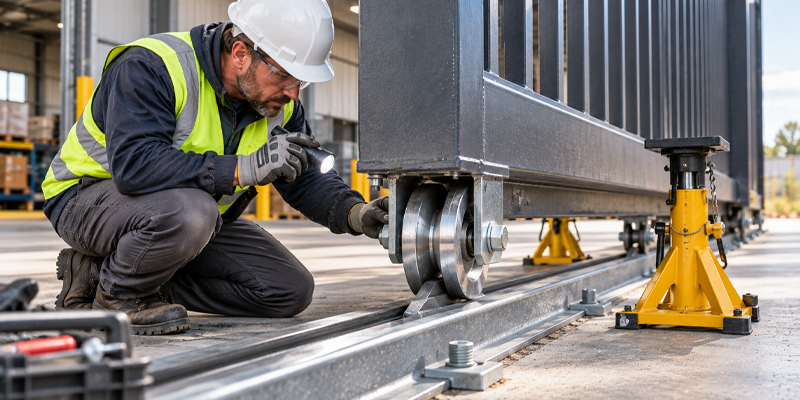
Replacing worn sliding gate wheels requires careful measurements, proper lifting equipment, and attention to gate stability.
Because commercial gates can be extremely heavy, qualified personnel should handle the replacement.
Step 1: Secure and Support the Gate
Disconnect power to any automatic gate operator and follow the manufacturer's lockout procedures.
Prevent unintended movement, and securely support the gate before removing its wheels or mounting hardware.
Never rely on the gate operator to hold the gate in position.
Step 2: Inspect and Measure the Existing Wheel
Remove the old wheel only after the gate is safely supported.
Record its:
- Outside diameter
- Groove profile and dimensions
- Bore diameter
- Hub length
- Bearing arrangement
Inspect the axle, mounting hardware, and track for damage.
Step 3: Install the Replacement Wheel
Select a replacement with compatible dimensions and sufficient rated capacity.
Install it according to the wheel and gate manufacturer's instructions.
Check that the wheel sits squarely on the rail and rotates without binding.
Step 4: Test Gate Movement
With the gate safely supported and following the manufacturer's procedure, check its movement manually before reconnecting the operator.
Look for unusual resistance, noise, or misalignment.
If another wheel shows similar damage, consider replacing both to avoid uneven performance.
Unsure which replacement fits? Send us your gate wheel measurements for assistance.
Do Sliding Gate Wheels Need Maintenance?
Yes. Routine maintenance helps sliding gate wheels move freely and reduces avoidable wear.
Outdoor rolling gate systems require particular attention because dirt, gravel, leaves, and moisture can collect around the track.
A practical maintenance checklist includes:
- Remove gravel, dirt, leaves, and ice from the track.
- Inspect wheel grooves for excessive wear or damage.
- Listen for grinding, squealing, or unusual bearing noise.
- Check for flat spots or irregular rolling.
- Examine the track for bending, corrosion, and misalignment.
- Inspect mounting hardware for looseness or damage.
Lubricate bearings only when the manufacturer's instructions require it. Some bearing designs may be sealed and require no routine lubrication.
Inspection frequency should reflect the gate's operating conditions and usage.
Addressing small problems early can help prevent unexpected downtime and more expensive repairs.
Get the Right Sliding Gate Wheels From Atlanta Caster
Need replacement wheels for a commercial rolling gate?
At Atlanta Caster & Equipment, we can help you review available V groove wheels and identify key specifications to consider for your application.
Call 800-526-3087, contact our team, or visit our Tucker, Georgia, showroom.
Share your existing wheel's measurements and gate requirements so we can help you narrow down your options before you buy sliding gate wheels online.
Frequently Asked Questions
1. How many wheels does a sliding gate need?
Many track-guided sliding gates use two or more load-bearing wheels. The correct quantity depends on the gate's weight, length, support arrangement, and manufacturer's requirements.
2. Can I use V-groove gate wheels on a cantilever gate?
Typically, no. Cantilever gates generally use roller assemblies supporting a suspended gate rather than wheels traveling along a ground-mounted V-track.
3. How long do sliding gate wheels last?
Service life depends on material, load, operating frequency, track condition, and maintenance. Regular inspections help identify wear before the wheel fails.
4. Can I replace just one sliding gate wheel?
Yes, when the replacement matches the existing system and the remaining wheels are serviceable. If other wheels are worn, replacing them together may be advisable.