Email US
 Hours
 Visit Our Showroom


Foam-Filled or Air-Filled Tires: Which Is Better for a Hand Truck You Use Every Day?
Nov 23rd 2026
For hand trucks and material-handling carts used every day, foam-filled or solid never-flat tires are generally better choices than air-filled tires when preventing flats and avoiding downtime are priorities. Air-filled pneumatic tires provide better cushioning on rough outdoor surfaces and when transporting delicate loads. Foam-filled hand truck tires offer a middle ground, combining puncture resistance with some pneumatic cushioning. Solid never-flat wheels suit frequent use on smooth or moderately uneven surfaces. The right choice depends on surface conditions, load capacity, daily usage, and the amount of downtime your operation can tolerate.
A flat hand truck tire can interrupt warehouse operations, delay deliveries, and leave employees struggling to move loaded equipment.
For businesses that use hand trucks throughout the day, choosing the right wheel is about more than just replacing a damaged tire. It directly affects equipment availability, operator comfort, and maintenance requirements.
Atlanta Caster & Equipment supplies pneumatic and never-flat wheel options for material-handling applications. We recommend air-filled wheels when their cushioning provides a practical advantage, even though flat-free alternatives can be more convenient for daily operations.
The Short Answer: Which Hand Truck Tire Is Best for Daily Use?
Flat-free hand truck tires generally make the most sense for frequent indoor use, while air-filled tires remain valuable on rough terrain.
The best choice depends on where the hand truck travels and how often it is used.
|
Hand truck application |
Recommended tire |
Primary reason |
|
Daily warehouse and delivery use |
Solid never-flat |
No air-pressure maintenance or puncture flats |
|
Rough outdoor surfaces and fragile loads |
Air-filled pneumatic |
Greater cushioning and adaptability to uneven ground |
|
Mixed indoor and outdoor use |
Foam-filled |
Puncture resistance with some cushioning |
Table note: Recommendations are based on general tire construction and operating conditions, not product-specific performance testing.
This guide focuses on hand trucks, delivery carts, and warehouse material-handling equipment. It does not cover foam filling for tractors, lawn mowers, or skid steers, which have different operating requirements.
For small businesses, warehouse teams, and delivery operations, tire-related downtime is often the deciding factor.
How Do Air-Filled Pneumatic Hand Truck Tires Perform?
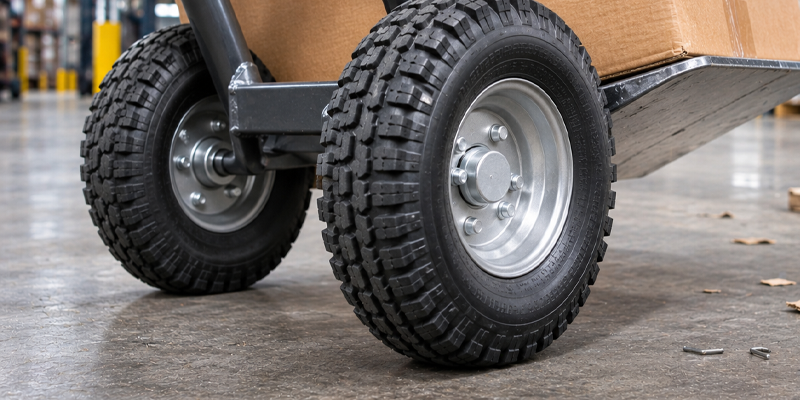
Air-filled pneumatic tires provide cushioning and traction on uneven surfaces but require pressure checks and are prone to punctures.
A pneumatic tire contains compressed air within a flexible rubber casing. Depending on its construction, it may use an inner tube or a tubeless design.
The air supports the load while allowing the tire to deform as it travels over irregular surfaces.
This makes pneumatic wheels especially useful for hand trucks moving across gravel, cracked pavement, rough concrete, and outdoor loading areas.
Benefits of Air-Filled Tires
Air-filled hand truck tires offer several practical advantages:
- Better cushioning: Compressed air helps absorb bumps and vibration.
- Rough-surface movement: Flexible tires conform to minor surface irregularities.
- Cargo protection: Reduced vibration can benefit sensitive items.
- Adjustable pressure: Inflation can be maintained within the manufacturer's recommended PSI range.
These qualities make pneumatic tires suitable for delivery operations transporting delicate products across uneven ground.
Limitations of Air-Filled Tires
The biggest disadvantage is their dependence on air pressure.
Punctures, damaged valves, and gradual pressure loss can leave a hand truck unusable until the problem is corrected.
Underinflated tires can also increase rolling resistance, making loaded equipment harder to move.
Employees must periodically check pressure and inspect the tire casing for damage.
Browse Atlanta Caster's pneumatic wheels for available options.
For applications involving rough outdoor surfaces, read our comparison of pneumatic vs. solid wheels for outdoor use.
How Do Foam-Filled Hand Truck Tires Work?
Foam-filled hand truck tires replace compressed air with resilient foam, eliminating inflation-related flats while retaining some cushioning.
A foam-filled tire uses a pneumatic casing filled with polyurethane foam rather than pressurized air.
Because the tire no longer depends on inflation, punctures generally do not cause the wheel to collapse or become flat.
This provides an advantage for businesses operating in areas with packaging debris, nails, staples, or other sharp objects.
Benefits of Foam-Filled Tires
Foam-filled hand truck tires are useful when operators want:
- Protection against puncture-related downtime
- No routine air-pressure adjustments
- Some cushioning on uneven surfaces
- More predictable performance during frequent use
- Less disruption from ordinary tire punctures
Foam-filled designs are particularly attractive for warehouse and delivery teams moving between indoor floors and outdoor loading areas.
Limitations of Foam-Filled Tires
Foam-filled tires are not identical to air-filled pneumatic tires.
They generally provide a firmer ride because the fill material cannot respond as precisely as compressed air.
Some foam-filled assemblies are heavier than equivalent air-filled designs, potentially affecting handling.
Foam filling also does not prevent damage to wheel bearings, hubs, or heavily worn tire casings.
Once the casing becomes unsuitable for service, replacement of the tire or wheel assembly may be necessary, depending on its construction.
How long do foam-filled hand truck tires last?
There is no reliable universal lifespan. Service life depends on load, tread material, surface roughness, travel distance, and operating frequency. Inspect tread wear, casing damage, and bearings regularly.
What Are Never Flat Tires for Hand Trucks?
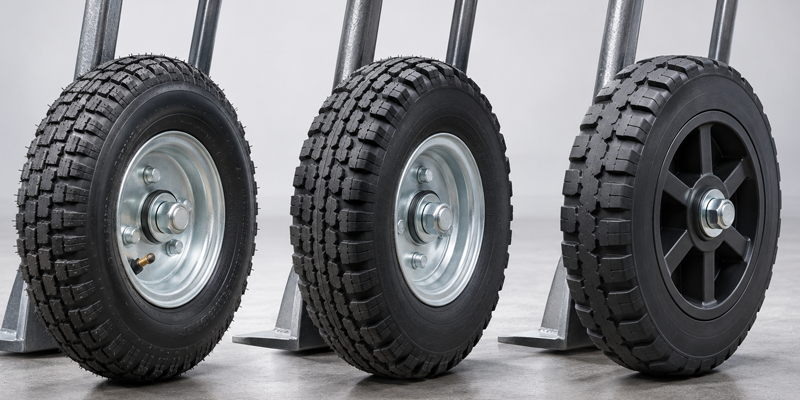
Never-flat tires are flat-free wheels designed to operate without compressed air, making them a practical choice for daily hand truck use.
Unlike conventional pneumatic tires, solid never-flat wheels do not require inflation.
Their construction eliminates tire-pressure checks and prevents the familiar problem of a punctured tube or deflated casing.
This makes them attractive to warehouse operators, small businesses, and delivery teams that depend on their equipment throughout the workday.
Why Flat Free Hand Truck Tires Are Worth Considering
Solid never-flat wheels are particularly useful when hand trucks travel repeatedly across relatively smooth concrete, warehouse floors, loading docks, and paved delivery areas.
Their advantages include:
- No puncture-related tire flats
- No inflation or PSI checks
- Consistent wheel shape during normal operation
- Reduced tire-related maintenance
- Convenient replacement options for compatible hand trucks
However, solid construction can transmit more vibration than an air-filled pneumatic tire.
Tread material and wheel design determine the actual level of cushioning.
Atlanta Caster's 10-Inch Never-Flat Wheel
Atlanta Caster lists a 10-inch 4.10/3.50-4 never-flat wheel intended for pneumatic and semi-pneumatic replacement applications.
The product listing identifies:
|
Specification |
Listed detail |
|
Wheel diameter |
10 inches |
|
Tire size marking |
4.10/3.50-4 |
|
Load capacity |
280 pounds |
|
SKU |
SF10627-08NF |
|
Wheel type |
Never Flat |
Table note: Specifications come from Atlanta Caster's product listing checked in November 2026. Capacity is the published rating for this wheel, not a universal rating for all never-flat wheels.
The manufacturer describes the wheel as suitable for non-marking operation and shock absorption. Compatibility with a particular hand truck still requires measurement.
Browse additional never-flat wheels before selecting a replacement.
Foam-Filled Tires vs. Air-Filled Tires vs. Solid Never-Flat Wheels
Foam-filled tires balance puncture resistance with cushioning, air-filled tires favor rough-ground comfort, and solid never-flat wheels favor low-maintenance operation.
Each design has advantages and limitations.
|
Comparison |
Air-filled |
Foam-filled |
Solid never-flat |
|
Cushioning |
Generally highest |
Moderate, depending on fill |
Varies by solid material |
|
Puncture flats |
Possible |
Generally eliminated |
Eliminated |
|
Air-pressure maintenance |
Required |
Not required |
Not required |
|
Wheel weight |
Often lighter |
Often heavier |
Depends on construction |
|
Surface suitability |
Rough outdoor ground |
Mixed surfaces |
Smooth to moderately uneven ground |
|
Initial cost |
Often lower |
Often higher |
Varies by model |
|
Service life |
Affected by pressure and punctures |
Depends on casing and tread wear |
Depends on material and tread wear |
Table note: These are directional comparisons of common tire constructions. No fixed lifespan, weight, or cost difference is implied; actual results depend on the product and operating conditions.
For frequently used equipment, focus on total operating inconvenience rather than the initial purchase price alone.
Expert Insight: One Flat Can Cost More Than a Tire Upgrade
Consider what happens when a delivery hand truck develops a flat tire during a busy shift.
The operator may need to stop deliveries, locate replacement equipment, move the remaining cargo, or arrange a repair. That disruption can matter more than the difference in purchase price between pneumatic and flat-free wheels.
For daily delivery operations, compare the cost of tire maintenance and interrupted work before choosing the least expensive wheel.
How to Choose Hand Truck Replacement Wheels That Fit
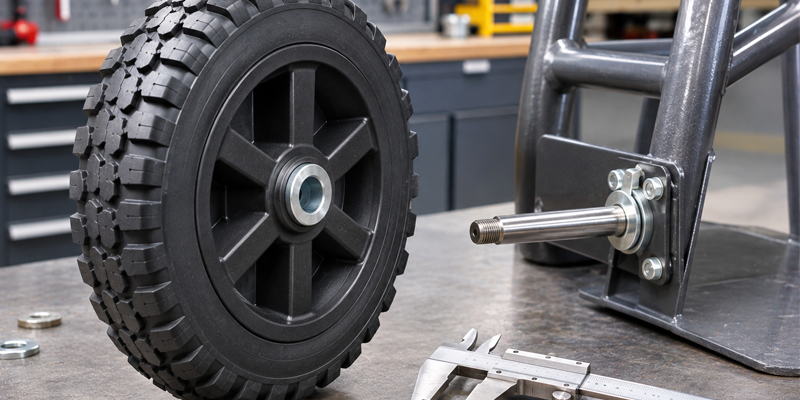
Correct hand truck replacement wheels must match the tire size, hub length, axle bore, and required load capacity.
A common hand truck tire marking is 4.10/3.50-4, but this marking alone does not guarantee that a replacement wheel will fit.
The complete wheel assembly must match the existing equipment.
Check These Measurements Before Ordering
1. Tire and wheel size
Look for markings on the existing tire, such as 4.10/3.50-4.
These identify tire dimensions and rim sizing. Verify the actual outside diameter because wheel constructions can differ.
2. Hub length
Measure the width of the wheel's hub where it fits between the hand truck's mounting supports.
An incorrect hub length can prevent proper installation or create excessive side-to-side movement.
3. Axle bore
Measure the opening through the wheel bearing or hub.
The bore must accommodate the axle correctly. A wheel with the right outside diameter but the wrong bore may not fit the existing hand truck.
Also verify bearing type, load capacity, and available clearance.
Atlanta Caster's guide on measuring casters for a perfect fit provides additional guidance.
Can You Replace Air-Filled Tires With Never-Flat Wheels?
Yes, provided the replacement wheel meets the hand truck's fitment and load requirements.
Some flat-free wheels are intended as replacements for pneumatic assemblies, but compatibility should not be assumed based on tire size alone.
If you operate Magliner hand trucks, confirm your specific truck configuration and wheel requirements before ordering.
Expert Insight: Why Matching Diameter Alone Is Not Enough
A replacement wheel may look identical to the original and still fail to install correctly.
The mistake is often an overlooked hub width or axle bore. Even minor differences can prevent the wheel from seating correctly.
When the original part number is unknown, photograph the old wheel and provide its measurements. This gives the specialist better information for identifying a compatible replacement.
Getting Flat-Free Hand Truck Tires From Atlanta Caster
Atlanta Caster offers never-flat and pneumatic wheel choices for buyers replacing hand truck tires and maintaining material-handling equipment.
Atlanta Caster & Equipment has served industrial and commercial customers since 1982 and has a showroom in Tucker, Georgia.
Our Certified Caster Specialists assist customers with wheel selection, replacement measurements, and application requirements.
For warehouse and distribution operations, flat-free wheels can help reduce maintenance interruptions. Delivery businesses may prefer foam-filled or pneumatic designs when outdoor cushioning remains important.
Browse our never-flat wheels and pneumatic wheels to compare suitable options.
Need help finding a replacement? Call 800-526-3087 or send us the measurements of your old wheel for assistance.
Frequently Asked Questions
Should I get foam-filled or air-filled tires for a hand truck we use every day?
Foam-filled tires are generally preferable when a hand truck operates daily and preventing puncture-related downtime is most important. Air-filled tires remain useful on rough outdoor terrain and for fragile cargo that requires cushioning. Solid never-flat wheels are another practical option for frequent use on smoother warehouse and delivery surfaces.
What is the difference between foam-filled and never-flat tires?
Foam-filled hand truck tires use a pneumatic casing filled with foam instead of compressed air. Solid never-flat tires use a solid or resilient non-pneumatic construction. Both eliminate inflation-related flats, but their cushioning, weight, and wear characteristics differ. Manufacturers sometimes use the term "flat-free" for both types, so check the construction.
Do foam-filled hand truck tires ride rougher than air-filled?
Foam-filled hand truck tires generally provide a firmer ride than comparable properly inflated pneumatic tires. The foam resists deformation differently than compressed air does. However, actual cushioning depends on tire construction, load, and surface conditions. Foam-filled options can still provide useful shock absorption during ordinary material-handling work.
How do I know what size hand truck tire to buy?
Check the tire's sidewall for a size marking, such as 4.10/3.50-4. Then measure the existing wheel's outside diameter, hub length, and axle bore. These measurements help establish compatibility. Also confirm the required load capacity, bearing arrangement, and available mounting clearance before purchasing a replacement.
Can flat-free tires replace the air-filled tires on my existing hand truck?
Flat-free tires can replace pneumatic hand truck wheels when the replacement assembly matches the necessary dimensions and capacity. Check tire size, hub length, axle bore, bearing type, and mounting clearance. Do not assume that two wheels with identical tire markings will fit the same hand truck.
Are solid rubber hand truck tires the same as never-flat tires?
Solid rubber hand truck tires are one type of flat-free wheel, but not all never-flat tires use solid rubber. Other designs may use polyurethane, foam filling, or different resilient materials. Review the manufacturer's material description to know cushioning, capacity, floor compatibility, and maintenance requirements.
Which tire type carries the most weight on a hand truck?
No tire construction automatically provides the highest load capacity. Capacity depends on wheel diameter, material, hub construction, bearings, and the complete assembly. Some solid wheels support demanding loads, but pneumatic and foam-filled products also have specific ratings. Always select a wheel with a manufacturer-approved capacity suitable for the loaded hand truck.
Does Atlanta Caster carry Magliner hand trucks and parts?
Atlanta Caster lists Magliner hand trucks in its material-handling product selection. Availability and compatibility of individual replacement wheels or parts must be confirmed for the specific Magliner model. Customers can contact Atlanta Caster with a model number, existing part number, or wheel measurements to request assistance identifying suitable components.
Author Information
Atlanta Caster & Equipment provides casters, wheels, hand trucks, and material-handling products for warehouses, delivery operations, manufacturing facilities, and small businesses. Its Tucker, Georgia, team assists customers with product selection, wheel replacement, and specialized equipment mobility requirements.