Email US
 Hours
Hours
 Visit Our Showroom


How to Choose Heavy-Duty Casters for Manufacturing Equipment
Sep 21st 2026
Heavy-duty casters play an important role in moving large manufacturing equipment, industrial carts, fixtures, and material-handling systems. The right caster setup allows operators to move equipment with controlled effort while supporting demanding industrial workloads.
Selecting the wrong caster can create operational problems, including excessive push force, unstable equipment movement, floor damage, faster wheel wear, and unnecessary downtime. A caster that works well for one application may not perform properly in another because manufacturing environments vary in load requirements, floor conditions, operating temperatures, and mobility needs.
The right heavy-duty caster should support the equipment's actual working load while providing the required mobility, stability, durability, and floor protection. Atlanta Caster stocks heavy-duty casters rated over 2,000 lbs for exactly these applications.
Key factors to review before selecting casters include:
- Load capacity
- Wheel material
- Caster type
- Floor conditions
- Maneuverability requirements
- Operating environment
- Mounting compatibility
A careful selection process helps manufacturing teams choose caster solutions that match their equipment and daily operating conditions.
What Are Heavy-Duty Casters?
Heavy-duty casters are caster assemblies designed to support and move high-capacity equipment and loads in demanding industrial environments.
Unlike standard industrial casters, heavy-duty casters are built for applications where equipment weight, frequent movement, and harsh operating conditions require stronger components. These casters commonly support manufacturing machinery, industrial carts, tooling systems, assembly equipment, material-handling equipment, and heavy fixtures.
A complete caster assembly includes several components:
- Caster: The complete assembly that attaches to equipment and allows movement.
- Wheel: The component that contacts the floor and affects load handling, noise, and rolling resistance.
- Mounting plate or stem: The connection point between the caster and equipment.
- Bearings: Components that support wheel rotation and swivel movement (see how bearing types affect industrial mobility).
- Brake or lock: A feature that helps keep equipment stationary when required.
Choosing the correct combination of these components helps match the caster to the application.
7 Factors to Consider When Choosing Heavy-Duty Casters
1. Determine the Total Load Capacity
Load capacity is a crucial factor to select heavy-duty casters. The selected caster must support the equipment's full operating weight, including materials, tools, and any additional loads.
Do not select casters based only on the empty equipment weight. Manufacturing equipment often carries additional materials during operation, which can significantly increase the required capacity.
The basic calculation is:
Required capacity per caster = Total load ÷ Number of load-bearing casters
For example, if a manufacturing cart weighs 4,000 pounds when fully loaded and uses four load-bearing casters:
4,000 ÷ 4 = 1,000 pounds minimum capacity per caster
In practice, a safety margin should be included because loads may not always be evenly distributed. Uneven floors, sudden movement, and shifting materials can place additional stress on individual casters - see calculating load capacity for uneven weight distribution. Overspecifying has a cost too, so it is worth understanding how to right-size caster capacity without overpaying.
2. Choose the Right Wheel Material
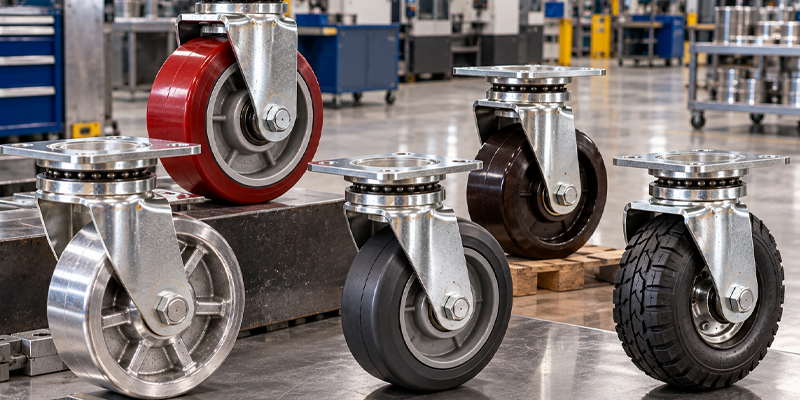
Wheel material affects performance, including load handling, floor protection, noise levels, vibration control, and resistance to chemicals or heat.
|
Wheel Material |
Best For |
Advantages |
Limitations |
|
Very heavy industrial loads |
High load capacity and durability |
Can create more noise and may damage sensitive floors |
|
|
Manufacturing floors |
Good floor protection and quieter operation |
May have lower capacity than steel options |
|
|
Vibration-sensitive applications |
Shock absorption and quiet movement |
Lower load capacity |
|
|
Industrial environments |
Durable and resistant to chemicals and heat |
Less forgiving on uneven surfaces |
|
|
Uneven surfaces |
Excellent shock absorption |
Requires maintenance |
Steel wheels work well for extremely heavy applications where floor protection and noise are less important. Polyurethane and rubber wheels are often preferred for facilities where protecting concrete floors and reducing noise are priorities - our comparison of rubber vs. polyurethane casters covers the trade-offs in detail.
The best wheel material depends on the complete operating environment rather than load capacity alone.
3. Select the Correct Caster Configuration
Caster configuration determines how equipment moves and how easily operators can control it.
Swivel Casters
Swivel casters rotate 360 degrees, allowing equipment to change direction easily. They are useful for applications that require frequent turning or movement through limited spaces.
Common uses include:
- Mobile workstations
- Manufacturing carts
- Tool carts
Rigid Casters
Rigid casters move in a fixed direction and provide better straight-line control. They are often used where equipment follows a consistent travel path.
Common uses include:
- Long travel routes
- Heavy equipment movement
- Directional applications
Swivel and Rigid Combination
Using both swivel and rigid casters can provide a balance between maneuverability and directional control. For a closer look at when each configuration fits, see swivel vs. rigid casters.
Locking or Braking Casters
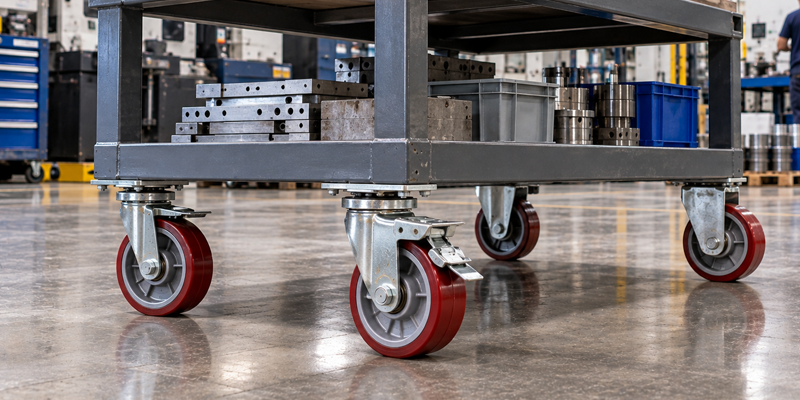
Locking casters help keep mobile equipment in position during operation, loading, maintenance, or assembly work.
|
Caster Type |
Best For |
Advantages |
Limitations |
|
Swivel |
Frequent direction changes |
High maneuverability |
Requires more control during straight movement |
|
Rigid |
Straight travel |
Better directional stability |
Limited turning ability |
|
Locking |
Stationary operation needs |
Helps hold equipment in place |
Adds additional components |
4. Consider the Manufacturing Floor
Floor conditions directly affect caster performance. A smooth concrete floor may require a different caster design than a rough surface with cracks, debris, or uneven areas.
Consider:
- Smooth concrete
- Rough concrete
- Expansion joints
- Metal flooring
- Uneven surfaces
- Finished floors requiring protection
Larger wheel diameters generally move more easily over obstacles and uneven areas. Softer wheel materials can reduce floor impact and vibration, while harder materials may provide greater load capacity.
The caster should match the floor rather than forcing one wheel type to handle every surface condition. Our guide to choosing caster wheels for your floor type walks through concrete, tile, epoxy, and other surfaces.
5. Evaluate Maneuverability and Push/Pull Requirements
Caster design affects the force required to move equipment. Manufacturing teams should consider how often equipment moves, who operates it, and how much control is required. If carts already feel heavier than they should, why carts are hard to push explains the usual causes.
Factors that affect maneuverability include:
- Wheel diameter
- Swivel design
- Bearing quality
- Equipment weight distribution
- Floor condition
Larger, heavy-duty caster wheels can make heavy equipment easier to move because they roll over small obstacles more effectively. Proper caster selection can also reduce operator strain during routine movement.
6. Account for the Operating Environment
Industrial environments can expose casters to conditions that affect performance and service life.
Review whether the equipment operates around:
- High temperatures
- Moisture
- Chemicals
- Oils and grease
- Food-processing conditions
- Outdoor exposure
- Heavy debris
For example, a caster used near chemicals may require a material that resists chemical exposure, while equipment used in wet environments may require corrosion-resistant components.
Wheel and caster materials should match the environment where the equipment operates.
7. Check Mounting and Equipment Compatibility
A caster with the correct capacity is still unsuitable if it cannot attach properly to the equipment.
Before purchasing, confirm:
- Top plate dimensions
- Bolt-hole pattern
- Stem configuration
- Mounting height
- Wheel diameter
- Swivel clearance
- Brake clearance
Our guide to measuring casters walks through each dimension. Proper mounting ensures the caster performs as designed and supports stable equipment movement.
How to Calculate the Right Heavy-Duty Caster Capacity
To calculate the correct caster capacity:
- Add the equipment weight and maximum operating load.
- Divide the total operating weight by the number of load-bearing casters.
- Add a safety margin based on the application.
Example:
A manufacturing cart weighs 3,500 pounds and carries 1,500 pounds of material.
Total operating weight = 5,000 pounds
With four load-bearing casters:
5,000 ÷ 4 = 1,250 pounds minimum capacity per caster
Because real-world conditions may create uneven loading, selecting a caster above the minimum rating is often appropriate.
Heavy-Duty Caster Wheel Materials: Which Is Best for Manufacturing?
No single wheel material fits every manufacturing application.
Steel: Best for extremely heavy loads and demanding industrial use. It provides excellent strength but may create more noise and impact on floors.
Polyurethane: A common choice for manufacturing facilities because it balances durability, floor protection, and quieter operation.
Rubber: Useful for vibration reduction and quiet movement.
Phenolic: Suitable for environments requiring resistance to heat and chemicals.
Pneumatic: Effective on uneven surfaces where shock absorption is needed.
The correct material depends on the equipment weight, floor type, environmental exposure, and movement requirements.
Heavy-Duty Casters for Common Manufacturing Applications
Manufacturing Machinery
Heavy machinery and production equipment often require high-capacity casters with strong mounting systems. Load capacity, stability, and durability are key considerations.
Industrial Carts
Material-handling carts and assembly carts benefit from casters that provide smooth movement and enough capacity for daily loads.
Production Lines
Mobile workstations and repositionable equipment often require a combination of maneuverability and stability.
Maintenance Equipment
Tool cabinets, service carts, and maintenance equipment typically require reliable casters that can handle frequent movement.
Common Heavy-Duty Caster Selection Mistakes
Common selection errors include:
- Choosing casters based only on empty equipment weight
- Ignoring uneven load distribution
- Selecting unsuitable wheel materials
- Using wheels that are too small
- Overlooking floor conditions
- Choosing the wrong caster configuration
- Ignoring environmental factors
- Failing to confirm mounting compatibility
- Not inspecting worn components
These mistakes can increase maintenance costs, reduce equipment mobility, and create avoidable operating challenges.
How to Maintain Heavy-Duty Casters in Manufacturing Facilities
Regular maintenance helps identify problems before they affect operations.
Heavy-Duty Caster Maintenance Checklist
- Inspect wheel wear
- Check bearings
- Inspect mounting hardware
- Confirm swivel operation
- Test brakes and locks
- Look for cracks or deformation
- Remove debris from wheels
- Replace damaged components
- Schedule regular inspections
When Should You Replace Heavy-Duty Casters?
Replacement may be necessary when casters show signs of damage or reduced performance, including:
- Excessive wheel wear
- Flat spots
- Cracks
- Increased rolling resistance
- Wobbling
- Damaged bearings
- Loose mounting hardware
- Brake failure
- Unusual noise
- Reduced equipment stability
Replacing worn casters helps maintain reliable equipment movement and reduces the risk of operational interruptions.
Choosing the Right Heavy-Duty Casters for Your Manufacturing Operation
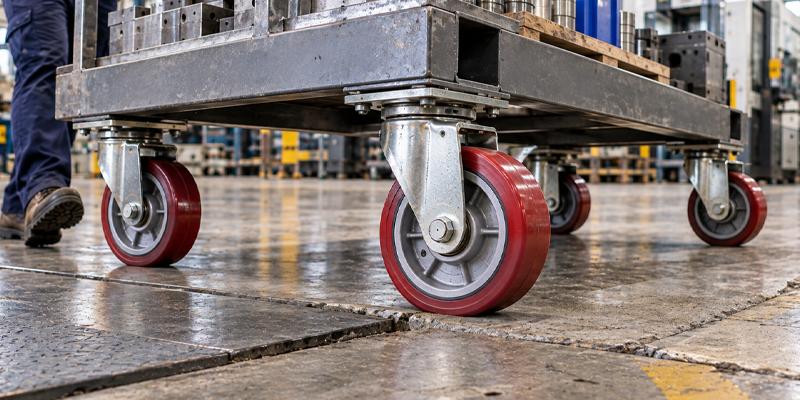
Selecting heavy-duty casters requires more than checking weight ratings. The best choice depends on the complete application, including equipment design, floor conditions, operating environment, movement requirements, and maintenance needs.
Atlanta Caster provides industrial caster solutions designed for a range of manufacturing and material-handling applications. Reviewing the full application requirements can help teams select the right caster type, wheel material, and configuration.
If you're unsure which heavy-duty caster configuration fits your manufacturing equipment, review Atlanta Caster's industrial and heavy-duty caster options, explore custom caster solutions for non-standard equipment, or contact the team for application guidance.
Frequently Asked Questions
1. What size heavy-duty caster do I need for manufacturing equipment?
The required caster size depends on equipment weight, load capacity, floor conditions, and mobility requirements. Wheel diameter and mounting dimensions should match the application.
2. How much weight can a heavy-duty caster support?
Capacity varies by caster design, wheel material, and construction. Always check the manufacturer's rated load capacity before selection.
3. How do I calculate caster load capacity?
Calculate the total operating weight and divide it by the number of load-bearing casters. Include an appropriate safety margin for real operating conditions.
4. Are steel or polyurethane casters better for manufacturing?
Both materials serve different purposes. Steel provides high load capacity, while polyurethane often provides better floor protection and quieter operation.
5. Should I use swivel or rigid casters on heavy equipment?
Swivel casters are useful for maneuverability, while rigid casters provide directional stability. Many applications use a combination of both.
6. What wheel material is best for concrete factory floors?
Polyurethane wheels are commonly used on concrete floors because they provide a balance of durability, quieter movement, and floor protection.
7. How many casters should heavy manufacturing equipment have?
The number depends on equipment design, weight distribution, and movement requirements. The load rating of each caster must support the total operating weight.
8. Do larger caster wheels make heavy equipment easier to move?
Larger wheels generally move more easily over uneven surfaces and obstacles because they require less effort to roll.
9. How often should heavy-duty casters be inspected?
Inspection frequency depends on usage, environment, and operating conditions. Facilities should establish regular inspection schedules.
10. When should heavy-duty caster wheels be replaced?
Replace caster wheels when they show excessive wear, damage, reduced mobility, or other signs that affect equipment performance.