Email US
 Hours
Hours
 Visit Our Showroom


Industrial Casters vs Heavy-Duty Casters: What's the Difference?
Sep 24th 2026
Industrial casters and heavy-duty casters are often discussed as if they are the same product category. While both are designed for industrial movement applications, they serve different needs. The term industrial casters generally refers to casters used in demanding work environments, while heavy-duty casters are designed for higher load capacities and more demanding operating conditions.
Industrial casters may support a wide range of equipment, including carts, workstations, tool cabinets, and material-handling equipment. Heavy-duty casters are typically designed for heavier machinery, larger loads, and applications where durability and stability are critical.
The right choice depends on several factors, including:
- Equipment weight
- Total load capacity
- Wheel material
- Floor conditions
- Operating environment
- Movement frequency
- Maneuverability requirements
Industrial casters are designed for demanding industrial applications, while heavy-duty casters are engineered to support heavier loads and withstand more demanding operating conditions. The right choice depends on the equipment, load, environment, and mobility requirements.
What Are Industrial Casters?
Industrial casters are mobility components designed for use in manufacturing, warehousing, distribution, maintenance, and material-handling environments. They allow equipment and loads to move efficiently while supporting regular industrial use.
Industrial casters are available in different configurations, including:
- Swivel casters: Allow 360-degree movement for easier maneuvering.
- Rigid casters: Provide straight-line movement and directional stability.
- Locking or braking casters: Help secure equipment when stationary.
These casters are commonly used on:
- Industrial carts
- Tool cabinets
- Mobile workstations
- Assembly equipment
- Material-handling equipment
- Maintenance equipment
Industrial casters cover a broad range of applications and load capacities. The correct choice depends on the equipment design, operating conditions, and required movement characteristics.
What Are Heavy-Duty Casters?
Heavy-duty casters are designed for moving heavier equipment and loads where higher capacity, structural strength, and durability are required.
These casters often include:
- Higher load ratings
- Larger wheel sizes
- Reinforced caster frames
- Heavy-duty bearings
- Stronger mounting systems
Heavy-duty casters are commonly used for:
- Heavy manufacturing machinery
- Large industrial carts
- Machinery platforms
- Heavy fixtures
- Specialized material-handling equipment
Heavy-duty casters are designed to support and move heavier equipment and loads than typical industrial caster applications, particularly where durability, stability, and load capacity are critical.
Industrial Casters vs Heavy-Duty Casters: Key Differences
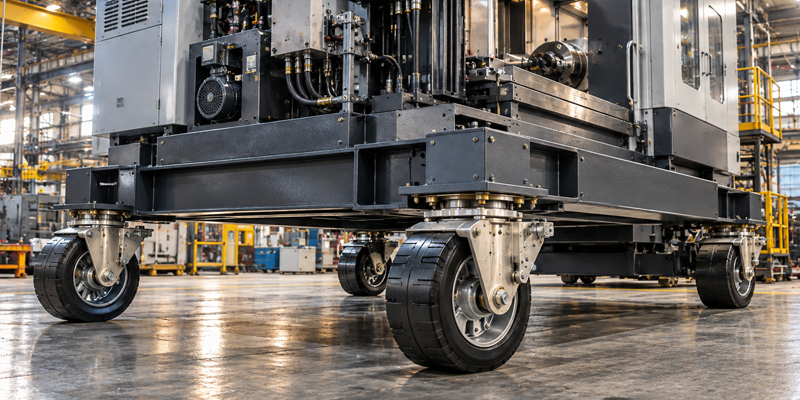
Although these categories can overlap, their main differences relate to capacity, construction, and intended application.
|
Factor |
Industrial Casters |
Heavy-Duty Casters |
|
Primary purpose |
General industrial mobility |
High-load industrial mobility |
|
Load capacity |
Moderate to high |
High to very high |
|
Typical equipment |
Carts, workstations, tools |
Machinery, heavy equipment, large carts |
|
Construction |
Varies by application |
Reinforced and heavier construction |
|
Wheel sizes |
Multiple size options |
Often larger wheel sizes |
|
Maneuverability |
Depends on the application |
Designed for the controlled movement of heavy loads |
|
Operating conditions |
Industrial environments |
More demanding industrial environments |
|
Best for |
General material handling |
Heavy equipment and high-capacity loads |
It is important to note that not every industrial caster has a lower capacity than every heavy-duty caster. Product specifications vary by design, materials, and manufacturer. The label alone should not determine the selection.
Is "Heavy-Duty" a Type of Industrial Caster?
In many applications, heavy-duty casters can be considered a specialized category within industrial caster solutions.
The difference is not always the product name. Manufacturers may use different terminology depending on design features, industries served, and product ranges.
When selecting casters, focus on measurable specifications, including:
- Rated load capacity
- Wheel dimensions
- Caster construction
- Bearing design
- Mounting requirements
- Operating environment
A caster should be selected based on application requirements rather than the product label alone.
Load Capacity: The Biggest Difference to Consider
Load capacity is one of the most important factors when comparing industrial casters and heavy-duty casters.
How Industrial Caster Load Capacity Works
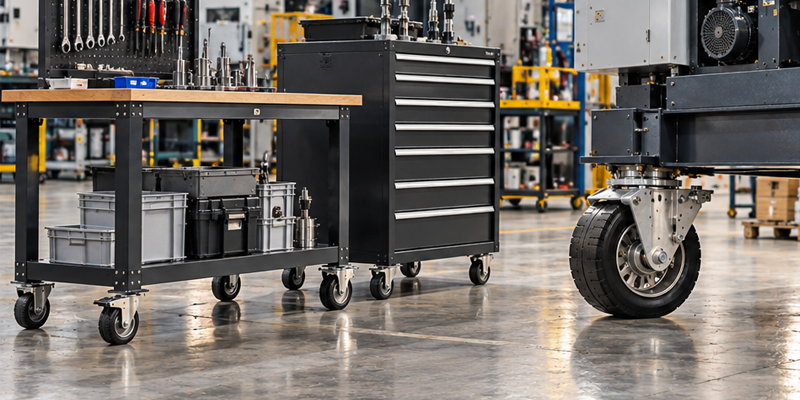
Industrial caster capacity refers to the maximum weight a caster can support under specified operating conditions.
To determine the required capacity:
Minimum caster capacity = Total operating weight ÷ Number of load-bearing casters
Total operating weight includes:
- Equipment weight
- Maximum payload
- Materials or tools carried during the operation
For example, a cart weighing 2,000 pounds with a 2,000-pound load has a total operating weight of 4,000 pounds.
With four load-bearing casters:
4,000 ÷ 4 = 1,000 pounds minimum capacity per caster
A safety margin should be considered because loads may not always be evenly distributed, especially on uneven floors or during movement.
When You Need Heavy-Duty Load Capacity
Heavy-duty casters are often appropriate for:
- Heavy machinery
- Large production equipment
- High-capacity carts
- Equipment moved while fully loaded
- Applications requiring increased stability
Choosing a caster based solely on static equipment weight can lead to reduced performance and premature wear.
Construction and Durability Differences
Caster construction affects how well a product performs under repeated industrial use.
Important construction features include:
Caster Frame
Heavy-duty designs often use reinforced frames to support higher loads and repeated movement.
Fork or Yoke Construction
The fork supports the wheel assembly. Stronger designs help manage heavier loads and impact forces.
Wheel Core
Wheel construction affects load handling, durability, and performance under demanding conditions.
Bearings
Bearing selection influences rolling resistance, movement control, and service life.
Mounting Plate and Fasteners
The mounting system must be compatible with the equipment to provide stable support.
A properly designed caster should match the demands of the application rather than simply provide the highest available capacity.
Wheel Materials: Industrial vs Heavy-Duty Applications
Wheel material affects load capacity, noise, floor protection, and movement characteristics.
|
Material |
Load Capacity |
Floor Protection |
Noise |
Shock Absorption |
Best For |
|
High |
Lower |
Higher |
Low |
Heavy industrial loads |
|
|
Medium to high |
Good |
Low |
Moderate |
Manufacturing floors |
|
|
Medium |
Good |
Low |
High |
Vibration-sensitive applications |
|
|
High |
Moderate |
Moderate |
Low |
Industrial environments |
|
|
Varies |
Good |
Low |
Excellent |
Uneven surfaces |
Steel Wheels
Steel wheels provide high load capacity and durability. They are commonly used in heavy industrial applications where maximum strength is required.
Polyurethane Wheels
Polyurethane wheels provide a balance of durability, quieter operation, and floor protection. They are commonly used in manufacturing environments.
Rubber Wheels
Rubber wheels help reduce vibration and noise, making them useful for applications where smooth movement is important.
Phenolic Wheels
Phenolic wheels are durable and suitable for industrial environments where resistance to heat or certain chemicals is needed.
Pneumatic Wheels
Pneumatic wheels provide excellent shock absorption and work well on uneven surfaces.
Industrial Casters vs Heavy-Duty Casters for Different Applications
|
Application |
Recommended Direction |
Why |
|
Tool carts |
Industrial casters |
Moderate loads and frequent movement |
|
Workstations |
Industrial casters |
Maneuverability and floor protection |
|
Warehouse carts |
Industrial or heavy-duty, depending on load |
Load requirements vary |
|
Manufacturing machinery |
Heavy-duty casters |
Higher equipment weight |
|
Heavy material-handling carts |
Heavy-duty casters |
Higher operating loads |
|
Large equipment platforms |
Heavy-duty casters |
Stability and capacity |
Application requirements matter more than the product category. A properly selected industrial caster may be the right solution for one application, while another requires heavy-duty caster wheels.
Which Is Better for Manufacturing Equipment?
Neither option is automatically better. The correct choice depends on the equipment and operating conditions.
Industrial casters may be suitable when:
- Loads fall within standard industrial ratings.
- Equipment requires frequent movement.
- Mobility and maneuverability are priorities.
- Equipment includes carts or workstations.
Heavy-duty casters may be more suitable when:
- Equipment and payloads are significantly heavier.
- High capacity is required.
- Equipment moves under demanding conditions.
- Greater structural durability is needed.
Oversized casters can also create challenges, including increased cost, added mounting height, and reduced maneuverability.
Industrial vs Heavy-Duty Casters: How to Choose
Use this process when selecting casters:
Step 1: Calculate the Total Operating Load
Add equipment weight and maximum payload.
Step 2: Determine Required Capacity Per Caster
Divide the operating load by the number of load-bearing casters.
Step 3: Evaluate the Floor
Consider:
- Smooth concrete
- Uneven concrete
- Cracks
- Expansion joints
- Sensitive flooring
Step 4: Select the Wheel Material
Match the wheel material to:
- Load requirements
- Noise expectations
- Floor protection needs
- Environmental conditions
Step 5: Choose Swivel or Rigid Casters
- Swivel casters support maneuverability.
- Rigid casters provide directional stability.
- Combination setups balance both needs.
Step 6: Review Environmental Conditions
Consider exposure to:
- Heat
- Moisture
- Chemicals
- Oils
- Debris
Step 7: Confirm Mounting Compatibility
Verify:
- Mounting plate
- Bolt-hole pattern
- Wheel diameter
- Overall height
- Clearance requirements
Common Mistakes When Choosing Between Industrial and Heavy-Duty Casters
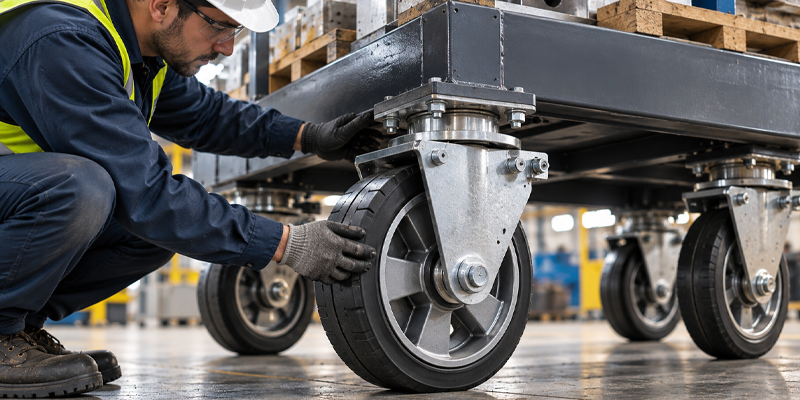
Common selection mistakes include:
- Choosing based only on the term "heavy-duty"
- Ignoring actual load capacity
- Forgetting the maximum payload
- Selecting an unsuitable wheel material
- Ignoring floor conditions
- Using the wrong caster configuration
- Overlooking environmental exposure
- Selecting a caster that does not fit the equipment
- Purchasing more capacity than required
Proper selection helps avoid unnecessary replacement costs and performance issues.
Do Heavy-Duty Casters Always Last Longer?
A higher load rating does not automatically guarantee longer service life.
Caster's life depends on:
- Operating conditions
- Movement frequency
- Wheel material
- Floor conditions
- Maintenance practices
- Proper installation
- Actual load requirements
A properly matched caster often performs better than an oversized caster that does not suit the application.
Maintenance Tips for Industrial and Heavy-Duty Casters
Regular inspection helps maintain reliable caster performance.
Maintenance Checklist
- Inspect wheels for wear and flat spots
- Check bearings
- Inspect mounting hardware
- Check swivel movement
- Test brakes and locks
- Remove debris
- Look for cracks or deformation
- Replace damaged components
- Establish inspection schedules
Industrial Casters vs Heavy-Duty Casters: Which Should You Choose?
The right caster depends on the application, not the label.
Choose industrial casters when:
- Loads are within standard industrial ratings.
- Equipment requires frequent movement.
- Carts, workstations, or tools are involved.
- Mobility and floor protection are priorities.
Consider heavy-duty casters when:
- Equipment and payloads are substantially heavier.
- High load capacity is required.
- Equipment operates under demanding conditions.
- Greater stability and durability are needed.
Do not choose based on the name alone. Select casters based on load, environment, floor conditions, mobility requirements, and equipment compatibility.
Atlanta Caster offers industrial and heavy-duty caster solutions for manufacturing, material handling, and other demanding applications. Review your equipment requirements carefully or contact the team for guidance on selecting the right caster configuration.
Frequently Asked Questions
1. What is the difference between industrial casters and heavy-duty casters?
Industrial casters describe a broad range of industrial mobility solutions, while heavy-duty casters focus on higher capacity and demanding applications.
2. Are heavy-duty casters stronger than industrial casters?
Heavy-duty casters are generally designed with stronger construction and higher load ratings, but specifications vary by product.
3. What load capacity do heavy-duty casters support?
Capacity depends on caster design, wheel material, and construction. Always check the rated capacity for the specific product.
4. Can industrial casters be used for heavy equipment?
Some industrial casters can support heavy equipment, but the required capacity and application conditions should be reviewed before selection.
5. Are heavy-duty casters better for manufacturing equipment?
Heavy-duty casters may be appropriate for heavier manufacturing equipment, but the best choice depends on the complete application.
6. Which wheel material is best for industrial casters?
The best wheel material depends on load, floor conditions, noise requirements, and operating environment.
7. Should I choose swivel or rigid heavy-duty casters?
Choose swivel casters for maneuverability, rigid casters for directional movement, or a combination when both are needed.
8. How do I calculate the load capacity needed for casters?
Divide the total operating weight by the number of load-bearing casters and include an appropriate safety margin.
9. Do larger caster wheels support heavier loads?
Larger wheels can improve movement over obstacles, but load capacity depends on the complete caster design.
10. How often should industrial and heavy-duty casters be inspected?
Inspection frequency depends on use, environment, and operating conditions. Regularly scheduled inspections are recommended.