Email US
 Hours
 Visit Our Showroom


What Are the Best Dual Wheel Casters for Moving Heavy Loads Without Damaging the Floor?
Nov 20th 2026
The best dual-wheel casters for moving heavy loads without damaging floors combine a properly rated caster assembly with a floor-friendly tread, typically polyurethane or other suitable rubber. A dual-wheel caster carries two wheels in a single rig, spreading weight across two contact patches. This can reduce concentrated floor pressure and make heavy equipment easier to swivel. The published caster capacity applies to the complete assembly, not to each wheel separately. For heavy industrial loads, consider heavy-duty casters and confirm your floor conditions, weight requirements, and mounting specifications with Atlanta Caster.
Heavy equipment can leave dents, scuffs, and permanent marks on finished floors when the wrong casters are installed. The problem is not always excessive weight. Sometimes, the wheel design concentrates too much force on a small contact area.
Dual-wheel casters, also called double-wheel casters or twin-wheel casters, address this problem by using two wheels within a single caster assembly.
Atlanta Caster & Equipment supplies both single- and dual-wheel configurations. We recommend the arrangement that fits the application, even when a simpler single-wheel caster is the more economical choice.
Understanding how wheel arrangement, tread material, and load capacity work together helps you select casters that protect floors without sacrificing mobility.
How Do Dual Wheel Casters Protect Floors Under Heavy Loads?
Dual wheel casters can reduce concentrated floor pressure by distributing weight across two wheel contact patches rather than one.
Every caster transfers weight from the equipment into the floor. The area where the wheel touches the surface is called the contact patch.
When heavy equipment rests on a narrow, rigid wheel, the load can become concentrated in a relatively small area. This creates higher localized pressure and increases the possibility of floor damage.
A dual wheel assembly distributes its supported load between two wheels. When both wheels maintain proper contact, their combined contact area can reduce concentrated loading.
This arrangement is particularly useful for:
- Finished concrete floors in manufacturing facilities
- Epoxy-coated warehouse and workshop floors
- Protected tile surfaces in commercial buildings
- Laboratory and healthcare flooring
- Finished stages and entertainment venues
However, two wheels do not automatically guarantee floor protection.
Tread hardness, wheel diameter, surface condition, and actual load distribution also affect pressure. A pair of hard steel wheels may still damage a sensitive surface.
The practical rule: Match the dual-wheel arrangement with a tread material approved for the floor and a caster rating appropriate for the equipment.
Why Are Double Wheel Casters Easier to Swivel Under Load?
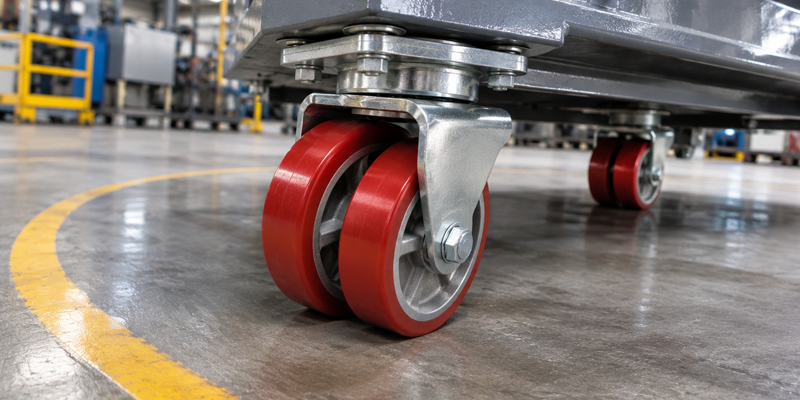
Double-wheel casters may require less swivel effort because their individual wheels can rotate at different speeds during a turn.
When a loaded caster changes direction, its wheels must follow curved paths.
A single wide wheel may experience tread scrubbing as the assembly changes direction. This creates resistance between the wheel and floor.
With independently rotating dual wheels, the inner and outer wheels can travel at different speeds. This helps reduce the sliding resistance associated with turning a wide contact surface.
The benefit is especially noticeable in applications involving frequent directional changes.
For example, a manufacturing operator repositioning a loaded machine base may need to make repeated turns within a limited workspace.
A suitable dual-wheel design may reduce steering effort compared with a comparable wide single-wheel configuration.
However, caster swivel geometry, bearings, tread composition, and floor condition also influence the result.
For facilities concerned about employee strain, our guide to reducing operator push force explains additional factors affecting equipment movement.
How Is Capacity Rated on Dual Wheel Casters?
The published capacity of a dual-wheel caster normally applies to the entire caster assembly, with the load shared between the two wheels.
This is one of the most important details to understand before selecting casters for heavy equipment.
A dual wheel caster contains two wheels, but its capacity is not automatically twice the rating of an individual wheel.
The complete assembly includes the mounting plate, swivel mechanism, fork, axle, bearings, and wheels.
Each component must withstand the intended working load.
For example, a dual-wheel caster rated for 2,000 pounds supports up to 2,000 pounds as a complete assembly under its specified operating conditions, not 2,000 pounds per wheel.
The published assembly rating must account for the applicable component limitations.
Also consider uneven loading, impacts, floor irregularities, and movement frequency when specifying the required capacity.
For additional guidance, see the guidance on calculating caster load capacity.
Atlanta Caster offers a heavy-duty caster category rated over 2,000 pounds for buyers comparing higher-capacity industrial options.
Expert Insight: Why Two Wheels Do Not Double Capacity
The most common sizing mistake is treating wheel count as a substitute for the caster's assembly rating.
Even when two wheels share the load, the swivel section, bearings, axle, and rig must withstand the applied forces. Equipment that experiences repeated impacts or high-frequency turns may require closer attention to swivel construction.
Kingpinless swivel casters are worth evaluating for demanding industrial conditions. However, their suitability depends on the actual load, movement pattern, and manufacturer specifications.
Which Tread Material Is Best for Twin Wheel Casters on Finished Floors?
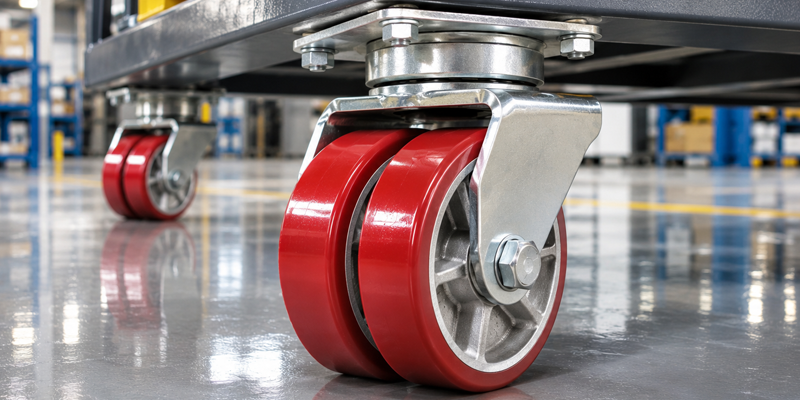
Twin wheel casters fitted with suitable polyurethane or rubber treads generally offer better floor protection than comparable hard-metal wheels.
Wheel material affects how pressure transfers to the floor.
Softer treads can deform slightly under load, increasing the contact area and helping reduce concentrated pressure.
Harder materials resist deformation and may support demanding loads, but they can also transmit greater pressure to sensitive surfaces.
|
Tread material |
Floor protection |
Load capacity tendency |
Typical environment |
|
Polyurethane |
Generally good on suitable finished floors |
Moderate to high, depending on construction |
Manufacturing, warehouses, coated concrete |
|
Rubber |
Generally good cushioning and grip |
Usually lower than comparable hard industrial wheels |
Healthcare, commercial facilities, protected floors |
|
Nylon |
Depends on floor hardness and finish |
Often suitable for substantial loads |
Smooth industrial floors |
|
Cast iron or steel |
Greater risk of marking or indentation |
Often suited to very heavy-duty applications |
Durable industrial flooring |
Table note: These are qualitative material comparisons, not measured floor-pressure or capacity figures. Actual performance depends on wheel construction, tread hardness, load, and floor conditions.
Polyurethane for Heavy Industrial Equipment
Polyurethane offers a useful combination of load support, wear resistance, and floor protection.
It is commonly considered for manufacturing carts, machine bases, and equipment operating over finished concrete.
Browse polyurethane casters to compare available wheel configurations.
Rubber for Sensitive Flooring
Rubber can provide cushioning and grip where surface protection is particularly important.
It may suit healthcare equipment, commercial carts, and applications where vibration and noise are concerns.
However, rubber compounds vary considerably. Verify load capacity and compatibility with the floor finish before purchasing.
Review rubber caster wheels for additional material choices.
Dual Wheel vs. Single Wheel Casters: Which Is Better?
Dual-wheel casters are often preferable for compact, heavy-load applications requiring frequent swiveling, while single-wheel casters may be simpler and more practical in dirty or debris-filled environments.
Neither design is automatically better for every application.
The correct choice depends on load, wheel material, clearance, movement requirements, and operating conditions.
|
Comparison factor |
Dual wheel casters |
Single wheel casters |
|
Floor pressure |
May spread loading across two contact patches |
Depends on the width and material of one wheel |
|
Swivel effort |
Independently rotating wheels can reduce turning resistance |
Wide wheels may scrub more during tight turns |
|
Capacity per footprint |
Can provide substantial capacity in a compact arrangement |
Depends on wheel diameter, width, and rig construction |
|
Overall height |
May offer compact arrangements for a given load |
Larger wheels may require additional clearance |
|
Debris sensitivity |
Material can collect between adjacent wheels |
No inter-wheel gap to collect debris |
|
Cost |
Often higher due to additional components |
Often less expensive for comparable basic configurations |
|
Maintenance |
Both wheels and bearings require inspection |
Usually fewer wheel components to inspect |
Table note: Comparisons describe typical design behavior, not tested performance figures. Cost, capacity, dimensions, and swivel resistance must be confirmed for the specific caster models.
A dual wheel caster is particularly attractive when a heavy machine must turn within a restricted space.
A single-wheel design may be preferable when the equipment travels mostly in a straight line, operates around debris, or needs to cross substantial floor obstacles.
The floor and operating environment should determine the choice, rather than wheel count alone.
Expert Insight: Check the Floor Before Choosing the Caster
A dual-wheel caster that works well on clean epoxy flooring may perform poorly on flooring with metal shavings, loose packaging, or outdoor debris.
Material trapped between the wheels can interfere with rotation and accelerate wear. In dirty applications, a larger single-wheel configuration may be more practical.
Before selecting a caster, identify the floor material, common debris, cleaning conditions, and obstacles along the travel route.
Three Applications Where Dual Wheel Casters Earn Their Cost
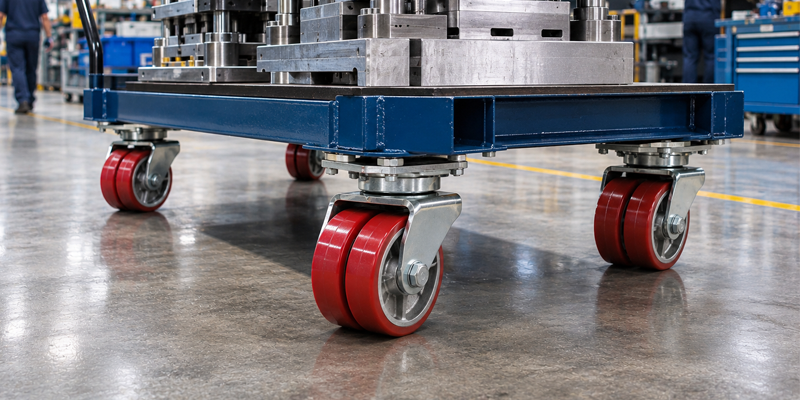
Dual wheel designs are especially useful when heavy equipment needs controlled movement across floors that must remain in good condition.
1. Manufacturing Die and Tooling Carts
Manufacturing facilities frequently move heavy dies, tooling, and machine components between workstations.
A properly rated dual-wheel caster with a suitable polyurethane tread can help distribute loading across finished concrete while supporting tight directional changes.
The exact caster specification must account for the cart's loaded weight and operating conditions.
2. Healthcare and Laboratory Equipment
Healthcare and laboratory facilities often operate equipment over finished or protected flooring.
Dual wheel casters with suitable non-marking treads may provide controlled movement while reducing concentrated surface pressure.
For these environments, buyers should also evaluate maneuverability, cleaning requirements, brakes, and floor compatibility.
3. Entertainment and Staging Equipment
Movies, entertainment productions, and staging operations frequently move equipment across finished surfaces.
Heavy staging carts and equipment platforms may benefit from dual-wheel arrangements when maneuverability and floor protection are important.
Wheel material must be checked against the stage finish, particularly when avoiding visible marks is a priority.
Similar selection principles apply to aerospace and defense equipment where loads, surface conditions, and handling requirements vary.
How to Choose Dual Wheel Casters at Atlanta Caster
Start with the equipment's weight and floor conditions, then select the caster construction, tread, and mounting arrangement required for safe movement.
Before purchasing, gather these details:
- Total loaded weight: Include the equipment and everything it carries.
- Load distribution: Identify uneven loading or shifting weight.
- Floor conditions: Specify concrete, epoxy, tile, or another surface.
- Movement pattern: Note frequent turns, straight travel, and towing.
- Mounting requirements: Confirm attachment dimensions and available clearance.
- Operating environment: Identify any debris, moisture, chemical, impact, or temperature concerns.
Atlanta Caster & Equipment serves industrial and commercial customers from its Tucker, Georgia, location.
Our team supports customers with caster selection, on-site application analysis, and specialized wheel requirements.
If standard models do not fit your equipment, we also offer custom casters for unusual loads.
For heavy industrial applications, review our heavy-duty casters and confirm each product's load capacity and wheel construction.
Need help selecting the right casters? Call 800-526-3087 or talk to a Certified Caster Specialist with your equipment specifications.
Frequently Asked Questions
What are the best dual wheel casters for moving heavy loads without damaging the floor?
The best dual-wheel casters combine sufficient assembly capacity with a floor-compatible tread, usually made of polyurethane or rubber. Two wheels distribute loading across separate contact patches, potentially reducing concentrated floor pressure. The correct selection depends on the equipment's weight, floor finish, turning requirements, and operating environment.
Do dual wheel casters really protect floors better than single wheels?
Dual wheel casters can provide better floor protection when their combined contact area reduces concentrated loading. However, protection also depends on tread hardness, diameter, and floor condition. Two hard metal wheels may still damage a sensitive surface. Always compare the complete wheel design rather than assuming two wheels automatically prevent damage.
Is a dual wheel caster's weight capacity per wheel or for the whole caster?
The published capacity of a dual wheel caster generally refers to the complete caster assembly. Its two wheels share the supported load, but the fork, axle, bearings, and mounting structure also limit capacity. Never multiply the assembly rating by 2 simply because the caster has 2 wheels.
Are dual wheel casters easier to push and swivel under heavy loads?
Dual wheel casters can be easier to swivel because independently rotating wheels accommodate different travel speeds during turns. This can reduce tread scrubbing compared with certain wide single-wheel designs. However, straight-line rolling resistance and pushing effort also depend on tread material, bearing quality, wheel diameter, load, and floor conditions.
What is the difference between dual, double, and twin wheel casters?
Dual wheel casters, double wheel casters, and twin wheel casters commonly refer to caster assemblies with two wheels mounted on a single rig. The terminology is often interchangeable, although manufacturers may use different product labels. Check the actual wheel arrangement, bearings, capacity, and mounting specifications rather than relying on the name alone.
What tread material should dual wheel casters have for finished floors?
Polyurethane and suitable rubber compounds are generally good starting points for protecting finished floors. Polyurethane may suit heavy industrial carts, while rubber can provide additional cushioning on sensitive surfaces. Verify the material's load rating, marking behavior, and compatibility with the particular floor coating before making a final selection.
When is a single wheel caster the better choice?
A single wheel caster may be better when the operating area contains debris, frequent floor obstacles, or surfaces that require a larger wheel diameter. Single-wheel assemblies can also be simpler to maintain and less expensive. If the load and floor permit, a correctly specified single-wheel caster may meet the requirement.
Can Atlanta Caster build custom dual wheel casters for unusual loads?
Yes. Atlanta Caster & Equipment provides custom caster and wheel solutions for applications that standard catalog products cannot adequately address. Options may involve different wheel sizes, materials, mounting arrangements, or load requirements. Share the equipment weight, dimensions, floor conditions, and movement pattern so the team can evaluate a suitable configuration.
Author Information
Atlanta Caster & Equipment supports manufacturing, healthcare, commercial, and industrial customers with caster selection and material-handling equipment. Based in Tucker, Georgia, the company offers application guidance, custom caster solutions, and assistance with demanding equipment mobility requirements.