Email US
 Hours
 Visit Our Showroom


What Are V-Groove Wheels? How They Ride on Angle-Iron Track
Oct 28th 2026
A V-groove wheel is an industrial wheel with a V-shaped channel in its rolling surface. The groove fits over a raised track, typically inverted angle iron, allowing heavy carts and equipment to follow a fixed path. Unlike ordinary wheels, V-groove wheels use the track itself for directional guidance.
Also called V-groove wheels, V-track wheels, or track wheels, these components are common in industrial material-handling systems.
Whether you're replacing worn wheels or designing track-guided machinery, understanding how they work helps you choose the correct replacement.
At Atlanta Caster & Equipment, we offer V-groove wheels for industrial applications.
What Is a V-Groove Wheel?
A V-groove wheel is a track-guided wheel designed to travel along a compatible raised rail. Its defining feature is the angled groove that helps keep equipment moving along a predetermined path.
A typical V-groove wheel includes four components:
- V-shaped groove: The channel that fits over the track and provides directional guidance.
- Tread shoulders: The rolling surfaces on either side of the groove.
- Hub: The central portion connecting the wheel body to its mounting arrangement.
- Bore or bearing: The center opening or bearing assembly that allows the wheel to rotate around an axle.
Many industrial V-groove designs use a 90-degree groove for compatible angle-iron track. However, actual groove angles must be confirmed against individual product specifications.
Unlike conventional caster wheels, metal V-groove wheels rely primarily on the track to guide movement rather than on a swivel assembly to steer.
This makes them useful for equipment that must travel repeatedly between fixed locations.
How V-Groove Wheels Ride on Angle-Iron Track
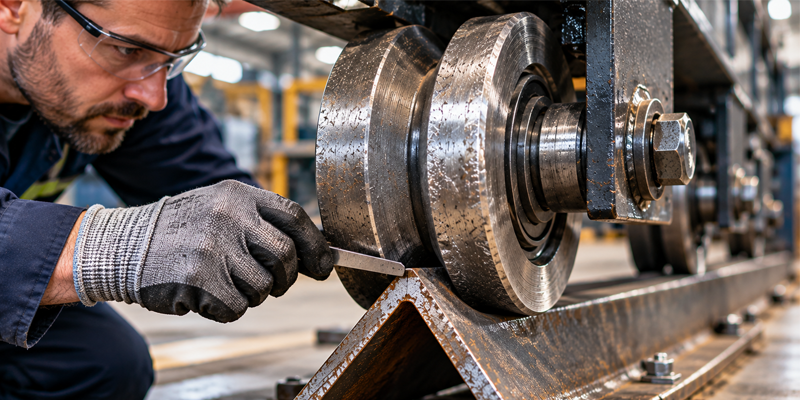
V-groove wheels work by fitting their angled rolling surface over a compatible raised track.
One commonly used track arrangement consists of inverted angle iron installed with its point facing upward.
As the wheel moves, its V-shaped groove rides along the track's raised apex.
How the Track Guides Movement
When a load rests on the wheel, the track and groove interact to limit sideways movement.
This helps the wheel remain centered and guides the equipment along a consistent route.
The resulting movement offers several practical benefits:
- Directional control: Equipment follows the installed track instead of moving freely across the floor.
- Repeatable travel: Carts can move between designated workstations along the same path.
- Controlled positioning: Track guidance helps equipment approach designated loading or transfer locations.
- Reduced exposure to floor debris: A raised running surface separates the main wheel-track contact area from some loose material on the surrounding floor.
However, track alignment remains important. Crooked, uneven, or improperly spaced rails can cause binding and excessive wear.
Some track wheel systems also use round-bar or pipe tracks, but their groove geometry must be compatible with those surfaces.
A standard V-groove wheel should not automatically be considered suitable for every rail profile.
For consistent operation, the wheel groove, track dimensions, mounting arrangement, and load capacity must work together.
V-Groove vs. Flat-Tread vs. Flanged Wheels
The main difference is directional guidance. Flat-tread wheels generally roll across suitable floors, while V-groove wheels follow a compatible raised track.
Flanged wheels provide another track-guided option, particularly for certain flat-rail applications.
|
Feature |
V-Groove Wheels |
Flat-Tread Wheels |
Flanged Wheels |
|
Rolling surface |
Raised V-shaped track |
Suitable for flat floors |
Compatible rail |
|
Directional guidance |
Groove follows track |
No built-in track guidance |
Flange helps guide wheel |
|
Floor operation |
Depends on wheel design |
Primary application |
Depends on design |
|
Typical application |
Guided industrial carts |
General material handling |
Rail-guided equipment |
Which Wheel Should You Choose?
Choose V-groove wheels when equipment needs to travel along a designated track.
Choose flat-tread wheels when the equipment must move across a suitable floor without a fixed route.
Consider flanged wheels when the rail design requires flange-based guidance.
The correct selection depends on how the equipment moves, its operating environment, and the track or floor surface.
These wheel types are not automatically interchangeable.
What Are V-Groove Wheels Made Of?
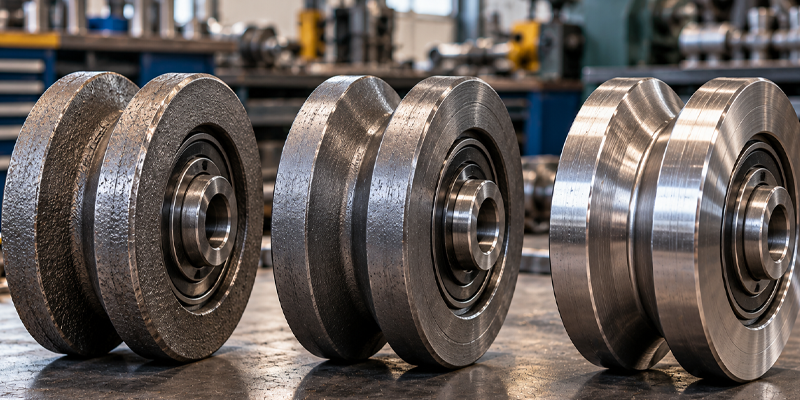
Industrial V-groove wheels are commonly manufactured from metal because track-guided equipment frequently handles substantial loads.
Material selection affects wheel durability, impact resistance, and performance on the track.
Cast Iron V-Groove Wheels
Cast iron is commonly used for heavy-duty V-groove wheels operating under steady loads.
Its rigid construction supports industrial equipment as it moves along suitable tracks.
However, cast iron can be more susceptible to damage from sudden impacts than ductile iron.
Ductile Iron V-Groove Wheels
Ductile iron offers greater resistance to shock loading than conventional cast iron.
This makes it worth considering for track-guided equipment that experiences repeated starts and stops or occasional impacts.
The appropriate choice still depends on the manufacturer's load rating and application recommendations.
Forged Steel V-Groove Wheels
Forged steel is another material used for demanding industrial track applications.
Atlanta Caster lists forged steel V-groove caster configurations. Exact dimensions, ratings, and mounting options should be verified against the selected product.
Bearings and Bore Options
V-groove wheels may use different bore and bearing arrangements depending on their design.
V-groove wheels with bearings can reduce rolling resistance when properly selected for the load and operating conditions.
The bearing type, bore diameter, and axle must be compatible.
Browse our metal caster wheels and cast iron casters to compare material options.
What Are V-Groove Wheels Used For?
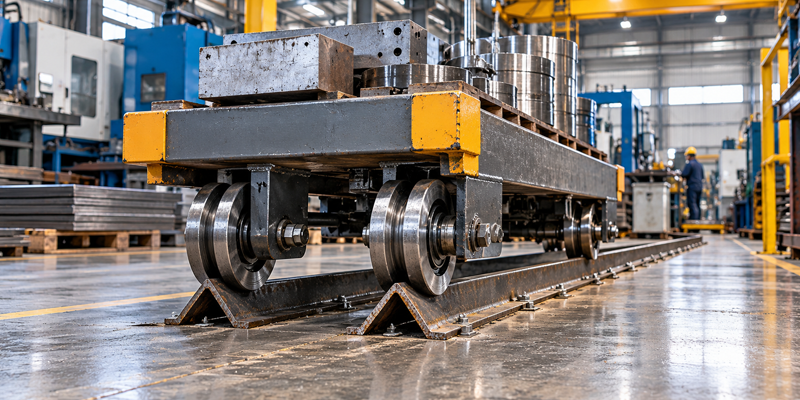
V-groove wheels are used wherever heavy equipment needs controlled, repeatable movement along a fixed track.
Common industrial applications include:
- Manufacturing: Track-guided transfer carts move parts, tooling, and materials between production stations.
- Automotive: Industrial carts transport heavy components and equipment along designated routes.
- Aerospace and defense: Track-guided systems help move large fixtures and specialized production equipment.
- Warehousing: Material-handling carts transport goods between fixed loading and storage locations.
- Heavy machinery: Movable machine bases and fixtures travel between designated work areas.
- Rolling gates: V-groove wheels support suitable sliding and rolling gate systems.
Example: Manufacturing Transfer Cart
Consider a manufacturing facility moving a heavy die between two presses.
Instead of manually steering the cart across the floor, V-groove wheels for carts allow it to follow an installed track between workstations.
Example: Movable Equipment Base
A production facility may use track-guided wheels for machinery that needs to be repositioned between fixed operating locations.
The track provides consistent directional guidance during movement.
Our manufacturing casters and automotive caster solutions support related industrial material-handling requirements.
For gate applications, see our guide to V-groove wheels for sliding and rolling gates.
V-Groove Wheel or V-Groove Caster?
A V-groove wheel and a V-groove caster are related products, but they are not the same assembly.
A V-groove wheel is the individual rolling component. It mounts onto a compatible axle or an existing equipment assembly.
A V-groove caster includes the wheel and additional mounting hardware, such as a rigid or swivel caster assembly.
Which should you purchase?
If the existing mounting assembly and axle remain serviceable, replacing only the wheel may be sufficient.
If the mounting assembly is bent, damaged, or excessively worn, replacing the complete caster may be necessary.
Read our guides on casters vs. caster wheels and whether to replace just the wheel for additional guidance.
V-Groove Wheel Sizes and the Three Checks Before You Order
V-groove wheels come in different diameters, tread widths, and bore sizes.
Atlanta Caster product listings include V-groove wheel and caster configurations with varying dimensions. Confirm available sizes and stock status before ordering.
Three compatibility checks matter most:
- Track fit: Verify that the groove profile and dimensions match the installed track.
- Axle fit: Confirm the bore diameter and bearing arrangement match the mounting system.
- Load capacity: Ensure the manufacturer's per-wheel rating supports the expected operating load.
Ordering by wheel diameter alone can result in incorrect fitment.
For detailed instructions, read our guide on how to match a V-groove wheel to your track.
Can V-Groove Wheels Be Used Outdoors?
Yes, V-groove wheels can operate outdoors when their materials, finishes, bearings, and mounting arrangements are suitable for the environment.
However, unprotected iron and steel can develop rust when exposed to moisture.
Outdoor tracks also collect dirt, gravel, leaves, and other debris that may interfere with wheel movement.
Regular inspection and track cleaning help maintain reliable operation.
Before selecting wheels for an outdoor application, confirm the manufacturer's environmental recommendations and available protective finishes.
Common V-Groove Wheel Mistakes
Several selection and installation mistakes can shorten wheel service life or cause operating problems.
Common mistakes include:
- Installing new wheels on worn or damaged tracks.
- Selecting wheels with an incompatible groove profile.
- Installing tracks that are not straight, level, or correctly spaced.
- Choosing wheels based only on outside diameter.
- Ignoring bore dimensions and bearing compatibility.
- Mixing heavily worn wheels with new wheels without checking load distribution.
- Exceeding the manufacturer's published wheel capacity.
Checking these factors before installation helps prevent unnecessary replacements and equipment downtime.
Find the Right V-Groove Wheel at Atlanta Caster & Equipment
Need reliable track wheels for your industrial equipment?
Browse Atlanta Caster & Equipment's V-groove wheel selection to review available materials, sizes, and configurations.
For nonstandard applications, ask about our custom wheel solutions.
Not sure which wheel fits your existing track? Call 800-526-3087 or send us your wheel measurements for help selecting the appropriate option.
Frequently Asked Questions
1. What materials are V-groove wheels made from?
Industrial V-groove wheels are commonly made from cast iron, ductile iron, and forged steel. Material selection depends on load requirements, impact exposure, track compatibility, and operating conditions.
2. Can a V-groove wheel roll on a flat floor?
Some V-groove wheel designs can roll on suitable flat surfaces using their tread shoulders. However, their primary purpose is guided movement on a compatible raised track.
3. Are V-groove wheels the same as U-groove wheels?
No. V-groove and U-groove wheels have different groove profiles. The correct wheel depends on the shape and dimensions of the track it must follow.
4. Do V-groove wheels come with bearings?
Some V-groove wheels include bearing assemblies, while others have different bore arrangements. Check the individual product specifications to make sure of availability of bearings and axle compatibility.