Email US
 Hours
 Visit Our Showroom


What Is Thermoplastic Rubber (TPR)? TPR Wheels vs Rubber and Polyurethane
Nov 5th 2026
Thermoplastic rubber (TPR) is a flexible, rubber-like material that softens when heated, allowing manufacturers to mold it like plastic while retaining many of rubber's cushioning and gripping properties. In caster wheels, TPR provides a quiet, non-marking tread suitable for sensitive flooring and light- to medium-duty equipment.
Thermoplastic rubber wheels are commonly used on hospital carts, food service equipment, laboratory carts, and light warehouse equipment.
But how do TPR wheels compare with conventional rubber and polyurethane?
Understanding the differences in load capacity, rolling resistance, floor protection, and durability among caster materials can help you select the right caster material for your facility.
What Is Thermoplastic Rubber?
Thermoplastic rubber belongs to the thermoplastic elastomer (TPE) family, a group of materials combining rubber-like flexibility with the processing characteristics of thermoplastics.
Unlike conventional vulcanized rubber, which undergoes permanent chemical curing, TPR softens when heated and hardens when cooled.
This allows manufacturers to mold it into specific shapes while maintaining the flexibility needed for caster applications.
In industrial wheels, a TPR tread is typically molded around a harder supporting core. The tread provides cushioning and traction, while the core supports the wheel's structure.
Many thermoplastic elastomer wheels feature gray treads, although other colors are possible.
Atlanta Caster identifies its thermoplastic wheel line as non-marking. However, color alone does not establish whether every wheel formulation will resist leaving marks.
TPR is also different from rigid plastic wheels, which generally provide less cushioning.
When comparing industrial caster materials, TPR falls between conventional soft rubber and harder wheel options, depending on its formulation.
Benefits of Thermoplastic Rubber Wheels
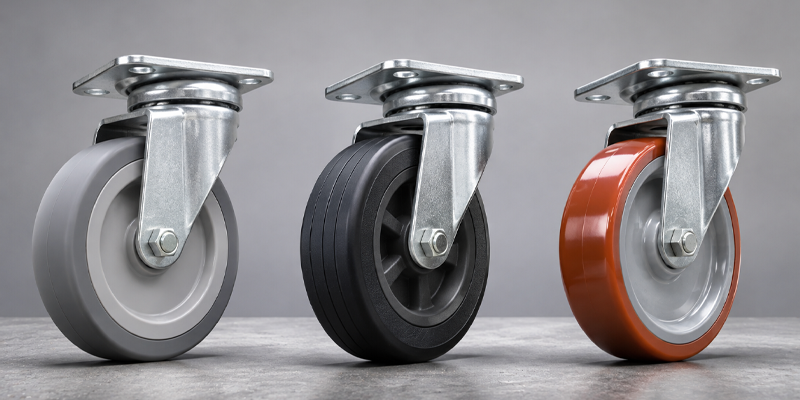
Thermoplastic rubber wheels offer several advantages for facilities where floor protection, quiet operation, and easy equipment movement matter.
Atlanta Caster describes its TPR wheels as lightweight, non-marking, and resistant to impact, water, and certain chemicals.
1. Non-Marking Floor Protection
TPR wheels are particularly useful on finished surfaces where visible streaks are undesirable.
Their resilient treads also help reduce the risk of scratches from direct contact with hard wheel surfaces.
This makes them suitable for vinyl flooring, sealed surfaces, and other floor-sensitive environments.
2. Quieter Rolling
The flexible tread absorbs some vibration during movement, reducing rolling noise compared with harder wheels.
For hospitals, laboratories, and customer-facing facilities, quieter equipment movement can improve daily working conditions.
3. Impact and Vibration Absorption
TPR provides cushioning when carts cross minor surface irregularities.
This helps reduce vibration transmitted through the cart and its contents, which is useful when transporting equipment or sensitive materials.
4. Water and Chemical Resistance
TPR can tolerate exposure to water and certain chemicals.
However, resistance varies by formulation and the substances involved. Always check chemical compatibility with the wheel material before using cleaning solutions.
5. Easy Movement for Lighter Equipment
For appropriately loaded carts, TPR provides a practical balance of traction, cushioning, and maneuverability.
Explore Atlanta Caster's thermoplastic rubber casters for suitable applications.
Where Thermoplastic Rubber Wheels Fall Short
Although TPR offers useful properties, it isn't the right material for every industrial application.
Limited Heavy-Load Capacity
Atlanta Caster positions thermoplastic rubber wheels primarily for light- to medium-duty applications.
For heavier equipment, polyurethane casters or solid elastomer alternatives may offer better load-bearing performance.
Always compare individual wheel ratings.
Potential Flat-Spotting
Resilient treads can temporarily deform when heavily loaded equipment remains stationary for extended periods.
This may cause uneven rolling when the cart moves again.
Higher Rolling Resistance Under Load
TPR typically compresses more than harder polyurethane compounds.
That compression can increase the force required to move heavily loaded equipment across smooth floors.
Environmental Limitations
Sharp debris may damage softer treads. High temperatures and long term exposure to sunlight can also affect certain TPR formulations.
Before selecting thermoplastic rubber wheels for heavy loads, outdoor equipment, or demanding industrial conditions, confirm product suitability with the supplier.
TPR vs. Rubber vs. Polyurethane: What's the Difference?
The main differences among thermoplastic rubber, conventional rubber, and polyurethane caster wheels lie in their flexibility, load-bearing capacity, and suitability for different floor types.
TPR generally prioritizes cushioning and quiet operation. Conventional rubber performance varies significantly by hardness, while polyurethane often provides greater wear resistance and higher load capacity.
|
Feature |
TPR Wheels |
Conventional Rubber Wheels |
Polyurethane Wheels |
|
Tread feel |
Soft and flexible |
Soft to hard |
Usually firmer |
|
Relative load support |
Light to medium |
Varies by compound |
Often medium to heavy |
|
Rolling noise |
Low |
Low to moderate |
Low to moderate |
|
Floor marking |
ACE TPR line: non-marking |
Depends on compound |
Check product specifications |
|
Floor protection |
Good |
Varies by hardness |
Generally good |
|
Push effort |
May increase under heavier loads |
Varies by hardness |
Often lower under load |
|
Water exposure |
Resistant, subject to specifications |
Compound dependent |
Formulation dependent |
|
Chemical exposure |
Check chemical compatibility |
Compound dependent |
Formulation dependent |
|
Common applications |
Medical and light-duty carts |
Utility and industrial carts |
Heavier material handling equipment |
How Do TPR Wheels Compare to Polyurethane?
TPR generally offers greater cushioning, while polyurethane is often preferred for heavier loads and applications where reduced tread deformation matters.
However, performance depends on the exact wheel formulation and operating conditions.
For a closer comparison of the other two materials, read our guide to rubber vs. polyurethane casters.
Flat Tread vs. Round Tread TPR Wheels
Atlanta Caster offers both flat-tread and round-tread thermoplastic rubber wheels.
Although the material may be similar, tread shape changes how the wheel contacts the floor.
Flat-Tread TPR Wheels
Flat treads provide a broader contact patch against smooth flooring.
This can distribute contact pressure across a wider surface and provide a steady rolling feel.
They are useful for equipment that primarily travels in straight paths across level floors.
Round-Tread TPR Wheels
Round treads feature a curved running surface with a smaller contact patch.
This design can make directional changes and swiveling easier, particularly on carts requiring frequent turns.
Neither tread shape automatically guarantees greater load capacity.
Always compare individual wheel specifications, including diameter, tread width, and manufacturer ratings, before choosing between flat and round profiles.
Where Do TPR Wheels Work Best?
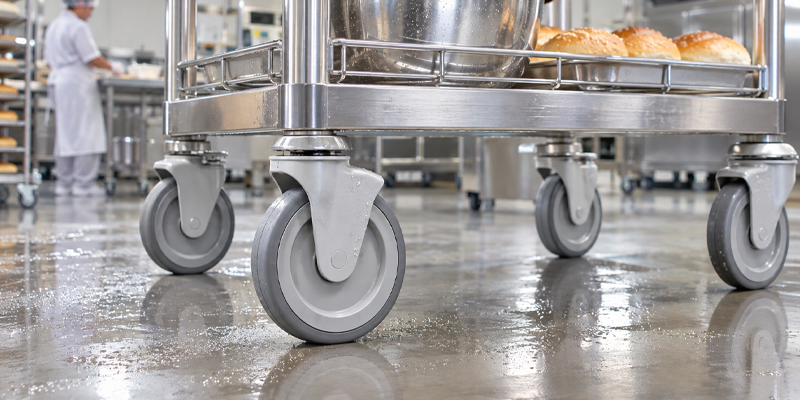
Thermoplastic rubber wheels are particularly useful in facilities that need quiet movement, floor protection, and dependable maneuverability.
Hospitals and Clinics
Medical supply carts, equipment stands, and transport carts frequently move across finished floors.
TPR's cushioning and non-marking properties make it a practical choice for many healthcare caster applications.
Food Processing and Bakeries
Food service carts and bakery equipment often require regular movement and floor-friendly treads.
TPR may suit certain applications, but cleaning chemicals, moisture, and temperature requirements must be checked.
Explore food service and bakery caster applications for additional selection guidance.
Laboratories and Clean Rooms
Atlanta Caster identifies thermoplastic casters as suitable for clean-room environments.
Their non-marking properties support applications where visible tread residue is undesirable.
However, specific contamination-control or cleanroom certification requirements must be verified separately.
Retail and Light Warehouse Equipment
Display fixtures, inventory carts, and lighter material handling equipment can benefit from TPR's quieter rolling and cushioning.
TPR generally works best on smooth indoor flooring.
Rough concrete, sharp debris, and demanding outdoor conditions require additional consideration before selecting the material.
How to Choose the Right TPR Wheel
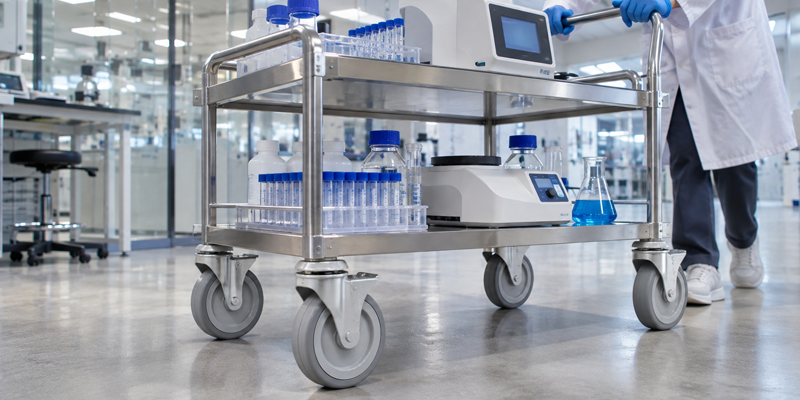
Choosing suitable thermoplastic rubber wheels requires matching the wheel's specifications to the equipment and operating environment.
Follow these steps:
- Check load capacity: Calculate the equipment's maximum loaded weight and compare it with each wheel's rated capacity.
- Select the diameter: Atlanta Caster's TPR range includes approximately 2- to 12-inch wheels, depending on the product.
- Choose tread shape: Compare flat and round tread profiles based on movement and steering requirements.
- Confirm fitment: Verify axle bore, hub length, bearing type, and mounting compatibility.
- Consider the environment: Account for floor material, moisture, cleaning chemicals, and operating temperature.
- Choose wheel or caster assembly: Decide whether you need a replacement wheel or a complete swivel or rigid caster.
For applications requiring frequent movement across delicate surfaces, also confirm that the selected product meets your floor-marking requirements.
Shop TPR Wheels and Casters at Atlanta Caster
Atlanta Caster & Equipment offers thermoplastic rubber wheels and casters for healthcare, food service, laboratory, and light industrial applications.
Browse our TPR replacement wheels or explore complete thermoplastic caster assemblies to compare available configurations.
Need assistance with load capacity, tread selection, or replacement measurements?
Call Atlanta Caster at 800-526-3087 to discuss suitable wheel options for your equipment.
Frequently Asked Questions
1. Are thermoplastic rubber wheels suitable for outdoor use?
Some TPR wheels can handle limited outdoor exposure, but prolonged sunlight, rough surfaces, and weather conditions may affect performance. Confirm the manufacturer's outdoor-use recommendations before purchasing.
2. Are thermoplastic rubber wheels noise-free?
No. TPR wheels generally roll more quietly than hard industrial wheels, but they aren't completely silent. Noise depends on floor conditions, load, bearings, and equipment construction.
3. Is thermoplastic rubber safe?
TPR can be suitable for many workplace and floor-sensitive applications when used within product specifications. Food-contact, medical, or cleanroom safety claims require separate manufacturer certification.
4. Is TPR the same as TPE?
TPR is a type of thermoplastic elastomer (TPE). TPE describes a broader material family, while TPR commonly refers to rubber-like formulations within that family.