Email US
 Hours
 Visit Our Showroom


Which Nylon Caster Wheels Work Well for Wet or Oily Areas?
Nov 18th 2026
Nylon caster wheels are hard thermoplastic wheels generally suited to carts operating on wet or oily floors. Complete nylon casters include the wheel and its mounting assembly. Nylon typically offers good resistance to oils, grease, and many cleaning chemicals, making it useful in food processing, bakeries, manufacturing, and automotive shops. However, hard nylon treads may provide less traction on wet, smooth floors than softer materials. For washdown applications, the caster rig and bearings must also resist corrosion. Atlanta Caster offers nylon casters in different designs and sizes.
Atlanta Caster & Equipment supplies nylon casters and alternative wheel materials, including polyurethane. We recommend evaluating the operating conditions before choosing either material, especially where slippery floors, frequent cleaning, or heavy loads are involved.
Why Wet and Oily Floors Damage the Wrong Caster Wheels
Moisture and oil can shorten caster life through wheel swelling, tread deterioration, and bearing corrosion.
A caster that performs reliably in a dry warehouse may develop problems when moved into a wet production area. The difference often comes down to how its components respond to contamination.
Three common failure points include:
- Moisture absorption: Some wheel materials absorb water and undergo dimensional changes, which can affect rolling performance.
- Tread deterioration: Oils, grease, and incompatible cleaning chemicals may soften, weaken, or damage certain tread compounds.
- Bearing corrosion: Water entering unprotected bearings can cause rust, increased rolling resistance, and eventual seizure.
These problems are especially relevant in food processing plants, commercial bakeries, automotive repair shops, and manufacturing facilities.
For example, a bakery ingredient cart may move between wet cleaning stations and dry storage areas. An automotive parts cart may come into contact with lubricants and cutting fluids throughout the day.
Both applications require wheels that withstand their operating environment without sacrificing predictable handling.
Choosing the correct caster material helps reduce premature wear, but material selection alone cannot eliminate every failure risk.
What Makes Nylon Work in Wet and Oily Areas? (Oil-Resistant Casters)
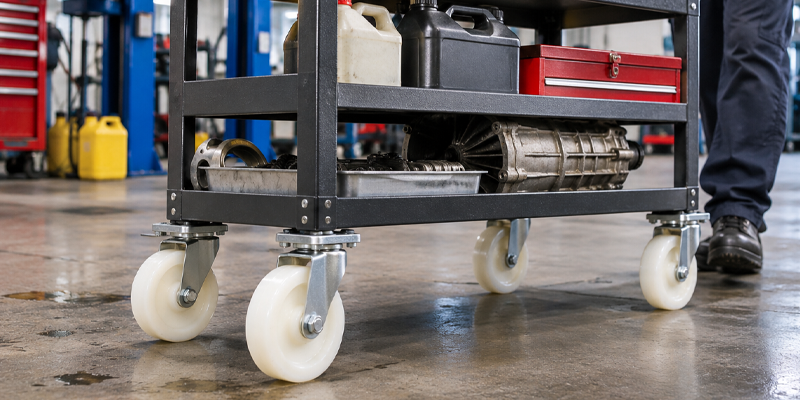
Nylon casters generally resist many oils and greases while offering a hard, relatively easy-to-clean rolling surface.
Nylon is a tough engineering thermoplastic commonly used in industrial wheels. Its hardness helps maintain wheel shape under suitable loads, while its resistance to many lubricants makes it useful around machinery.
Unlike metal wheels, nylon treads do not rust. Their relatively smooth surfaces also make routine removal of oil and dirt practical.
However, nylon is not completely waterproof. Its moisture absorption depends on the nylon grade, exposure duration, and operating conditions.
Key Properties of Nylon Caster Wheels
|
Property |
How Nylon Behaves |
What Buyers Should Consider |
|
Moisture resistance |
Generally absorbs limited moisture compared with highly absorbent materials |
Prolonged exposure can still cause dimensional changes |
|
Oil resistance |
Typically resists many common oils and greases |
Confirm compatibility with specific lubricants |
|
Chemical resistance |
Tolerates various cleaning agents, depending on formulation |
Concentration, temperature, and exposure duration matter |
|
Rolling resistance |
Hard treads generally roll readily across smooth, firm floors |
Surface contamination affects handling |
|
Cleanability |
Smooth surfaces are relatively easy to rinse and wipe |
Bearings and mounting assemblies also need cleaning |
|
Load support |
Rigid construction can support demanding industrial applications |
Capacity depends on the specific caster assembly |
Table note: Qualitative material guidance based on general nylon characteristics and Atlanta Caster's published material information. No numerical performance ratings are implied.
Which Caster Wheels Hold Up to Cleaning Chemicals?
Chemical-resistant casters must be selected based on the cleaning chemicals used, not simply on the wheel material name.
Nylon generally tolerates many cleaning products, but certain acids, oxidizers, and aggressive chemical formulations can damage specific nylon grades.
A wheel exposed to occasional detergent cleaning may face substantially different conditions from one repeatedly sprayed with concentrated sanitizers.
Before purchasing, document the chemicals used, their concentrations, cleaning temperatures, and contact times.
Chemical compatibility requires confirmation against the wheel manufacturer's specifications. The same review should cover seals, bearings, and mounting hardware.
Where Nylon Falls Short on Wet Floors
Hard nylon wheels offer strength and relatively easy rolling, but their limited cushioning and traction can be disadvantages on slippery floors.
Nylon is not automatically the right choice for every wet-floor application.
Its rigid tread provides less surface conformity than softer materials. On smooth, sealed concrete or tile contaminated with water or oil, available grip can be reduced.
The difference becomes especially important when employees push loaded carts through corners, ramps, or frequently washed production areas.
Three Limitations Worth Checking
1. Wet-floor traction
Hard nylon may slip more readily than a suitable softer tread on smooth, contaminated surfaces. Traction depends on flooring, wheel design, load, and the amount of contamination.
2. Noise and vibration
Nylon wheels generally generate more rolling noise and transmit more vibration than softer polyurethane or rubber alternatives.
3. Floor protection
Although nylon wheels may be non-marking in some applications, non-marking does not necessarily mean non-damaging.
Hard wheels can concentrate loads against softer flooring or damaged surface coatings.
Manufacturers specify wheel hardness using measures such as durometer. However, a hardness value alone cannot establish wet-floor traction.
Expert Insight #1: When the Floor Is Both Oily and Slippery
Certified Caster Specialist guidance
If your floor is oily and traction is a concern, don't select a hard wheel solely because it resists oil. Consider how the cart behaves during turns, braking, and changes in floor level. A softer tread may offer better contact with the floor, provided it can tolerate the lubricant.
Testing a representative caster under actual operating conditions is often worthwhile. When in doubt, tell us the floor, the load, and the cleaning chemical, and we'll match the wheel.
Nylon vs. Polyurethane Casters for Wet or Oily Areas
Nylon is often preferable where oil exposure and washability matter most, while polyurethane can be preferable for traction, floor protection, and quieter operation.
Both materials have legitimate industrial applications. The right decision depends on which operating conditions create the greatest risk.
|
Selection Factor |
Nylon Casters |
Polyurethane Casters |
|
Oil exposure |
Generally good resistance |
Formulation-dependent resistance |
|
Wet-floor grip |
Harder tread may provide less grip |
Softer tread may improve contact |
|
Rolling noise |
Typically louder |
Typically quieter |
|
Floor protection |
Requires care on sensitive surfaces |
Generally more forgiving |
|
Cleaning |
Smooth tread is relatively easy to clean |
Compatibility depends on formulation |
|
Load handling |
Rigid construction suits many demanding loads |
Depends on wheel core, tread, and design |
Table note: Directional comparison based on material characteristics and Atlanta Caster's published caster comparison. Actual performance varies by product and application.
For a machining cart exposed to lubricants, nylon may be a reasonable starting point.
For a cart traveling across polished warehouse floors, polyurethane may provide better operator comfort.
Neither material guarantees traction on contaminated surfaces.
For additional material comparisons, read Atlanta Caster's nylon vs polyurethane casters guide.
Matching the Whole Caster to a Washdown Environment (Washdown Casters)
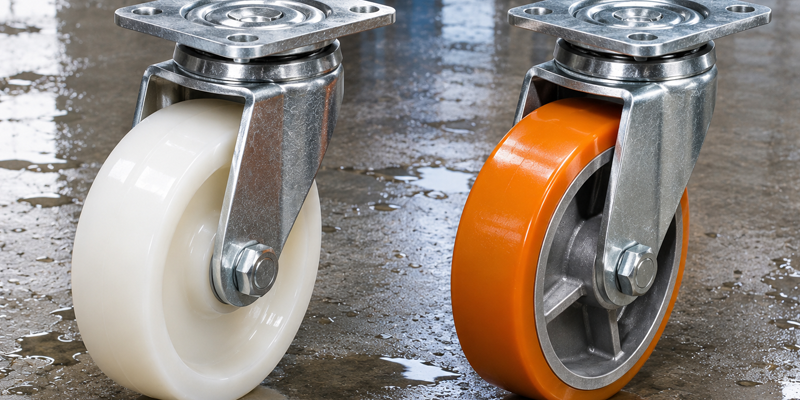
The best washdown casters combine a compatible wheel material with corrosion-resistant mounting hardware and appropriately protected bearings.
For food-processing carts, a nylon wheel alone does not make the caster suitable for repeated washdowns.
Water and cleaning solutions can reach the axle, swivel mechanism, bearings, fasteners, and mounting plate.
If these components deteriorate, the entire caster may fail despite an undamaged wheel.
Five Questions to Ask Before Choosing Washdown Casters
- What is the caster rig made of? Stainless steel rigs are generally preferable in environments where frequent moisture exposure poses corrosion concerns. Verify the steel grade against the cleaning environment.
- Are the bearings protected? Consider sealed bearings designed for the intended moisture exposure. Confirm whether they can withstand the facility's washdown procedures.
- What load must each caster support? Calculate the cart's total loaded weight, accounting for uneven distribution, movement, and impacts. Confirm the complete caster's rated capacity.
- How hard should the tread be? Evaluate traction, floor condition, rolling resistance, and potential surface damage rather than choosing by wheel hardness alone.
- Which cleaning chemicals are used? Confirm compatibility with the wheel, seals, bearings, and rig. Include chemical concentration and cleaning temperature in the review.
Selecting Casters for Food Processing and Bakeries
Food-processing facilities often use cleaning procedures intended to support sanitation and HACCP-based food safety programs.
However, a washable caster is not automatically certified for food contact or compliant with a particular food safety requirement.
Application-specific verification remains essential.
Atlanta Caster provides stainless steel casters to businesses requiring them for food processing and bakeries.
Expert Insight #2: Why Replacing Only the Wheel Can Be a Mistake
Certified Caster Specialist guidance
A common maintenance mistake is installing a new wheel on a rig that already shows corrosion. The replacement may roll properly at first, but damaged bearings, worn swivel components, or a weakened mounting assembly can cause recurring problems.
Inspect the axle, mounting hardware, bearing movement, and swivel assembly before deciding on a wheel-only replacement. If the rig is compromised, replacing the complete caster may be the more practical decision.
Choosing Nylon Casters at Atlanta Caster
Atlanta Caster offers nylon casters in multiple configurations and provides specialist assistance for matching wheels to demanding applications.
Founded in 1982, Atlanta Caster & Equipment serves industrial and commercial customers from its Tucker, Georgia, location.
Its nylon caster collection includes swivel casters, fixed casters, hard nylon wheels, and heavy-duty options.
Specific capacities, bearing types, mounting dimensions, chemical compatibility, and current inventory require verification against individual product listings.
The company's published service information states that many products are stocked and most items ship within 24–48 hours. Shipping and availability should be confirmed for the selected product.
Atlanta Caster also provides on-site application analysis, custom caster design, and assistance from Certified Caster Specialists.
For an application with uncertain specifications, call 1-800-526-3087 or talk to a Certified Caster Specialist.
Have the cart's loaded weight, floor type, operating conditions, cleaning chemicals, and existing caster measurements available when requesting recommendations.
Frequently Asked Questions
Which nylon caster wheels work well for carts that roll through wet or oily areas?
Hard nylon caster wheels generally work well where carts encounter moisture, lubricants, and routine cleaning. Nylon resists many oils and is relatively easy to clean. However, hard treads can provide limited traction on slippery floors. Choose complete casters with appropriate corrosion-resistant rigs, protected bearings, and verified load ratings.
Do nylon wheels absorb water or swell?
Yes. Nylon absorbs some moisture, although the amount depends on its formulation and operating conditions. Prolonged exposure can cause dimensional changes, including swelling. This does not automatically make nylon unsuitable for wet environments. Buyers should confirm the specific wheel's moisture-related limitations when frequent washdown or prolonged immersion is expected.
Are nylon casters resistant to oil and grease?
Nylon caster wheels generally resist many common industrial oils and greases, making them suitable candidates for automotive workshops, manufacturing facilities, and machinery carts. However, resistance varies with the nylon formulation and lubricant involved. Verify compatibility when wheels are exposed to concentrated chemicals, unusual lubricants, or prolonged exposure.
Can nylon casters handle washdown cleaning chemicals like bleach?
Some nylon formulations tolerate certain cleaning solutions, but compatibility with bleach cannot be assumed. Chemical concentration, temperature, contact duration, and nylon grade affect performance. Bleach may also damage metal components or bearings. Request manufacturer compatibility information before specifying nylon casters for repeated bleach exposure or aggressive sanitation procedures.
Are nylon caster wheels slippery on wet floors?
Hard nylon wheels can have less traction than softer wheels on wet, smooth surfaces such as sealed concrete or tile. Oil contamination may further reduce grip. Suitability depends on the floor finish, load, wheel design, and operating conditions. Evaluate braking, turning, and ramp travel before selecting nylon for slippery areas.
Nylon or polyurethane: Which is better for a wet warehouse or plant floor?
Nylon is generally worth considering when chemical exposure, hard-wearing treads, and straightforward cleaning are priorities. Polyurethane may be preferable when traction, quieter movement, and floor protection matter more. Both materials have limitations. Match the exact wheel formulation to the floor, contamination, load, and cleaning process.
What should the caster rig be made of in a washdown area?
Stainless steel is generally a suitable rig material for washdown applications because it offers corrosion resistance. However, not all stainless steel grades withstand all cleaning chemicals equally well. Bearing protection, mounting hardware, swivel construction, and cleanability must also be evaluated before selecting a complete caster assembly.
Does Atlanta Caster stock nylon casters for food processing carts?
Atlanta Caster lists nylon caster configurations and supports food-processing and bakery applications. Its catalog includes fixed, swivel, and heavy-duty nylon options. However, current inventory and suitability for a particular food-processing cart require verification. Contact Atlanta Caster with your cleaning procedures, floor conditions, load requirements, and mounting details before ordering.
Need Help Selecting Nylon Casters for Your Facility?
Call Atlanta Caster & Equipment at 1-800-526-3087 or use the contact form to discuss your cart's operating conditions with a Certified Caster Specialist.
About Atlanta Caster & Equipment
Atlanta Caster & Equipment, Inc., founded in 1982, is a caster, wheel, and material-handling equipment distributor based in Tucker, Georgia. Its team includes Certified Caster Specialists and offers on-site analysis, custom design assistance, and application-specific product guidance for industrial and commercial customers.