Email US
 Hours
 Visit Our Showroom


Hard Rubber vs Soft Rubber vs Mold-On Rubber Wheels: Which Fits Your Cart?
Nov 11th 2026
Hard rubber caster wheels generally support heavier loads and roll easily on smooth industrial floors. Soft rubber wheels provide better cushioning, quieter movement, and greater floor protection. Mold-on rubber wheels combine a soft rubber tread with a metal core, offering additional structural support for carts and equipment.
One important distinction is that soft rubber refers to tread hardness, while mold-on rubber refers to how the wheel is constructed. They aren't completely separate materials.
Whether you're replacing wheels on a warehouse cart, bakery rack, or maintenance trolley, understanding these differences helps you choose the right rubber caster wheels for your application.
Hard, Soft, and Mold-On Rubber: What Each Term Means
Industrial rubber wheels are categorized by tread hardness, construction, and intended applications.
Hard Rubber Wheels
Hard rubber wheels use rigid rubber compounds that resist compression under load. Their firm treads provide lower rolling resistance on smooth surfaces, making them suitable for equipment that requires frequent movement.
Soft Rubber Wheels
Soft rubber wheels use more flexible compounds that compress slightly under weight. This flexibility provides cushioning, absorbs vibration, and reduces noise. Solid rubber wheels have no air-filled chamber, and the term can describe either hard or soft rubber construction.
Mold-On Rubber Wheels
Mold-on rubber wheels feature a rubber tread bonded to a rigid metal core. The core provides structural support, while the outer rubber layer offers cushioning and floor protection.
Wheel hardness is commonly measured using a durometer scale. Softer rubber generally falls within the Shore A scale, while much harder compounds may be measured using Shore D.
However, actual hardness varies by formulation. Always refer to the manufacturer's specifications rather than assuming a specific durometer rating.
Hard Rubber Caster Wheels: Benefits and Limits
Hard rubber caster wheels are designed for applications where durability, relatively high load capacity, and easy rolling matter more than cushioning.
Their firm construction helps them maintain their shape under loads that may cause softer wheels to compress significantly.
Benefits of Hard Rubber Wheels
- Higher relative load capacity: Hard rubber generally supports heavier loads than comparable soft rubber constructions.
- Easier rolling on smooth floors: The rigid tread deforms less, reducing rolling resistance.
- Durable construction: Hard rubber withstands regular movement across suitable industrial surfaces.
- Cost-conscious replacement: These wheels provide a practical option for routine equipment maintenance.
Hard rubber wheels work well on shop carts, utility carts, industrial racks, and other equipment operating primarily on firm, smooth surfaces.
Atlanta Caster's hard rubber range includes wheel diameters of approximately 2 to 5 inches, with various tread widths. Available configurations include swivel, rigid, and stem casters.
For example, 4-inch hard-rubber caster wheels may suit compact equipment that requires a firm tread and manageable rolling resistance.
Disadvantages of Hard Rubber Caster Wheels
Hard rubber provides less cushioning than softer alternatives. As a result, it can transmit vibration to the equipment and produce more noise on rough flooring.
Some black hard rubber compounds may also leave marks on finished surfaces.
For equipment that transports delicate materials or operates in quiet environments, a softer wheel may be preferable.
Soft Rubber Wheels: Quiet and Cushioned

Soft rubber wheels are often selected for equipment that needs gentle movement, vibration absorption, and reduced rolling noise.
Their flexible treads compress slightly when moving across floors, helping cushion equipment and reduce the effects of minor surface imperfections.
This makes them suitable for carts and fixtures used in healthcare facilities, retail stores, libraries, and other indoor environments where noise is a concern.
Benefits of Soft Rubber Wheels
- Quieter movement compared with hard rubber.
- Better absorption of minor shocks and vibrations.
- Reduced pressure on sensitive flooring.
- Comfortable movement for lighter equipment.
However, soft rubber generally has lower load capacity than harder tread materials.
When heavily loaded equipment remains stationary for extended periods, the tread may develop temporary flat spots or deformation.
Soft rubber can also require greater pushing effort under heavier loads because more energy is lost through tread compression.
Atlanta Caster's soft rubber caster offerings include sizes of approximately 2 to 4-1/2 inches, depending on the model.
For healthcare applications, learn how caster materials affect noise levels.
Mold-On Rubber Wheels: Soft Tread on a Metal Core
Mold-on rubber wheels combine a flexible rubber tread with a rigid metal center.
Unlike wheels made primarily from solid rubber, these wheels use a metal core to support the wheel's structure and maintain its shape during operation.
Atlanta Caster describes its mold-on rubber wheels as suitable for light- to medium-load applications where quieter rolling and floor protection matter.
Why the Metal Core Matters
The metal core provides a firm foundation for the softer outer tread.
This construction can offer greater structural support and shape retention than comparable one-piece soft rubber wheels.
Meanwhile, the rubber tread absorbs some vibration and reduces direct contact between the metal core and the floor.
Mold-on rubber is useful for warehouse carts, material handling equipment, and bakery racks that move across relatively smooth floors with occasional joints or minor irregularities.
Atlanta Caster's mold-on rubber wheel range includes diameters of approximately 4 to 16 inches, as well as swivel and rigid caster configurations.
Limitations of Mold-On Rubber
Although mold-on rubber provides several benefits, the bond between the tread and core requires consideration.
Exposure to incompatible chemicals, excessive heat, repeated impacts, or overloading can weaken the bond and contribute to tread separation.
Rubber may also deform when equipment remains heavily loaded in one position for extended periods.
For outdoor applications, verify the core material and its corrosion resistance before selecting a wheel.
Hard vs. Soft vs. Mold-On Rubber at a Glance
The following comparison highlights the general differences among these three rubber-wheel constructions.
|
Feature |
Hard Rubber |
Soft Rubber |
Mold-On Rubber |
|
Tread hardness |
Hard |
Soft |
Soft tread |
|
Relative load support |
Higher than comparable soft rubber |
Lower |
Greater structural support than comparable one-piece soft rubber |
|
Rolling noise |
Moderate to high |
Low |
Low to moderate |
|
Floor protection |
Limited on delicate floors |
Good |
Good |
|
Shock absorption |
Limited |
High |
Moderate to high |
|
Rolling on smooth floors |
Easier |
More resistance |
Depends on load and tread |
|
Rough floor performance |
Less cushioning |
Good cushioning |
Good cushioning |
|
Best applications |
Utility carts and equipment racks |
Quiet indoor carts |
Warehouse carts and bakery racks |
These comparisons describe general material behavior rather than guaranteed specifications. Wheel diameter, construction, tread compound, bearings, and operating conditions all influence actual performance.
Always compare the load rating and material specifications of individual products before purchasing.
Which Rubber Wheel Fits Your Cart?
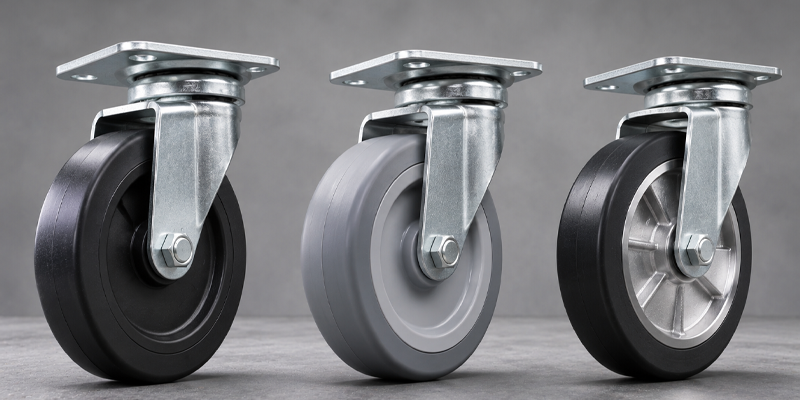
The right rubber wheel depends on equipment weight, floor conditions, movement frequency, and the required level of cushioning.
For Utility Carts and Light Stock Carts
Choose hard rubber when a cart travels mainly over smooth concrete and needs to roll relatively easily.
Its firm tread resists excessive compression and works well for routine material movement.
For Quiet Retail and Healthcare Equipment
Choose soft rubber when noise reduction, vibration absorption, and floor protection are primary requirements.
Soft rubber is well-suited for display fixtures, medical carts, and lighter equipment where quiet operation is important.
For Warehouse Carts and Bakery Racks
Consider mold-on rubber when equipment needs a cushioned tread supported by a rigid core.
For bakery racks and food processing equipment, also verify compatibility with cleaning chemicals, moisture, and operating temperatures.
For Heavy Equipment
Hard rubber may support heavier loads than soft rubber, but it isn't automatically suitable for every heavy-duty application.
For demanding loads, compare alternatives such as solid elastomer wheels or polyurethane.
Read our guide to rubber vs. polyurethane casters for additional material comparisons.
For Carpet and Outdoor Surfaces
Harder rubber treads generally roll more easily across low-pile carpet than softer rubber, which can compress and increase pushing resistance.
For outdoor use, consider pavement conditions, moisture exposure, and the wheel's construction. Mold-on rubber may provide more support than one-piece soft rubber, but metal cores require appropriate corrosion protection.
For specific floor recommendations, see our guide to choosing caster wheels for your floor type.
Common Mistakes to Avoid With Rubber Wheels
Selecting the wrong rubber wheel can increase rolling resistance, cause premature wear, or damage flooring.
Avoid these common mistakes:
- Leaving heavily loaded carts parked on soft rubber: Extended static loading can cause temporary flat spots.
- Ignoring operating conditions: Chemicals, heat, and excessive loading may damage mold-on rubber treads or their bond.
- Assuming all rubber is non-marking: Black rubber compounds can leave streaks on certain flooring materials.
- Choosing only by diameter: Replacement wheels must also match axle bore, hub length, and bearing requirements.
- Overlooking load ratings: Similar-looking wheels can have very different weight capacities.
Inspect existing wheels before replacement and verify equipment requirements.
Find the Right Rubber Wheels at Atlanta Caster
Atlanta Caster & Equipment offers hard rubber, soft rubber, and mold-on rubber options for industrial carts and material handling equipment.
Browse our rubber replacement wheels and compare available sizes, constructions, and product specifications.
Need help matching an existing wheel?
Call 800-526-3087 or send us the measurements of your old wheel to discuss suitable replacement options.
Frequently Asked Questions
1. Do hard rubber caster wheels leave marks on floors?
Some hard rubber compounds, particularly black formulations, may leave visible streaks on finished flooring. Check the manufacturer's non-marking specifications before selecting wheels for sensitive surfaces.
2. What weight capacity do hard rubber caster wheels have?
Load capacity varies by wheel diameter, tread width, construction, and bearing configuration. Refer to each Atlanta Caster product's individual load rating rather than relying on a general capacity estimate.
3. How long do hard rubber caster wheels last?
Their service life depends on equipment weight, floor conditions, movement frequency, and maintenance. Proper loading and regular inspection help reduce premature wear and unexpected wheel failure.
4. Are hard rubber caster wheels better than plastic ones?
Neither material is universally better. Hard rubber offers some cushioning, while certain hard plastic wheels provide greater resistance to deformation. Compare load ratings, floor conditions, and operating requirements before making a choice.