Email US
 Hours
 Visit Our Showroom


How to Match a V-Groove Wheel to Your Track: Angle Size, Groove Fit and Hardness
Oct 20th 2026
Choosing the right V-groove track wheels starts with four checks: track profile and size, groove angle and width, wheel hardness, and load capacity with the correct bore and bearing.
A mismatch can cause wheels to climb the track, wear unevenly, or bind during movement. These problems increase maintenance costs and may interrupt daily operations.
Whether you're replacing worn track wheels or building a new industrial cart, accurate measurements help you avoid ordering the wrong parts.
At Atlanta Caster & Equipment, we help businesses select V groove track wheels for demanding industrial applications. This guide explains how to check compatibility before purchasing.
What a V-Groove Track Wheel Has to Do
A V-groove track wheel has an angled groove that rides along a matching raised track. The groove guides the wheel while the rolling surface carries the load.
These wheels are commonly used on industrial carts, material-handling equipment, and track-guided systems.
Unlike standard flat-tread wheels, V-groove track rollers follow a fixed path rather than moving freely across the floor.
However, the groove must fit the track properly. Even a strong wheel can perform poorly when the track profile, dimensions, or material is incorrect.
Check 1: Identify Your Track Profile and Size
Before selecting a wheel, identify the type of track your equipment uses.
V-groove wheels and track must have compatible profiles to maintain smooth, controlled movement.
Identify the Track Profile
The three common track profiles are:
- Inverted angle-iron track: A raised V-shaped track commonly used with V-groove wheels.
- Round bar or pipe track: Requires a wheel with a groove specifically designed for the rounded surface.
- Flat rail: Generally requires a flat-tread or flanged wheel rather than a standard V-groove wheel.
Are V-groove wheels suitable for all track types? No. They are designed for compatible raised tracks, and the correct groove profile must be confirmed before installation.
Measure the Angle-Iron Track
Use a tape measure and calipers to record:
- Leg width: Measure the width of one side of the angle iron.
- Material thickness: Measure the thickness of the track material.
- Track condition: Inspect the raised apex for flattening, burrs, or uneven wear.
Industrial suppliers offer angle-iron tracks in various sizes, including 1-1/4-inch, 1-1/2-inch, and 2-inch profiles.
However, these examples do not establish compatibility with a particular Atlanta Caster wheel. Always confirm the manufacturer's recommended track dimensions.
For applications involving track-guided gates, see our guide to V-groove wheels for sliding and rolling gates.
Check 2: Match Groove Angle and Width to the Track
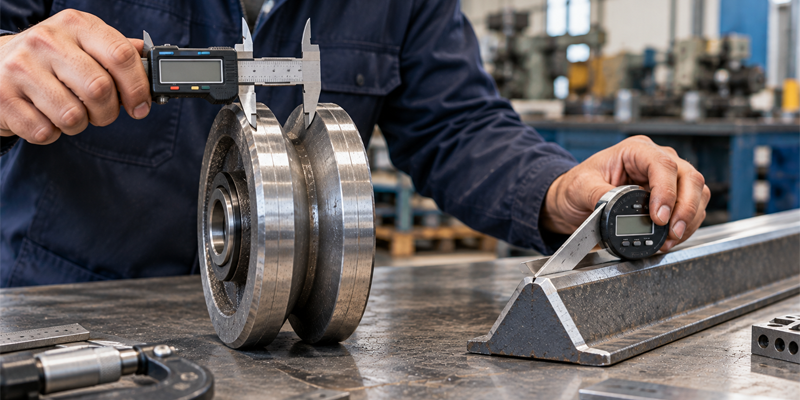
Once you know the track dimensions, inspect the wheel's groove.
The groove angle, opening width, and depth determine how the wheel contacts and follows the track.
Check the Groove Angle
Standard equal-leg angle iron forms a 90-degree included angle. A compatible V-groove wheel must have the correct groove geometry for that track.
However, not every V-groove wheel has identical dimensions.
Before ordering, confirm the groove angle specified for the individual wheel.
Measure Groove Width and Depth
The groove must provide sufficient clearance while maintaining appropriate contact with the track.
A groove that is too shallow may cause the wheel to ride up on the track.
An excessively deep or otherwise incompatible groove may allow unwanted contact or cause the wheel to bottom out.
Use calipers to measure the groove opening and an angle gauge to check the included angle.
Also record the outside wheel diameter and overall tread width.
V-Groove Wheel Measurement Guide
|
What to measure |
What it must match |
Specification to check |
|
Groove angle |
Track profile |
Groove angle |
|
Groove width |
Track dimensions |
Groove width |
|
Groove depth |
Track clearance |
Groove geometry |
|
Wheel diameter |
Equipment clearance |
Overall diameter |
|
Tread width |
Available mounting space |
Wheel width |
Not every product listing publishes all these measurements. Contact our team when a required dimension is unavailable.
For additional guidance on measuring casters, read our step-by-step guide.
Check 3: Get Hardness and Material Right
The material and hardness of your V-groove wheel affect wear, impact resistance, and load performance.
A properly matched combination helps protect both the wheel and the track.
Why Wheel Hardness Matters
Industry guidance generally recommends considering a wheel that is slightly softer than the track.
This allows the replaceable wheel to absorb more wear rather than damaging the installed track.
Some industry guidance suggests a difference of approximately five Rockwell D hardness points. However, that is not a universal requirement.
Actual suitability depends on the wheel material, track material, operating loads, and manufacturer's recommendations.
Compare Common Wheel Materials
Cast Iron V-Groove Wheels
Cast iron wheels are suitable for certain applications involving steady, substantial loads.
They offer a rigid rolling surface but are generally less resistant to sudden impacts than ductile iron.
Ductile Iron V-Groove Wheels
Ductile iron provides better shock resistance than conventional cast iron.
It is worth considering when equipment experiences frequent starts, stops, or occasional impact loading.
Forged Steel V-Groove Wheels
Steel V-groove track wheels can serve demanding industrial applications involving substantial loads.
However, their actual load capacity and suitability depend on the specific product's published specifications.
When comparing heavy-duty V-groove wheels, consider both wheel and track wear rather than selecting the hardest available material.
Browse our metal wheel selection to compare available materials.
Check 4: Load per Wheel, Bore and Bearing
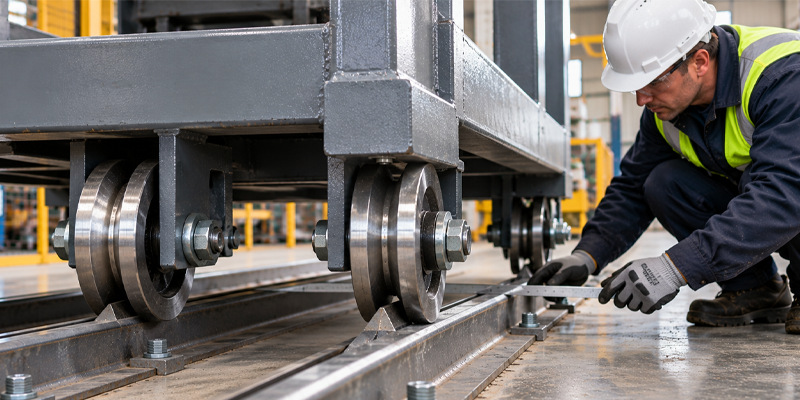
Correct track fit is only part of selecting the right wheel. The wheel must also support the equipment's load and fit its axle.
Determine the Load per Wheel
Identify the total loaded weight of the equipment and how that weight is distributed across its load-bearing wheels.
Compare the resulting load per wheel with the manufacturer's published capacity.
Uneven floors, shifting loads, and movement can place additional stress on individual wheels.
For more guidance, see our article on calculating caster load capacity for uneven weight distribution.
Check the Bore and Axle
The wheel bore must match the intended axle and bearing arrangement.
An incorrect fit can cause unwanted movement, premature wear, and poor tracking.
When replacing an existing wheel, record the bore diameter and compare it with the replacement specifications.
Choose the Right Bearing
Bearings affect rolling resistance, wheel movement, and performance under load.
V-groove wheels with ball bearings may be appropriate for certain applications, but available bearing configurations differ by product.
Check the bearing type, axle compatibility, and maintenance requirements before ordering.
What is the weight capacity of V-groove track wheels? Capacity varies by model. Always use the manufacturer's published per-wheel rating rather than assuming that all similarly sized wheels support the same load.
How to Install and Align V-Groove Track Wheels
Proper alignment is essential when installing V-groove track wheels on industrial equipment.
Even correctly sized wheels can bind when the track is crooked, uneven, or improperly spaced.
Start by inspecting the track installation.
For equipment running on two parallel tracks, confirm that both tracks are straight, level, and consistently spaced.
The distance between the wheel centers must correspond to the distance between the tracks.
Before installation:
- Secure the equipment and prevent unintended movement.
- Verify wheel dimensions and axle compatibility.
- Inspect the track for damaged sections or raised edges.
- Install the wheels according to the manufacturer's instructions.
- Check alignment and test movement under controlled conditions.
V-groove wheels are available in wheel-only and complete caster configurations.
Atlanta Caster offers rigid casters, while the appropriate rigid or swivel V-groove arrangement must be confirmed for your equipment.
Never assume a swivel configuration will maintain proper tracking without checking the application requirements.
Signs Your Wheel and Track Don't Match
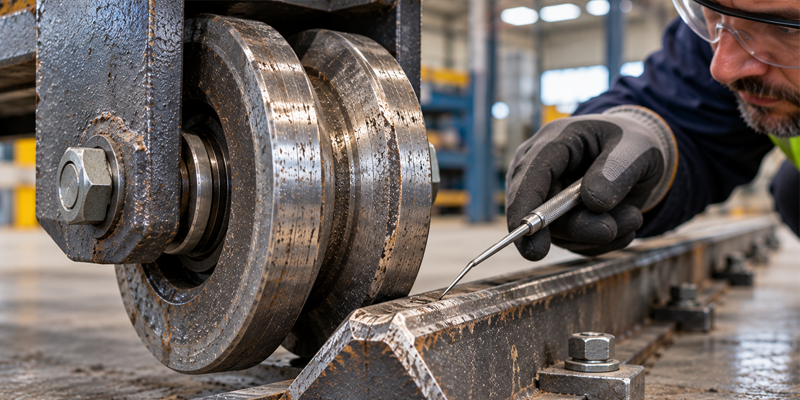
An incorrect wheel-track combination often produces noticeable warning signs.
Watch for these problems:
- Wheel climbing the track: The groove may not seat correctly on the rail.
- Uneven shoulder wear: One side of the groove experiences greater contact than the other.
- Binding: Equipment becomes difficult to push despite following a straight track.
- Unusual noise: Grinding or scraping may indicate improper contact or bearing problems.
- Track damage: Burrs, flattening, and irregular wear develop along the raised apex.
These symptoms can also result from damaged bearings, excessive loading, or poor alignment.
Inspect the complete rolling assembly before replacing the wheel.
Correcting the underlying problem helps prevent the replacement wheel from developing the same damage.
V-Groove Track Wheel Fitment Checklist
Before ordering V-groove track wheels, record the following information.
- Track profile and angle-iron leg dimensions
- Track material thickness and condition
- Required groove angle, width, and depth
- Wheel diameter and tread width
- Bore diameter and axle dimensions
- Equipment load per wheel
- Manufacturer's rated wheel capacity
- Wheel and track material compatibility
- Indoor or outdoor operating conditions
- Wheel-only or complete rigid/swivel caster requirement
Use this checklist when requesting a quote or preparing a purchase order.
You can also send us your track measurements for assistance with fitment.
Get a Fitment Check From Atlanta Caster & Equipment
Not sure which V-groove track wheel fits your equipment?
At Atlanta Caster & Equipment, we can help you review wheel dimensions, track requirements, and available product specifications.
Browse our V-groove track wheels or ask about custom wheel solutions for nonstandard applications.
Call 800-526-3087 or contact our team with your measurements and photos before placing an order.
Frequently Asked Questions
1. Are V-groove wheels the same as U-groove wheels?
No. V-groove wheels have an angled groove for compatible V-shaped tracks, while U-groove wheels have a rounded groove designed for suitable round or curved rails.
2. Can I put a new V-groove wheel on a worn track?
Only if the track remains within acceptable operating limits. Inspect for flattening, burrs, misalignment, and damage before installing a replacement wheel.
3. Are there different sizes of V-groove track wheels?
Yes. V-groove wheels come in different diameters, tread widths, bore sizes, and groove dimensions. Match each specification to your equipment and track before ordering.
4. Can V-groove track wheels be used outdoors?
Yes, when the selected wheel and bearing arrangement are approved for outdoor conditions. Consider moisture exposure, corrosion protection, track debris, and maintenance requirements.