Email US
 Hours
 Visit Our Showroom


What Are the Best Rubber Caster Wheels for Tile Floors in an Office or School?
Nov 16th 2026
The best rubber caster wheels for tile floors in offices and schools generally have soft, non-marking treads that protect floor finishes, reduce rolling noise, and absorb vibration when crossing grout lines. Rubber caster wheels include hard rubber, soft rubber, mold-on rubber, and thermoplastic rubber (TPR) varieties. For ceramic, porcelain, and vinyl composition tile (VCT), softer, non-marking compounds are typically preferable to hard rubber. However, wheel capacity, diameter, and mounting style also matter. Atlanta Caster offers rubber caster wheels for different commercial applications.
Atlanta Caster & Equipment supplies rubber casters, as well as polyurethane and other wheel materials. Although rubber works well in many tile-floor applications, we also recognize situations where another material may be more suitable.
Why Tile Floors Punish the Wrong Wheels
The wrong caster wheels can leave marks, create scratches, and generate disruptive noise when carts move across tile floors.
Offices and schools often use ceramic tile, porcelain tile, or vinyl composition tile in hallways, cafeterias, classrooms, and shared workspaces.
These surfaces are generally easy to maintain, but repeated cart movement can affect their appearance and condition.
Three problems deserve particular attention.
Black scuff marks: Some rubber compounds transfer material onto smooth floors. Repeated movement can leave visible streaks, especially during sharp turns.
Scratches and surface wear: Small pieces of grit can become trapped in a wheel tread. As the cart moves, embedded debris may scratch floor coatings or polished surfaces.
Noise and vibration: Hard wheels can produce noticeable noise when crossing grout lines, thresholds, and uneven tile joints.
A school cafeteria cart, for example, may travel through several hallways daily. Repeated contact between hard wheels and tile joints can increase noise and vibration.
Similarly, office mail carts may interrupt nearby employees when their wheels rattle across tiled corridors.
The goal is to select a wheel that protects the floor while supporting the cart's weight and movement.
For broader guidance across different surfaces, read Atlanta Caster's guide to choosing caster wheels for your floor type.
What Makes a Rubber Wheel Non-Marking? (Non-Marking Casters)
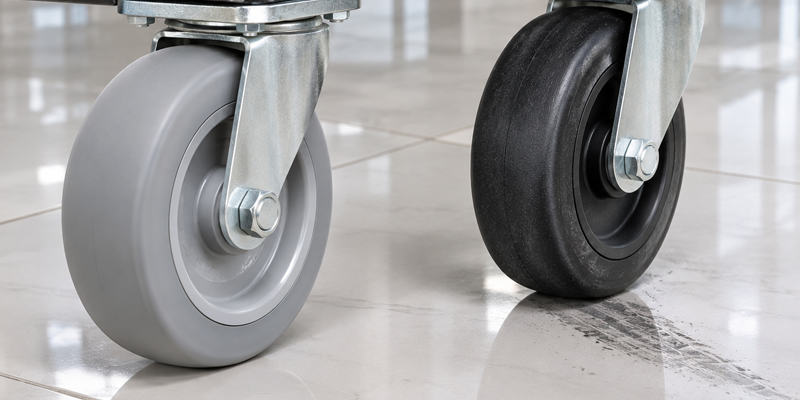
Non-marking caster wheels use tread compounds designed to minimize visible rubber transfer and scuff marks on flooring.
Not every rubber wheel is non-marking.
Traditional black rubber compounds may leave streaks on light-colored tile, especially under heavy loads or during sideways movement.
Non-marking casters are often manufactured with gray, white, or other light-colored tread compounds.
However, wheel color alone does not establish whether a product is non-marking.
The manufacturer's tread specifications should explicitly confirm this property.
Why Non-Marking Rubber Matters
For office buildings, schools, and healthcare facilities, the appearance of floors affects routine maintenance requirements.
A cart that leaves black streaks across a school hallway may require additional cleaning.
Frequent scuff removal can increase custodial work and expose floor finishes to repeated cleaning treatments.
Non-marking caster wheels can help facilities:
- Reduce visible scuff marks on light-colored tile.
- Maintain a cleaner appearance in busy hallways.
- Limit unnecessary floor-cleaning work.
- Support quieter movement when paired with suitable soft treads.
- Protect finished surfaces when the wheels remain free of embedded debris.
Non-marking does not mean scratch-proof. Even a properly selected rubber wheel can damage flooring when grit becomes trapped in its tread.
A practical approach to buying is to confirm the tread compound and test it on a small, representative section of the flooring.
Expert Insight #1: Don't Choose Rubber Wheels by Color Alone
Certified Caster Specialist Perspective
One mistake facilities buyers make is assuming every gray wheel is non-marking or every black wheel will damage tile.
Color is a useful clue, but the tread compound determines actual performance.
Repeated scuff removal can consume maintenance time, particularly in long school corridors and frequently used hallways.
Before replacing an entire set of wheels, confirm the manufacturer's non-marking designation and test a sample under the cart's normal load. This can prevent an unsuitable purchase.
Hard Rubber, Soft Rubber, Mold-On, and TPR: Which Fits a Tile-Floor Cart?
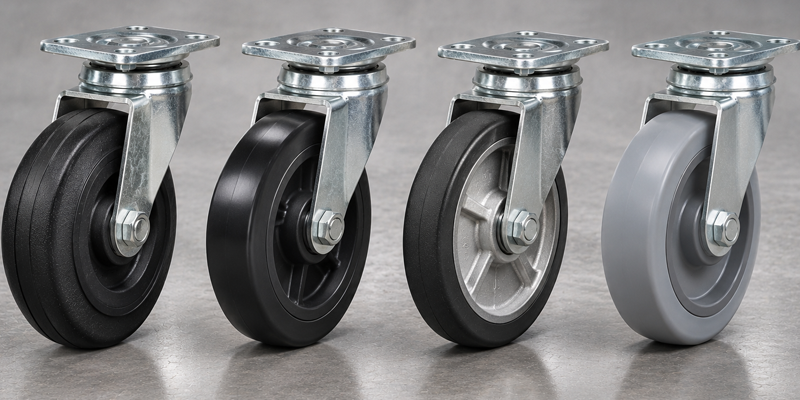
Soft rubber and suitable TPR wheels are generally preferable for quiet, floor-sensitive applications, while harder rubber often rolls more readily under heavier loads.
Rubber casters are available in several constructions.
Understanding these differences helps buyers choose appropriate rubber wheels for carts rather than relying entirely on appearance or price.
Rubber Caster Wheel Comparison
|
Wheel Type |
Tread Feel / Hardness |
Best Tile-Floor Application |
Watch Out For |
|
Soft rubber casters |
Softer, more flexible tread |
Office carts, classroom equipment, light institutional carts |
Greater rolling resistance under some loads |
|
Hard rubber casters |
Firmer, less flexible tread |
Heavier carts where easier rolling matters |
More vibration and potentially greater marking risk |
|
Mold-on rubber |
Rubber bonded to a wheel core; hardness varies |
Commercial and industrial carts with appropriate floor requirements |
Not automatically soft or non-marking |
|
Formulation-dependent, often flexible |
Quiet carts in offices, schools, and healthcare facilities |
Confirm load capacity and tread specifications |
Table note: Qualitative comparison based on general wheel-material characteristics and Atlanta Caster's published rubber caster guidance. Exact durometer, load capacity, and non-marking properties vary by manufacturer and model.
Soft Rubber Casters
Soft rubber casters typically provide more cushioning than hard rubber alternatives.
Their flexible treads absorb some vibration when traveling over grout lines and minor floor irregularities.
This makes them useful for carts operating around classrooms, offices, and reception areas.
However, softer wheels may require more pushing effort when carrying heavier loads.
Hard Rubber Casters
Hard rubber wheels are generally more rigid and may offer lower rolling resistance on smooth, firm floors.
They can suit certain warehouse and industrial carts.
For delicate tile surfaces, however, buyers should confirm marking characteristics and consider the effects of wheel hardness.
Mold-On Rubber Wheels
Mold-on rubber wheels have rubber bonded to a supporting core.
The construction does not determine whether the rubber is soft, hard, or non-marking.
Atlanta Caster's rubber caster wheels category includes hard rubber and mold-on rubber configurations.
Thermoplastic Rubber Wheels
TPR is a thermoplastic elastomer that can provide rubber-like cushioning.
It is often used for quieter equipment movement.
However, TPR is not identical to natural rubber, and individual products should be evaluated separately.
Sizing Rubber Wheels for Office and School Carts
Choose rubber wheels for carts by calculating the loaded weight, checking each caster's rated capacity, and selecting a suitable diameter for the floor conditions.
An undersized wheel may make an otherwise functional cart difficult to push.
Small wheels can also struggle when crossing recessed grout lines, floor transitions, or doorway thresholds.
A suitable replacement should account for the cart's weight, existing mounting arrangement, and available clearance.
Five Checks Before Selecting Caster Wheels
- Determine the total loaded weight. Include the cart itself and its maximum expected contents. Divide the weight among the supporting casters, then allow for uneven loading and movement. See Atlanta Caster's guide on how to calculate caster load capacity.
- Check wheel diameter. Larger wheels generally cross small obstacles and grout lines more easily. However, the replacement must fit the cart without creating clearance or stability problems.
- Choose swivel or rigid casters. Swivel casters help carts turn through classrooms and narrow corridors. Rigid casters can improve directional control during longer, straight movements.
- Consider brakes. Classroom equipment, mobile storage units, and carts parked on sloped surfaces may require appropriately rated brakes. Confirm whether the brake locks the wheel, swivel, or both.
- Verify the mounting type. Measure the existing stem, threaded attachment, or mounting plate. An incorrect mounting arrangement can prevent proper installation.
Expert Insight #2: A Difficult Cart May Not Need Replacing
Certified Caster Specialist Perspective
When a school or office cart becomes difficult to push, replacing the entire cart is not necessarily the first answer.
Small, hard, or worn wheels may be contributing to the problem.
A larger wheel with a suitable softer tread can sometimes improve movement across tile joints without requiring new equipment.
Before buying replacement casters, inspect the bearings and mounting hardware. Bring the existing caster to our Tucker showroom or send photographs and measurements so the replacement can be checked for compatibility.
Quiet Matters: Rubber Wheels in Occupied Buildings
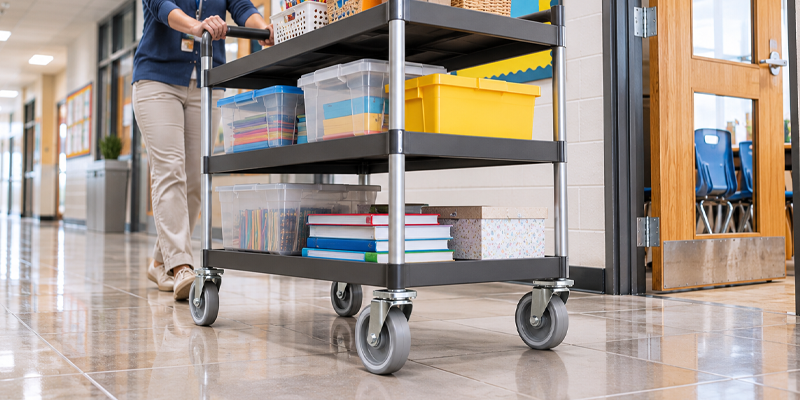
Soft rubber and suitable TPR casters are generally among the quieter wheel options for carts operating in offices, schools, and clinics.
Rolling noise matters in spaces where people work, learn, or receive care.
A cart passing through a quiet office corridor can become distracting when hard wheels strike tile joints.
In schools, noisy cafeteria or supply carts can interrupt classrooms near busy hallways.
Healthcare facilities face similar concerns when staff move equipment near patient rooms.
Softer rubber treads generally absorb more vibration than rigid metal or hard plastic wheels.
Their flexibility can reduce impact noise as the wheel crosses minor surface changes.
However, wheel material is not the only factor.
Worn bearings, loose mounting bolts, overloaded carts, and damaged swivel assemblies may also contribute to rattling and squeaking.
Regular inspection helps maintain quieter movement.
For further guidance on wheel materials and bearing maintenance, read Atlanta Caster's article on how to quiet down noisy carts.
Choosing Rubber Casters at Atlanta Caster
Atlanta Caster offers rubber caster configurations for commercial equipment and assists with product selection, mounting, and application requirements.
Founded in 1982, Atlanta Caster & Equipment serves businesses requiring caster wheels and material-handling products.
As of November 2026, its online rubber caster category lists hard rubber and mold-on rubber products, including rigid and swivel configurations.
Exact load capacities, non-marking specifications, tread hardness, and availability must be verified on individual product pages.
Atlanta Caster also assists buyers with replacement wheels and application-specific requirements.
Customers near Tucker, Georgia, can visit the company's showroom at 1810 Auger Drive.
If you are replacing casters on office furniture, school equipment, or institutional carts, prepare the existing wheel measurements and expected load before contacting the team.
Frequently Asked Questions
What are the best rubber caster wheels for carts used on tile floors in an office or school?
Soft, non-marking rubber caster wheels are generally suitable for office and school carts operating on tile. They help reduce visible scuffing, absorb vibration, and support quieter movement. Choose wheels with verified non-marking treads, sufficient load capacity, suitable diameter, and compatible mounting hardware.
Will rubber caster wheels mark or scuff tile floors?
Some rubber caster wheels can leave black marks on tile, particularly when their tread compounds transfer material during turning or dragging. Non-marking rubber wheels are designed to reduce this problem. However, trapped debris can still scratch floors, so regular wheel inspection and cleaning remain important.
What does "non-marking" mean on a caster?
Non-marking means the wheel tread is designed to minimize visible marks or material transfer onto flooring during normal use. These casters often have gray or light-colored treads, but color alone is not proof. Always check the manufacturer's specifications before choosing wheels for finished tile surfaces.
Hard rubber or soft rubber: Which is better on tile?
Soft rubber is generally preferable when floor protection, cushioning, and noise reduction are priorities. Hard rubber may roll more easily under certain heavier loads but can produce additional vibration. For offices, classrooms, and tiled hallways, a suitable non-marking soft rubber tread is often a reasonable starting point.
Are rubber casters quiet enough for offices, schools, and clinics?
Yes. Soft rubber caster wheels typically operate more quietly than rigid metal or hard plastic wheels on smooth tile. Their flexible treads absorb some impact and vibration. Actual noise also depends on bearings, cart construction, wheel condition, and floor joints. Worn components can remain noisy regardless of tread material.
What size rubber wheel should an office or school cart use?
The appropriate wheel size depends on the cart's total loaded weight, clearance, mounting dimensions, and floor conditions. Larger wheels generally cross grout lines and small thresholds more easily. However, increasing diameter may change cart height and stability. Confirm wheel capacity and mounting compatibility before selecting a replacement.
Do rubber casters work on both carpet and tile?
Rubber casters can work on both carpet and tile, but performance depends on tread hardness, diameter, carpet thickness, and cart weight. Soft rubber may protect tile yet require more pushing effort on carpet. For carts crossing multiple surfaces, compare rolling resistance and floor protection before choosing.
Can I replace just the wheels on my existing cart casters?
Yes, some caster assemblies allow wheel-only replacement when the fork, axle, bearings, and mounting hardware remain serviceable. The new wheel must match the required dimensions and load rating. If the caster rig is bent, corroded, or worn, full replacement may be necessary. Read Atlanta Caster's guide on replacing just the wheel.
Need Rubber Caster Wheels for Your Office or School?
Call Atlanta Caster & Equipment at 1-800-526-3087 or talk to a Certified Caster Specialist for help selecting suitable wheels.
Customers can also visit the Tucker, Georgia, showroom to discuss replacement caster requirements.
About Atlanta Caster & Equipment
Founded in 1982, Atlanta Caster & Equipment, Inc. is a distributor of casters, wheels, and material-handling equipment located in Tucker, Georgia. The company supplies products for industrial, commercial, and institutional applications and assists customers with caster selection, replacement requirements, and custom solutions.